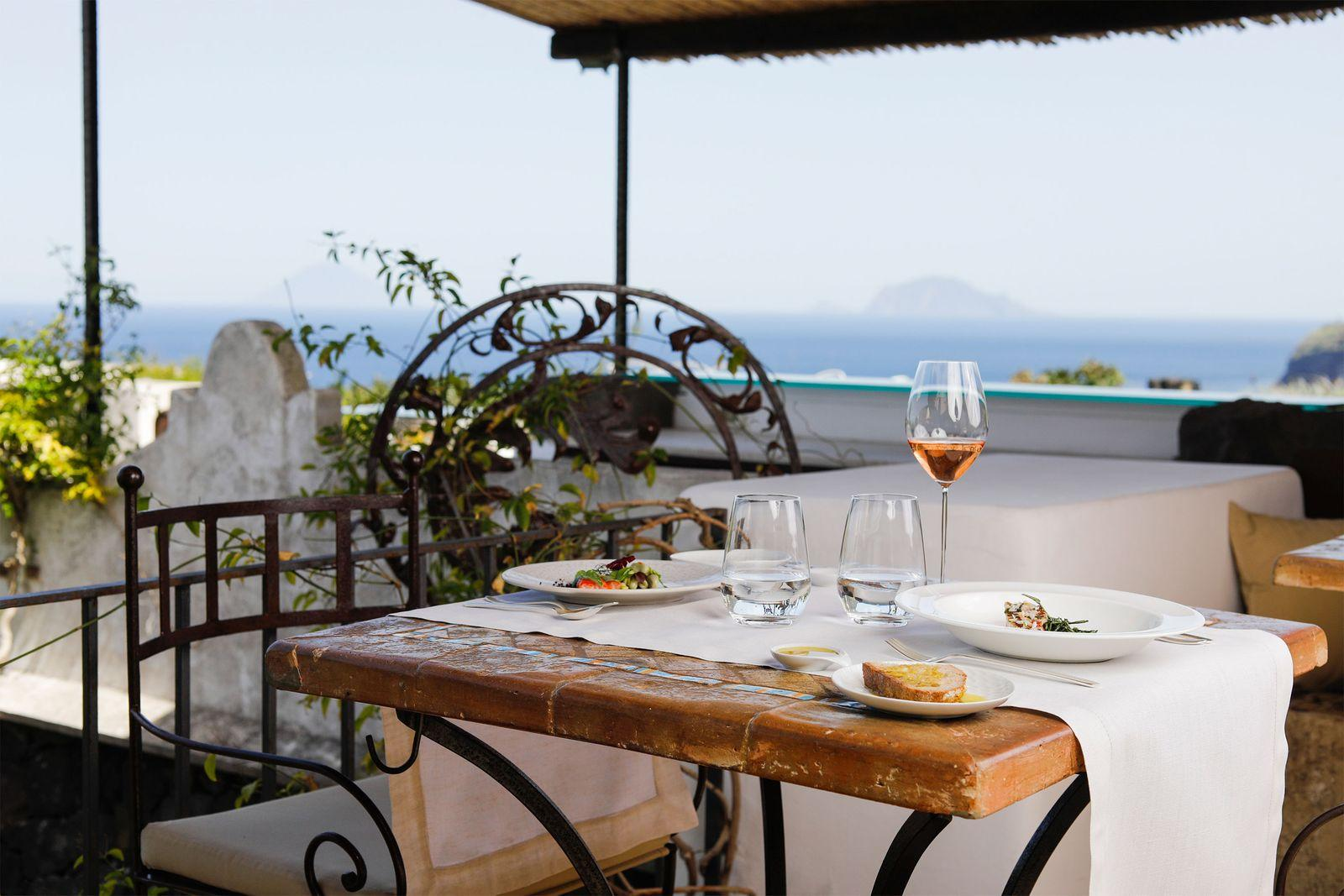
Some restaurants are excellent because of what happens at the table. Others become destinations because the meal cannot be separated from the landscape, culture and journey required to reach them.
Sicily has an unusual number of restaurants that belong to the second category.
The island’s most compelling dining rooms are rarely interchangeable with restaurants elsewhere in Europe. Their identity comes from an exceptional concentration of local ingredients and culinary traditions: red prawns and line-caught fish from surrounding seas, citrus fruits, almonds, pistachios, capers, vegetables, ancient grains, cheeses, olive oils and wines shaped by volcanic slopes, limestone soils and Mediterranean climate.
At the highest level, contemporary Sicilian chefs are no longer simply modernising traditional recipes. They are interpreting the island itself—its history of Greek, Arab, Norman and Spanish influence, its rural cooking, coastal communities and highly distinctive landscapes.
The result is a gastronomic journey that can justify designing part of a Sicily itinerary around restaurant reservations.
From Ragusa Ibla’s Baroque streets to a restaurant on the volcanic island of Salina, these are places where travelling to dinner becomes part of the experience.
Ristorante Duomo Makes Ragusa Ibla Part of the Menu
Ragusa already offers one of southeastern Sicily’s most dramatic arrivals. Historic Ragusa Ibla descends and rises across a steep landscape of stone houses, church domes and Baroque façades, culminating around the Duomo di San Giorgio.
Within that setting, Ristorante Duomo has become one of the defining names of contemporary Sicilian gastronomy.
Chef Ciccio Sultano’s restaurant occupies Palazzo La Rocca on Via Capitano Bocchieri, the Baroque street leading towards the dome of San Giorgio. The restaurant’s own description places Sicily at the centre of Sultano’s culinary philosophy, treating the island’s succession of cultures and ingredients not as historical decoration but as material for contemporary cuisine. (Ciccio Sultano)
Ristorante Duomo received its first Michelin star in 2004 and its second in 2006, according to the restaurant’s official history. Today it remains positioned as one of Sicily’s important destination restaurants, with tasting menus, à-la-carte dining and a dedicated wine cellar that places Sicilian wines alongside major Italian and international labels. (Ciccio Sultano)
What makes the journey worthwhile is the relationship between the meal and Ragusa itself. Dining here after spending an afternoon walking Ibla is very different from encountering the same cuisine in a neutral metropolitan setting. The Baroque city provides the historical context that the kitchen repeatedly explores.
This is also why Ragusa should not be approached only as somewhere to eat and depart. Staying overnight allows dinner to become the centrepiece of a wider experience that includes the Duomo, the surrounding streets and the landscapes of southeastern Sicily.
Val di Noto: Sicilian Baroque, a UNESCO World Heritage Site
La Madia Turns Licata into a Gastronomic Destination
Licata is not one of the places most international travellers automatically place on a first Sicily itinerary.
That is precisely what makes La Madia so relevant to the idea of a restaurant worth travelling for.
Chef Pino Cuttaia has transformed the southern Sicilian town into a destination for diners who arrive specifically for his cooking. The Michelin Guide describes La Madia as a restaurant deeply rooted in Sicily, where memories and familiar flavours are reinterpreted with contemporary sensitivity rather than embellished for spectacle. (Guida Michelin)
Cuttaia’s cuisine is often associated with memory: childhood, domestic cooking, fishermen, familiar ingredients and dishes whose apparent simplicity conceals considerable technical control.
That philosophy matters because it distinguishes La Madia from the idea that destination dining must always rely on extravagant surroundings.
The restaurant itself is in Licata rather than in a resort or grand hotel. The journey therefore shifts attention towards the cooking. Travellers heading between Agrigento and southeastern Sicily can deliberately incorporate Licata into the route, turning what might otherwise be a transit day into one of the island’s major gastronomic experiences.
The surrounding territory also reinforces the restaurant’s identity. Southern Sicily has a different rhythm from Taormina or Palermo: broader agricultural landscapes, quieter coastal stretches and a culinary culture that remains closely connected to ingredients rather than spectacle.
La Madia is valuable precisely because it makes that Sicily worth stopping for.
Signum Makes the Journey to Salina Part of Dinner
Few Sicilian restaurants demonstrate the meaning of destination dining as clearly as Signum.
Reaching it requires travelling beyond mainland Sicily to Salina, one of the seven Aeolian Islands. That means ferry, hydrofoil or private yacht, followed by the slower rhythm of an island whose vineyards, caper plants, citrus and volcanic terrain shape its culinary identity.
Chef Martina Caruso leads the restaurant at Hotel Signum in Malfa. For the 2026 season, the property confirms the restaurant’s Michelin star and Michelin Green Star and describes three principal tasting paths: Sigillo, combining land and sea; Oltremare, focused on fish; and Radici, centred on plant-based ingredients. (Scent of Salina)
Caruso’s cooking is inseparable from Salina. The restaurant highlights local fish, vegetables, herbs, citrus fruits, tomatoes, ricotta and capers, while seasonality and relationships with local producers remain central to its approach. (Scent of Salina)
That connection explains why Signum deserves to be experienced on the island rather than viewed simply as another Michelin restaurant.
Dinner follows a day of sea, volcanic landscape and villages. The air, vegetation and light experienced outside the restaurant reappear through ingredients and flavours inside it. The dining experience therefore becomes an interpretation of the place the guest has been exploring all day.
Salina is also a destination where staying longer improves the experience. Two or three nights allow time for a boat excursion, swimming, vineyard landscapes and sunset at Pollara rather than making dinner part of a hurried island hop.
Volcanic Sicily: Embracing the Fire and Beauty of Etna and the Aeolian Islands
Principe Cerami Brings Fine Dining to Taormina’s Grandest Setting
Taormina represents a different expression of Sicilian dining.
Here, the journey is not towards remoteness but towards one of the Mediterranean’s most celebrated resort towns, where Mount Etna, the Ionian coastline and layers of Greek, medieval and modern history create a setting of unusual theatricality.
At San Domenico Palace, Taormina, A Four Seasons Hotel, Principe Cerami provides the fine-dining interpretation.
Four Seasons currently lists Principe Cerami as a Michelin-starred restaurant under Executive Chef Massimo Mantarro and confirms one Michelin star in the 2026 guide. The restaurant describes Mantarro’s cooking as a contemporary reinterpretation of Sicilian cuisine built around seasonal ingredients and refined technique. (Four Seasons)
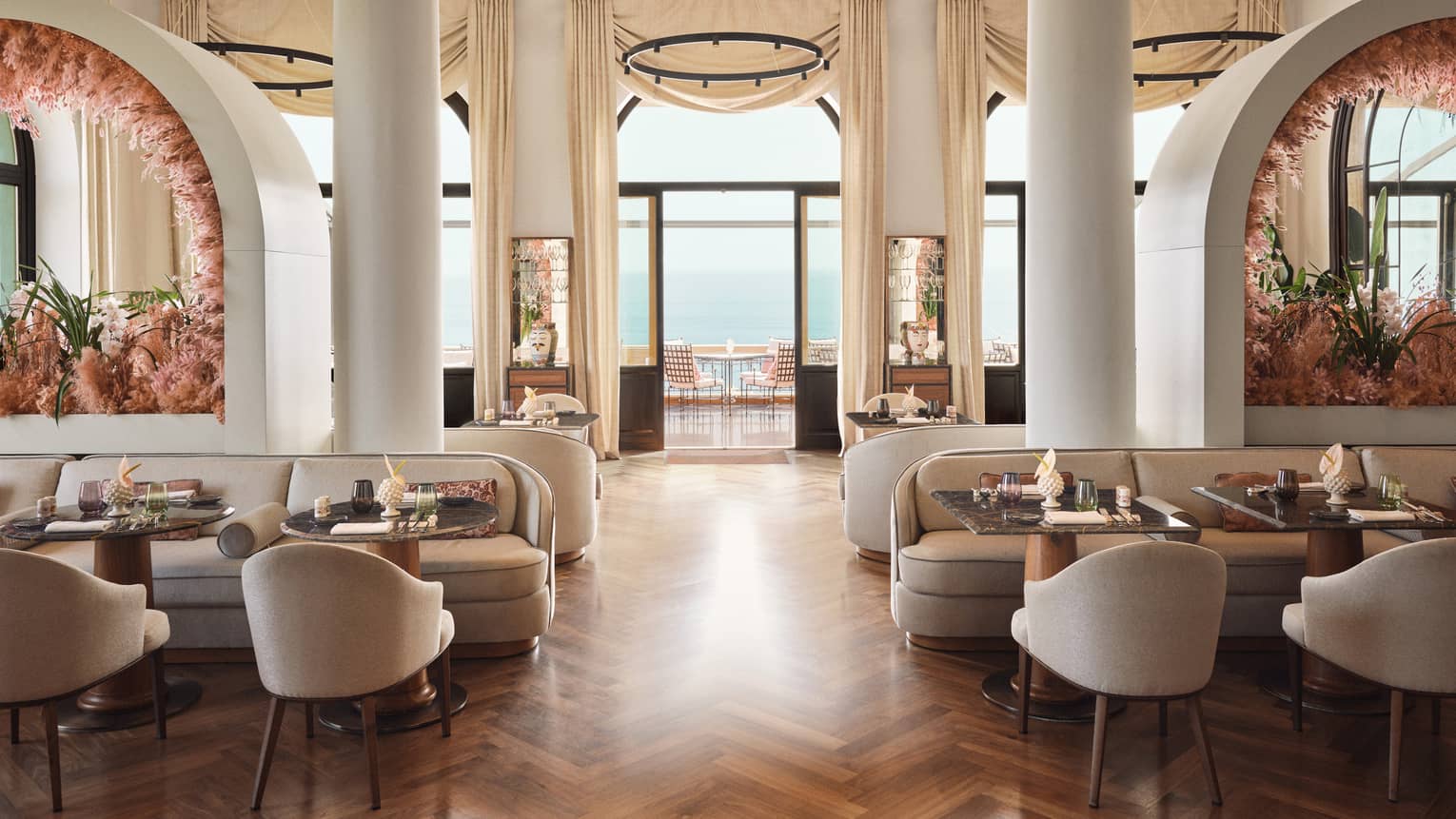
The setting contributes significantly to the sense of occasion. San Domenico Palace occupies a former Dominican convent above the sea, and the restaurant forms part of a broader hotel experience in which terraces, gardens and views over the Ionian coast are integral to the stay.
The current menu demonstrates how explicitly the restaurant draws on Sicily. Four Seasons highlights preparations referencing Mount Etna, Nebrodi pork, ricotta salata, citrus and other regional ingredients, while the cellar contains more than 1,000 labels. (Four Seasons)
Principe Cerami is therefore particularly suitable for travellers who want destination dining without separating dinner from luxury hospitality.
An afternoon at Isola Bella, sunset over the coastline and an evening tasting menu can all belong to the same day.
Taormina: The Enchanted Balcony of Sicily’s Eternal Shores
Zash Connects Fine Dining with the Landscape of Mount Etna
Between Taormina and Catania, the eastern slopes of Etna create another important gastronomic territory.
The combination of volcanic soils, citrus groves, vineyards and proximity to the Ionian Sea gives the region a particularly strong culinary identity. At Zash, near Riposto, the restaurant sits within a country property whose history is itself connected to agriculture and wine.
The restaurant occupies spaces associated with the property’s former wine production, including an old fermentation area. Chef Giuseppe Raciti leads the kitchen, and Zash confirms his Michelin star for 2026. (Zash)
The restaurant describes its philosophy through the relationship between creativity, tradition and territory. That may sound familiar in contemporary Italian fine dining, but here the physical setting makes the concept unusually tangible: lava stone, citrus vegetation and Etna’s agricultural landscape are part of the environment surrounding the meal.
Raciti has led the Zash kitchen since 2014, and the restaurant received its first Michelin star in 2019, subsequently retaining the distinction. (Zash)
Zash works particularly well within an Etna itinerary. A day can include vineyard visits or exploration of the volcano before moving downhill towards Riposto for dinner.
This is an important distinction. The meal should not be considered an isolated reservation but as one element of a larger Etna experience in which wine, geology, agriculture and contemporary cuisine reinforce each other.
I Pupi Gives Bagheria a New Reason to Leave Palermo
Travellers staying in Palermo could easily spend every evening within the city.
I Pupi provides a persuasive reason not to.
Chef Tony Lo Coco’s restaurant is in Bagheria, east of Palermo, and in 2025 moved into a new setting within the lower structures of historic Villa Palagonia. The Michelin Guide describes the restaurant’s cuisine as Sicilian and contemporary, built around ingredients from both sea and inland Sicily and expressed through tasting menus and à-la-carte choices. (Guida Michelin)

The relocation strengthens the restaurant’s destination quality considerably.
Villa Palagonia is one of Bagheria’s most famous historic residences, known particularly for its unusual sculptural decoration. I Pupi’s move into this context makes the evening more than a suburban restaurant excursion from Palermo; it allows architecture, history and contemporary Sicilian cooking to converge within the same destination. (Guida Michelin)
Michelin also notes a chef’s table for four, multiple dining spaces and a cellar containing around 1,300 labels, giving the restaurant different levels of intimacy depending on the experience selected. (Guida Michelin)
For travellers spending several days in Palermo, an evening in Bagheria can therefore expand the itinerary beyond the capital without requiring a complete change of base.
It also demonstrates that Sicily’s strongest dining experiences are increasingly distributed across the island rather than concentrated exclusively in the best-known tourism centres.
Sicily’s Best Restaurants Make Geography Part of the Meal
These restaurants are worth travelling for because they reveal different Sicilies.
Ragusa’s Duomo examines an island shaped by successive civilisations from inside a Baroque city. La Madia turns memory and southern Sicilian ingredients into a reason to travel to Licata. Signum could scarcely exist without Salina. Principe Cerami represents Taormina’s grand Mediterranean sophistication. Zash interprets the agricultural and volcanic territory below Etna, while I Pupi connects contemporary cuisine with Bagheria’s aristocratic heritage.
The locations are not incidental.
This is increasingly important in high-end travel, where a restaurant reservation can determine an itinerary just as strongly as a hotel or landmark. A couple may travel to Salina because Signum has become part of the reason for visiting the island. A Sicily road trip can deliberately divert through Licata for La Madia. Ragusa can become a two-night stop because dinner at Duomo deserves both anticipation and time afterwards.
For a seven- to ten-day gastronomic journey, travellers should resist trying to include every restaurant. Distances across Sicily are substantial enough that concentrating on one region generally produces a better experience.
An eastern itinerary might combine Taormina, Etna and the Baroque southeast, creating natural opportunities for Principe Cerami, Zash and Ristorante Duomo. A western journey can combine Palermo and Bagheria before continuing towards Trapani and Marsala. The Aeolian Islands should ideally form their own chapter rather than a rushed extension, allowing Signum to be experienced within Salina itself.
Reservations should also be made early for destination restaurants, particularly during summer and around weekends. Seasonal closures are common in island destinations, and tasting menus, opening days and service schedules can change. Current information should therefore always be checked directly with the restaurant before restructuring travel around a reservation.
Most importantly, travellers should leave space around the meal.
A destination restaurant loses some of its meaning if guests arrive exhausted after a five-hour drive and depart immediately afterwards. The more compelling approach is to allow the place surrounding the restaurant to explain part of what appears on the plate.
That is where Sicily has a particular advantage.
The island’s gastronomy is intensely geographical. Sea changes from coast to coast. Volcanic Etna produces a different agricultural environment from southeastern limestone country. Salina’s island ingredients cannot be separated from Aeolian isolation, while Ragusa’s cuisine reflects centuries of cultural exchange.
At the right restaurant, dinner becomes another way of reading that landscape.
Frequently Asked Questions
Which restaurants in Sicily are worth planning a trip around?
Ristorante Duomo in Ragusa Ibla, La Madia in Licata, Signum on Salina, Principe Cerami in Taormina, Zash near Riposto and I Pupi in Bagheria are strong examples because both the cuisine and destination contribute to the experience. Each was verified as currently operating for this feature. (Ciccio Sultano)
Is it necessary to book Sicily’s top restaurants far in advance?
For acclaimed fine-dining restaurants, particularly during summer and holiday periods, advance reservations are advisable. This is especially important when the restaurant is determining another element of the itinerary, such as an overnight stay on Salina or a visit to Ragusa.
Which part of Sicily is best for a fine-dining trip?
Eastern and southeastern Sicily offer an especially strong route because Taormina, Etna and Ragusa can be combined within one itinerary. Palermo and Bagheria provide another concentrated gastronomic area, while Salina works best as a dedicated Aeolian extension.
Is Michelin-starred dining in Sicily focused mainly on traditional cuisine?
No. Sicily’s leading restaurants generally use regional ingredients and culinary memory as foundations rather than simply reproducing traditional dishes. Contemporary techniques, tasting menus and personal interpretation are common, while the connection to the island remains central.
Which Sicilian restaurant offers the strongest island experience?
Signum is particularly distinctive because reaching Salina is part of the experience itself. Martina Caruso’s cooking is closely connected to local products, island seasonality and the surrounding Aeolian landscape. (Scent of Salina)
By Luxury Magazine Editorial Team