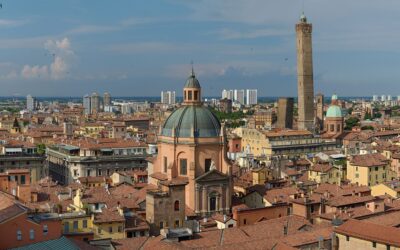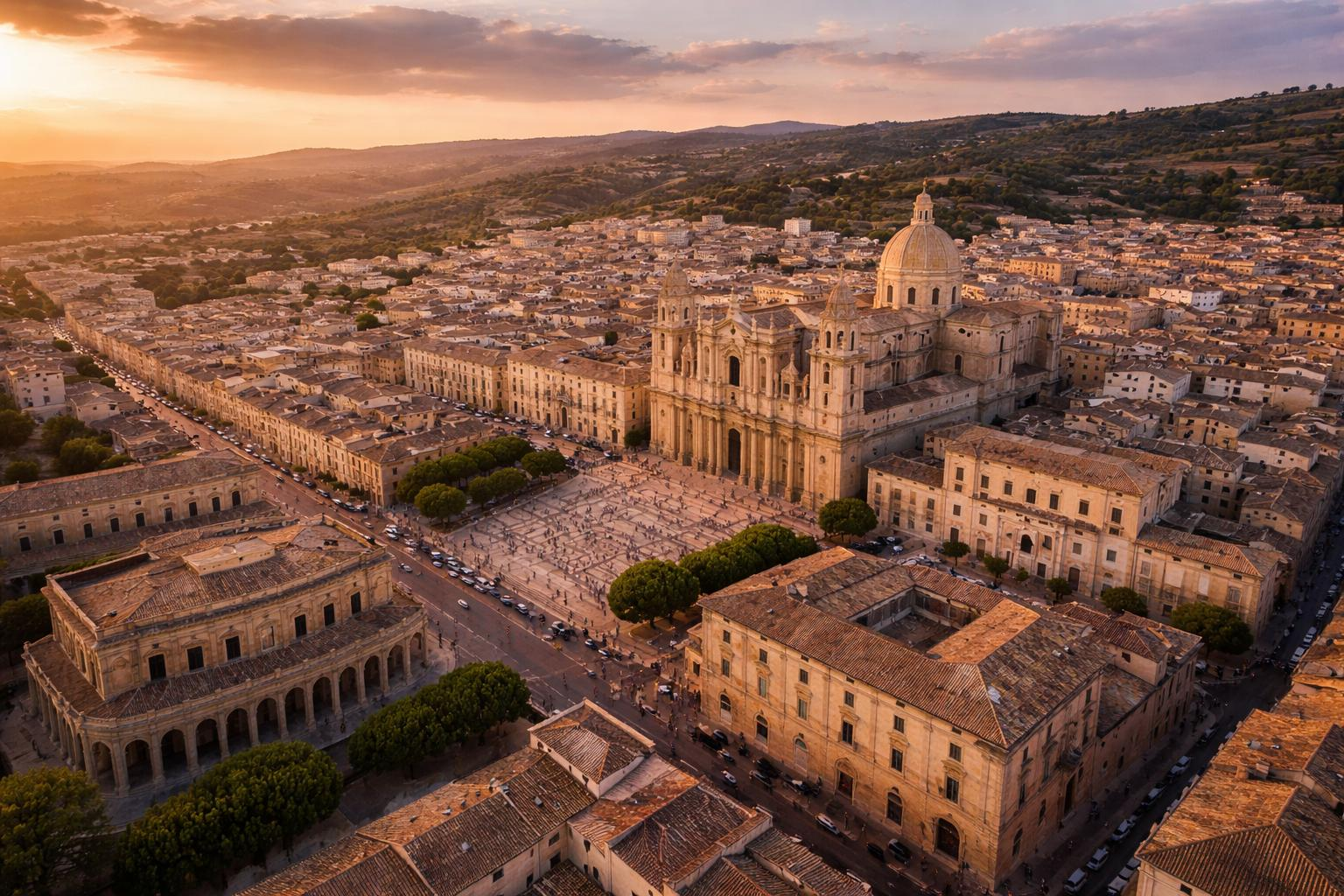
In southeastern Sicily, architecture does more than decorate the landscape. It gives entire cities their rhythm. Limestone façades turn gold in the late-afternoon sun, monumental staircases rise towards theatrical churches, wrought-iron balconies project above narrow streets, and piazzas unfold like carefully composed stages.
This is the world of the Val di Noto, one of Sicily’s most extraordinary cultural landscapes and one of the great expressions of late Baroque architecture in Europe.
Its beauty, however, emerged from catastrophe. In 1693, a devastating earthquake struck southeastern Sicily, destroying or severely damaging numerous towns. What followed was not simply reconstruction but an extraordinary collective architectural undertaking. Noto was rebuilt on a new site; Catania rose again largely over its previous urban fabric; Ragusa developed a new centre alongside the older settlement; and other communities responded differently according to their geography and circumstances.
The result was sufficiently exceptional for UNESCO to inscribe the Late Baroque Towns of the Val di Noto (South-Eastern Sicily) on the World Heritage List in 2002. The serial property encompasses components in eight towns: Noto, Ragusa, Modica, Scicli, Caltagirone, Catania, Militello Val di Catania and Palazzolo Acreide. UNESCO considers them both an exceptional expression of late Baroque art and one of Europe’s culminating manifestations of the style.
For the luxury traveller, this heritage creates something more compelling than a conventional architectural tour. The Val di Noto can become a journey through southeastern Sicily itself, combining extraordinary cities with archaeological landscapes, country estates, local gastronomy, wine and the Mediterranean coast.
Travellers approaching the region as part of a longer journey can place it within Luxury Magazine’s wider guide to luxury travel in Sicily, where the Baroque southeast forms one chapter of a much larger island experience.
Noto Turns Baroque Architecture into Urban Theatre
Noto is the most celebrated introduction to the Val di Noto and perhaps its most immediately harmonious expression.
The present city was constructed after the 1693 earthquake destroyed the older settlement at what is now known as Noto Antica. Rather than rebuilding entirely among the ruins, the new Noto was created on another site, giving architects and planners an unusual opportunity to conceive a city according to contemporary Baroque principles. UNESCO specifically identifies this new-site reconstruction as one of the distinctive responses to the disaster across the eight towns.
The effect remains remarkably coherent.
Entering the historic centre and walking along Corso Vittorio Emanuele reveals a sequence of churches, convents, palazzi and open spaces built from the warm local stone that has become inseparable from Noto’s visual identity. The Cathedral of San Nicolò dominates Piazza Municipio from its broad staircase, facing Palazzo Ducezio across one of Sicily’s most recognisable urban spaces.
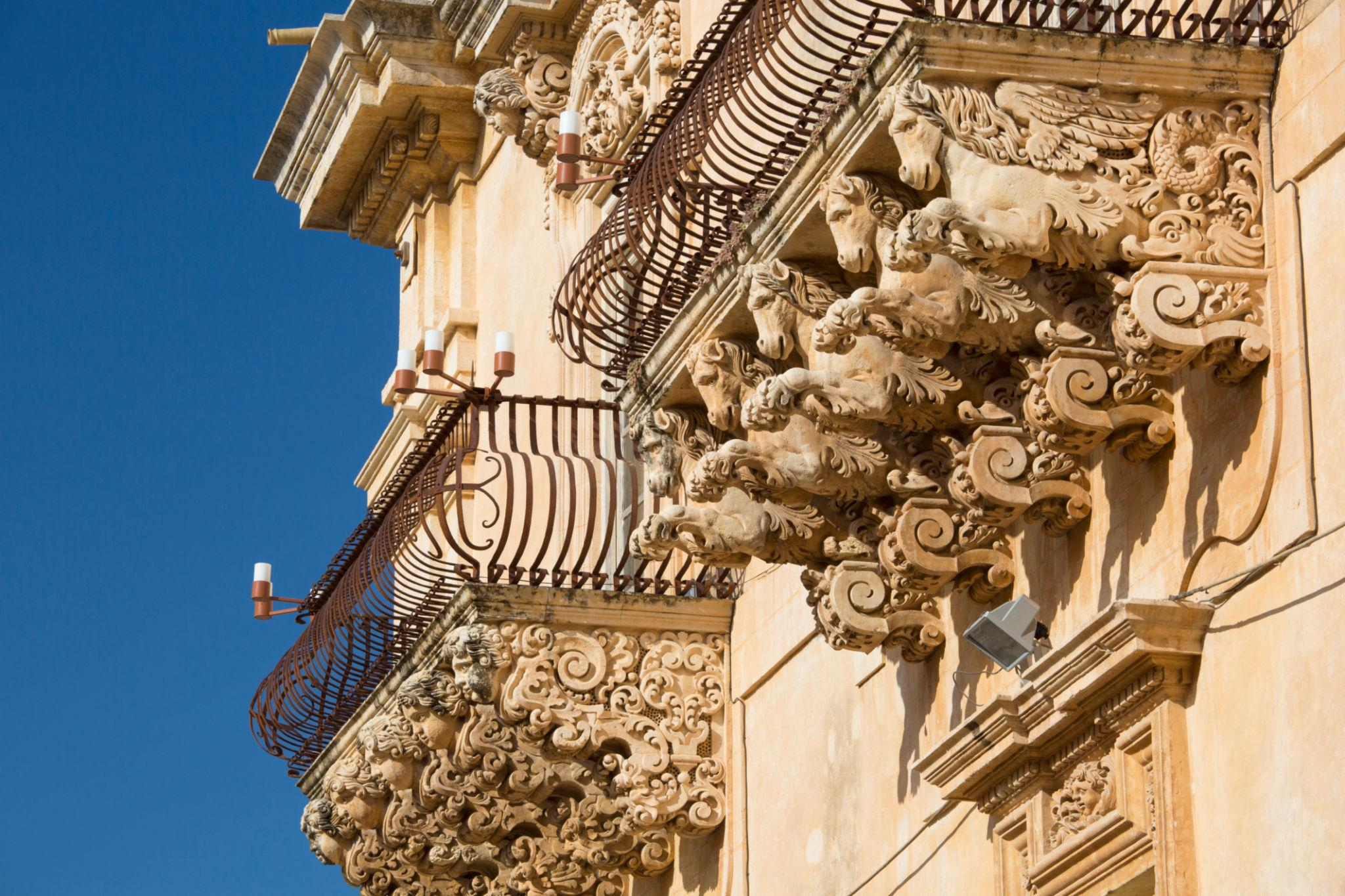
Nearby, Palazzo Nicolaci di Villadorata provides a more intimate demonstration of Baroque imagination. Its celebrated balconies, supported by elaborately carved figures, reveal how decoration could transform a noble residence into an architectural performance.
Yet Noto is best experienced without turning these monuments into a checklist.
The city changes throughout the day. Morning gives its streets a quieter clarity, while late afternoon brings out the golden and amber tones of the limestone. After sunset, illuminated façades create an atmosphere quite different from the daytime excursion experienced by many visitors.
For that reason, luxury travellers should consider staying in or around Noto rather than arriving only for several hours. The surrounding countryside and nearby coast make it possible to build two or three days around the city, combining architecture with rural dining, wine, archaeological excursions and the beaches and wetlands around Vendicari.
The result is a more convincing interpretation of luxury: not simply privileged access to a monument, but sufficient time to understand the landscape around it.
Ragusa Ibla Creates Baroque Drama Through Landscape
If Noto impresses through compositional harmony, Ragusa achieves its effect through topography.
The city occupies a dramatic landscape of hills and valleys, and its post-earthquake history produced an unusual urban relationship between Ragusa Superiore and the older Ragusa Ibla. UNESCO notes that Ragusa was among the communities where a new urban centre was created alongside the ancient one after the earthquake.
Ragusa Ibla is the more immediately atmospheric experience for visitors.
Its streets climb, descend and turn unexpectedly between limestone houses, churches, stairways and small squares. Unlike a city designed principally along a monumental axis, Ragusa reveals itself gradually. Views appear between buildings; church domes emerge above rooftops; steep staircases turn a relatively short walk into a sequence of changing perspectives.
At its architectural heart stands the Duomo di San Giorgio, designed by Rosario Gagliardi and approached across a sloping piazza. Its convex façade and elevated position make the building one of the defining monuments of Sicilian Baroque.
The experience becomes particularly evocative towards evening. As the light softens, the limestone buildings acquire warmer tones and the city begins to illuminate across the hillside.
Ragusa also demonstrates why a journey through the Val di Noto benefits from a private car or driver. The distances between towns are manageable, but the landscape between them matters. Travelling slowly through the Hyblaean countryside makes it possible to understand that these cities were never isolated architectural objects; they belonged to an agricultural territory of farms, stone walls, olive trees and historic estates.
A luxury itinerary can therefore combine a guided architectural exploration of Ragusa Ibla with lunch or dinner rooted in the surrounding territory, rather than treating the city as another brief stop between Noto and Modica.
Modica Connects Monumental Architecture with Sicilian Gastronomy
Modica may be the most theatrical of the Val di Noto towns when viewed as a whole.
The city unfolds across multiple levels, with houses, churches and palazzi rising along steep slopes and filling the valley below. The topography creates a composition that can resemble a vast stone amphitheatre, particularly when seen from one of the higher viewpoints.
Its most important Baroque landmark is the Duomo di San Giorgio.

The church rises above an imposing staircase, its richly articulated façade dominating the surrounding urban fabric. San Pietro, another major church in the historic centre, offers a different monumental expression, with statues of the apostles accompanying its approach. Sicily’s official tourism portal highlights both among Modica’s defining architectural symbols.
But Modica introduces another reason to linger: chocolate.
The city’s chocolate tradition is associated with a distinctive cold-working process historically linked to techniques of Mesoamerican origin that reached Sicily through Spanish influence. The result differs markedly from conventional smooth European chocolate, retaining a characteristic granular texture.
For the luxury traveller, this should be approached as cultural heritage rather than simply souvenir shopping. A carefully chosen tasting or artisan encounter can connect Modica’s culinary identity with the same historical exchanges visible elsewhere in Sicilian architecture and culture.
This intersection of food and art gives Modica a particularly sensory character. A morning can begin among Baroque churches, continue through the steep historic streets and finish with chocolate, pastry or a longer lunch focused on southeastern Sicilian ingredients.
It is one of the reasons the Val di Noto should not be compressed into a single day.
Scicli Reveals the Intimate Side of Sicilian Baroque
Scicli has a different scale.
Where Noto announces itself through monumental avenues and Ragusa through dramatic topography, Scicli can feel more intimate. The town sits between rocky hills, its historic streets and palazzi closely connected to the surrounding landscape.
Via Francesco Mormina Penna forms one of the principal architectural ensembles, while Palazzo Beneventano displays the expressive sculptural decoration associated with the most imaginative side of Sicilian Baroque. The Church of San Bartolomeo, set against the rocky landscape, creates one of Scicli’s most memorable compositions. Sicily’s official tourism authority highlights Palazzo Beneventano and San Bartolomeo among the town’s defining monuments.
Scicli has also acquired a modern cultural identity through film and television productions, but its appeal does not depend on that association. The town deserves attention because it still feels lived in rather than staged exclusively for visitors.
A long lunch followed by an unhurried walk can be more rewarding here than a heavily structured tour. Small streets lead towards palazzi and churches, while the rocky hills surrounding the centre remain constantly visible.
Scicli also works particularly well as part of a wider journey towards the southeastern coast. Its position allows travellers to move between Baroque culture and the Mediterranean without the sense of crossing from one unrelated destination to another.
This proximity between architecture, countryside and sea is one of the defining luxuries of southeastern Sicily.
The UNESCO Story Extends Far Beyond the Four Famous Towns
Noto, Ragusa, Modica and Scicli dominate most international Val di Noto itineraries, but they represent only half of the UNESCO story.
The World Heritage property also encompasses Caltagirone, Catania, Militello Val di Catania and Palazzolo Acreide. Each illustrates a different response to the destruction of 1693. UNESCO notes that Caltagirone was largely repaired, Catania was rebuilt on its original site, while Palazzolo Acreide developed a new centre beside the ancient one.
This diversity is crucial to understanding why the UNESCO designation matters.
It does not recognise eight towns simply because they contain attractive Baroque churches. Together, they document a vast post-seismic reconstruction project carried out within a shared period and cultural environment, yet adapted to different existing cities and landscapes. UNESCO describes the ensemble as remarkable for its geographical and chronological homogeneity while also emphasising its innovations in town planning and urban rebuilding.
Caltagirone is particularly worthwhile for travellers extending the journey inland. Its historic centre introduces a different urban setting and is also celebrated for a centuries-old ceramic tradition that remains integral to the city’s identity.
Catania offers the most urban interpretation. Its historic core, built extensively in dark volcanic stone combined with lighter architectural details, connects Baroque reconstruction to the constant presence of Mount Etna.
Palazzolo Acreide provides a compelling alternative for travellers already exploring the Hyblaean interior. Its Baroque heritage exists alongside a much older archaeological landscape, allowing different periods of Sicilian history to be experienced within the same destination.
Militello Val di Catania is less prominent on conventional itineraries, which is precisely why it may appeal to travellers interested in going beyond the most photographed stops.
For a first Val di Noto journey, it is not necessary to see all eight towns. But knowing that the UNESCO property extends beyond the famous quartet transforms the understanding of the region from a sequence of beautiful destinations into a shared historical phenomenon.
The Countryside and Coast Complete the Val di Noto Experience
Architecture may provide the reason for coming, but southeastern Sicily becomes more compelling when the cities are connected to the landscape surrounding them.
Dry-stone walls cross the countryside. Olive and carob trees punctuate agricultural estates. Vineyards appear around areas associated with Nero d’Avola and other Sicilian varieties. Towards the coast, the terrain opens to beaches, wetlands and Mediterranean vegetation.
This is where the Val di Noto becomes particularly suitable for slow luxury travel.
Rather than changing hotels every night, travellers can choose a carefully located base and make private excursions into the surrounding towns. A restored masseria or country property can provide a deliberate contrast to the architectural intensity of Noto and Ragusa, while remaining close enough for evening visits.
The coast around Vendicari adds another dimension. The protected reserve combines wetlands, beaches and Mediterranean habitat, allowing a morning dedicated to Baroque architecture to be followed by several quiet hours beside the sea.
For travellers interested in discovering even less familiar corners of the southeast, Luxury Magazine’s guide to Secret Sicily and its extraordinary places off the beaten path extends the journey towards Pantalica, Ferla, Palazzolo Acreide, Cava d’Ispica and Noto Antica.
The connection is important. Southeastern Sicily is not a museum of Baroque façades. Its architecture belongs to a much older landscape of Greek settlements, rock-cut necropolises, medieval communities, agricultural traditions and Mediterranean nature.
Experiencing these layers together is considerably more rewarding than visiting Noto merely to photograph the cathedral.
A Val di Noto Journey Rewards Time Rather Than Distance
The temptation is to think of Noto, Modica, Ragusa and Scicli as a convenient sequence of day-trip destinations. Geographically, that is possible. Experientially, it misses much of what makes them exceptional.
A three-night itinerary is a sensible minimum for the principal southeastern towns. Four or five nights create a more luxurious rhythm, allowing architecture to be combined with countryside, gastronomy, the coast and archaeological sites without turning every day into a transfer.
Spring and early autumn are particularly attractive for this style of travel. Walking through historic centres is more comfortable than during the hottest summer afternoons, while the surrounding countryside becomes an integral part of the itinerary. Summer remains appealing for travellers who want to combine the Baroque towns with the southeastern coast.
Timing within each day matters too. Noto deserves to be seen as its limestone changes colour towards sunset. Ragusa Ibla becomes particularly atmospheric in the evening. Modica benefits from viewpoints that reveal the vertical structure of the town, while Scicli invites slower exploration on foot.
For travellers crossing Sicily by car, the Val di Noto also forms one of the island’s most rewarding road-trip stages. Luxury Magazine’s Sicily by Porsche road-trip itinerary places Noto and the southeastern countryside within a longer journey linking Palermo, Agrigento, the Baroque southeast, Taormina and Mount Etna.
But whatever the mode of travel, the principle should remain the same: do less and look longer.
The significance of the Val di Noto lies not in a single cathedral, staircase or palace. It lies in the extraordinary collective response of communities rebuilding after disaster. The earthquake of 1693 destroyed cities; the reconstruction that followed produced new urban landscapes of such coherence and creativity that UNESCO now regards them as the culmination and final flowering of Baroque art in Europe.
More than three centuries later, those cities remain inhabited, evolving places rather than architectural relics. Their piazzas still function as social spaces, their churches remain woven into civic identity, and their streets continue to change with the rhythms of daily life.
That is what gives the Val di Noto its enduring power. Its beauty is monumental, but it is never entirely static. Stone, sunlight, landscape, food and contemporary Sicilian life continue to exist together, turning one of Europe’s great architectural legacies into one of the Mediterranean’s most rewarding cultural journeys.
Frequently Asked Questions
Which towns are included in the UNESCO Val di Noto World Heritage Site?
The UNESCO property officially comprises components in eight southeastern Sicilian towns: Caltagirone, Militello Val di Catania, Catania, Modica, Noto, Palazzolo Acreide, Ragusa and Scicli. They were inscribed on the World Heritage List in 2002 for their exceptional late Baroque architecture and post-1693 urban reconstruction.
Which Val di Noto town is the most beautiful?
Noto offers the most harmonious and immediately recognisable Baroque ensemble, while Ragusa Ibla is arguably more dramatic because of its hillside setting. Modica combines monumental architecture with a particularly distinctive urban landscape and culinary tradition, whereas Scicli has a quieter and more intimate atmosphere. Ideally, travellers should experience several rather than choosing only one.
How many days are needed to explore the Val di Noto?
Three days are sufficient for an introduction focused on Noto, Ragusa, Modica and Scicli. Four to five nights are preferable for a luxury itinerary that also includes Palazzolo Acreide, countryside experiences, local gastronomy, archaeological sites or the southeastern coast.
What is the best time to visit the Val di Noto?
Spring and early autumn are particularly suitable because temperatures generally make architectural exploration and countryside excursions more comfortable. Summer is attractive for combining the historic towns with beaches and coastal experiences, although sightseeing is better planned for mornings and later afternoons during hotter periods.
Why is the Val di Noto a UNESCO World Heritage Site?
UNESCO recognises the eight towns as an exceptional collective example of reconstruction following the catastrophic earthquake of 1693. Their architecture represents an outstanding expression of late Baroque art, while their rebuilding also produced significant innovations in urban planning. UNESCO describes the ensemble as representing the culmination and final flowering of Baroque art in Europe.
By Luxury Magazine Editorial Team