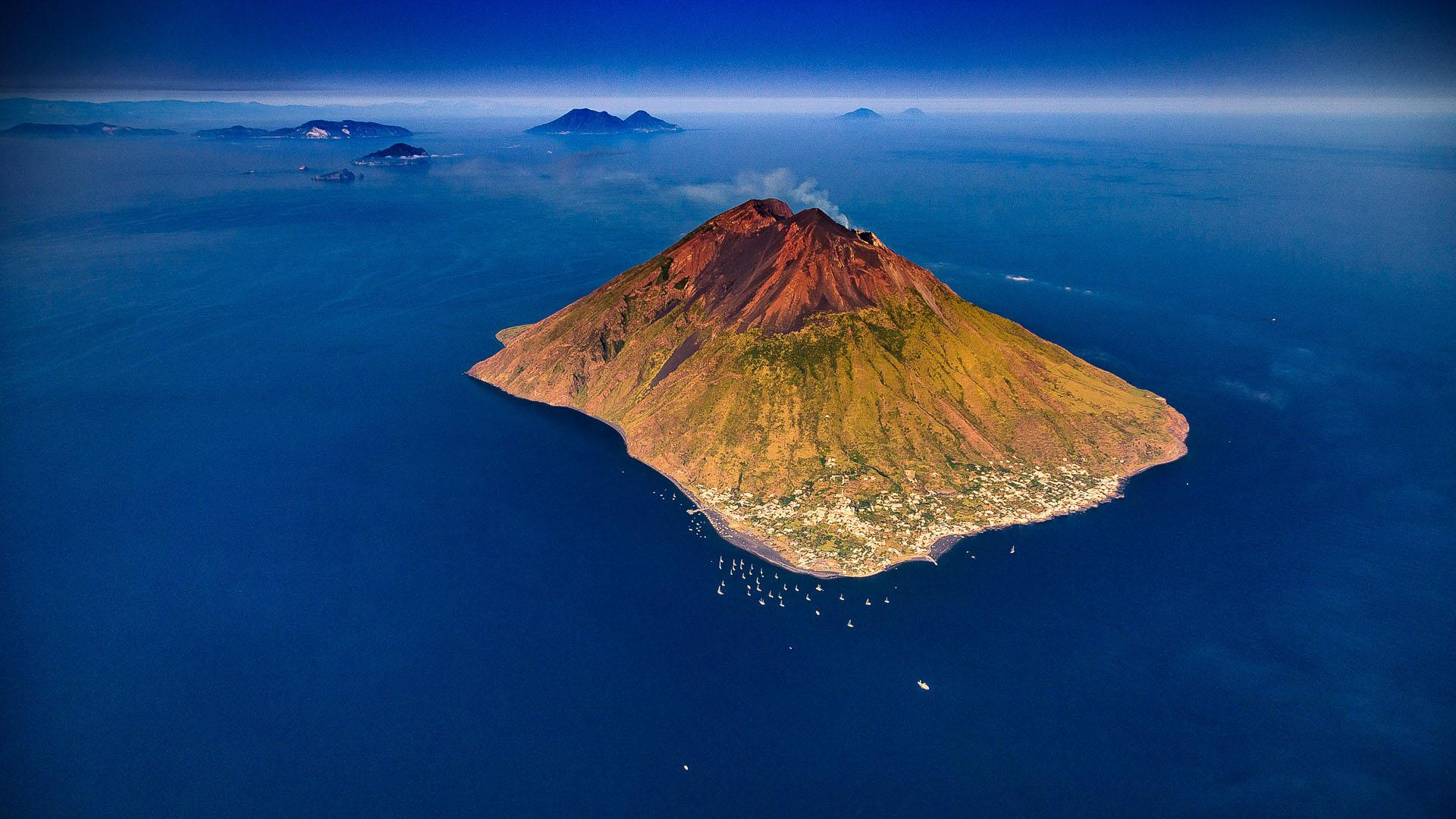
Sicily is an island shaped by fire. Volcanoes have determined its mountains, coastlines, soils and agricultural traditions, leaving behind landscapes that can feel almost otherworldly. Nowhere is this relationship more dramatic than between Mount Etna and the Aeolian Islands, two volcanic worlds that reveal different expressions of the same geological force.
On Sicily’s eastern coast, Etna rises above vineyards, forests and historic villages, an active presence visible from Taormina and much of the Ionian shoreline. To the north, the Aeolian archipelago emerges from the Tyrrhenian Sea: seven principal islands whose black beaches, volcanic cliffs, fertile slopes and active craters tell a story millions of years in the making.
Both Mount Etna and the Aeolian Islands are UNESCO World Heritage Sites. Etna was inscribed in 2013 for its extraordinary geological significance and continuing volcanic activity, while the Aeolian Islands have been on the World Heritage List since 2000 as an exceptional record of volcanic island formation and ongoing geological processes. (UNESCO World Heritage Centre)
For the luxury traveller, however, volcanic Sicily is not primarily about geology. It is about experiencing how fire has shaped wine, food, architecture, culture and some of the Mediterranean’s most extraordinary landscapes.
Mount Etna, Sicily’s Living Monument
Etna cannot be understood simply as a mountain on the horizon. It is a living part of eastern Sicily.
UNESCO describes it as the highest mountain on a Mediterranean island and the world’s most active stratovolcano. Its eruptive history stretches back approximately 500,000 years, with human documentation covering at least 2,700 years. Summit craters, lava flows, cinder cones, caves and the immense Valle del Bove form a constantly evolving volcanic landscape. (UNESCO World Heritage Centre)
Yet Etna’s fascination lies partly in the transition from apparent hostility to extraordinary fertility.
At higher elevations, the terrain can become stark and almost lunar. Descend, and vegetation gradually returns. Forests of oak and chestnut give way to orchards and vineyards; villages appear among lava-stone walls; cultivated terraces occupy land created or transformed by earlier eruptions.
For travellers staying in Taormina, Etna is close enough to become a central part of the journey rather than a distant excursion. A privately guided day can move through different elevations and landscapes, with routes adapted to volcanic conditions, weather and the traveller’s desired level of physical activity.
The most rewarding experience is rarely about reaching the highest accessible point as quickly as possible. Etna deserves time. Walking across an old lava field with a specialist guide, understanding the formation of the Valle del Bove and observing how vegetation reclaims volcanic ground provides a much richer perspective on the mountain.
There is also a quieter Etna beyond the most visited routes. Small villages, historic estates, vineyards and rural restaurants allow the volcano to become the background to an entire day rather than a single attraction.
Etna’s Vineyards Turn Volcanic Soil into Wine
Wine provides one of the most sophisticated ways to understand Etna.
Vines grow across a landscape defined by altitude, lava, exposure and dramatic variations between individual contrade. On the northern slopes in particular, old lava flows sit beside vineyards enclosed by dark stone walls, while significant differences in elevation and microclimate create a wine territory of remarkable complexity.
Native varieties are central to that identity. Nerello Mascalese and Nerello Cappuccio are associated with Etna’s reds, while Carricante plays a leading role in its whites.
At Planeta’s Sciaranuova estate on Etna’s northern slope, vineyards sit at approximately 850 metres above sea level among lava flows dating from the long eruption that began in 1614. The estate grows Carricante, Nerello Mascalese and Nerello Cappuccio alongside international varieties, with restored historic buildings forming part of its contemporary hospitality experience. (Planeta)
This is where volcanic Sicily moves naturally into luxury travel.
A serious Etna wine experience is not simply a tasting counter followed by the purchase of bottles. It can begin in the vineyard, continue through historic agricultural structures and conclude around a table with wines, local breads, cheeses and olive oil.
Planeta currently offers several experiences at Sciaranuova, including tastings focused on the flavours of the volcano and a more specialised Vertical Etna experience. The latter explores Etna crus across three vintages and includes a vineyard and palmento visit, food and olive-oil tasting. (Planeta)
Planeta Sciaranuova experiences
The value of such experiences is not simply exclusivity. They reveal the connection between the wine in the glass and the apparently unforgiving landscape outside.
On Etna, terroir is unusually visible. The lava is not an abstract concept discussed during the tasting; it is underfoot.
The Journey from Etna to the Aeolian Islands
If Etna demonstrates how people have learned to live beside a volcano, the Aeolian Islands reveal how volcanoes can create an entire archipelago.
Located off Sicily’s northern coast, the islands form one of the Mediterranean’s most remarkable geological landscapes. Lipari, Vulcano, Salina, Panarea, Stromboli, Filicudi and Alicudi are related by volcanic origin but differ profoundly in atmosphere.
UNESCO considers the archipelago an outstanding record of volcanic island-building and destruction. The islands have been studied scientifically since at least the eighteenth century and gave volcanology two internationally recognised terms: Vulcanian, from Vulcano, and Strombolian, from Stromboli. (UNESCO World Heritage Centre)

For travellers, the transition from Etna to the Aeolian Islands creates one of Sicily’s most compelling itineraries.
The volcano first appears as something immense and terrestrial, rising above eastern Sicily. In the Aeolians, volcanic forms emerge directly from the sea.
The best way to appreciate that transformation is slowly. Rather than approaching the archipelago as seven islands to be checked off a list, a luxury itinerary should select two or three according to the traveller’s interests and allow the yacht, sailing boat or private transfer between them to become part of the experience.
The sea is not simply transportation here. It is the viewpoint from which the volcanic architecture of the islands becomes clearest.
Panarea and Salina Reveal the Softer Side of the Archipelago
Panarea has long represented the more polished face of the Aeolian Islands. Small in scale and visually distinctive, it combines whitewashed architecture, narrow lanes, rocky coves and a social scene that becomes considerably livelier during the summer.
Its luxury is deliberately different from that of a grand Mediterranean resort. There is little need for monumental architecture or elaborate formality. The island’s appeal comes from privacy, simplicity, access by sea and evenings that move naturally between terraces, restaurants and boats in the harbour.
Panarea works particularly well as part of a private-yacht itinerary because the surrounding islets and coves can be explored from the water before returning ashore later in the day.
Salina presents a different interpretation of Aeolian refinement.
Greener and more agricultural, the island is associated with capers and Malvasia delle Lipari, and its twin volcanic peaks create one of the archipelago’s most recognisable silhouettes. Here, volcanic identity becomes gastronomic.
The experience is slower: vineyards, gardens, small villages, sea views and long meals rather than an itinerary built around constant movement.
That contrast is precisely what makes Panarea and Salina so effective together. Panarea brings social energy and maritime elegance; Salina offers agriculture, wine and a more contemplative relationship with the landscape.
For a traveller seeking the luxury of time rather than excess, two or three nights across these islands can be more memorable than attempting to visit the entire archipelago in rapid succession.
Stromboli Turns Volcanic Power into Theatre
No island expresses the drama of volcanic Sicily more clearly than Stromboli.
The volcano rises almost directly from the Tyrrhenian Sea, forming the overwhelming physical presence of the island. Its activity is so distinctive that the term Strombolian is used internationally to describe a particular style of volcanic eruption. UNESCO specifically identifies Stromboli, together with Vulcano, as fundamental to the historical development of volcanology. (UNESCO World Heritage Centre)

The most evocative encounter comes from the water.
A private yacht can remain offshore as daylight fades, allowing the island’s darkening profile to dominate the horizon. Depending on current volcanic conditions, natural activity may become visible against the night sky.
This is an experience that should never be overscheduled. Dinner can wait. Music can be lowered. The luxury lies in allowing one of the Mediterranean’s most elemental landscapes to provide the spectacle.
Any approach to Stromboli must, however, respect current volcanic restrictions and official safety guidance. Conditions around active volcanoes can change, and access to hiking routes or higher elevations should always be arranged through authorised local professionals and checked close to the date of travel.
Stromboli is not a stage created for visitors. That is precisely why it remains so powerful.
Vulcano Brings Travellers Closer to the Geological Story
Vulcano has a rougher, more elemental character.
Its name has travelled far beyond Sicily: through Roman mythology and later scientific language, Vulcano became part of the vocabulary through which volcanic landscapes are understood around the world.
The island’s fumaroles, crater landscape, sulphurous features and dark volcanic terrain make its geological origins immediately visible. Unlike the elegance of Panarea or the agricultural richness of Salina, Vulcano feels more exposed.
For travellers moving through the archipelago by boat, the island provides a valuable contrast. A morning can begin on the water, continue with a professionally guided exploration ashore where conditions permit, and end with a return to the yacht for lunch and swimming.
The important distinction is between adventure and unnecessary risk. Volcanic Sicily is dynamic. Routes, access rules and safety conditions can change, so premium travel planning should include local guides, flexible timing and respect for official restrictions rather than promising access to a particular crater or trail months in advance.
That flexibility is not a compromise. It is part of travelling intelligently through an active volcanic landscape.
A Private Yacht Reveals the Aeolian Islands at Their Best
There are destinations where a yacht is primarily a symbol of luxury. In the Aeolian Islands, it is also one of the most logical ways to travel.
Distances that can feel complicated when organised around fixed ferry schedules become part of a fluid itinerary. A morning anchorage can be chosen for swimming; lunch can be taken ashore on another island; the afternoon can be spent navigating volcanic cliffs before arriving somewhere entirely different for dinner.
The most successful itinerary is not necessarily the longest.
A few carefully chosen combinations work particularly well: Panarea with Stromboli for glamour and volcanic drama; Salina with Panarea for gastronomy and social life; or a longer route incorporating Vulcano and Lipari before moving towards the quieter western islands of Filicudi and Alicudi.
Weather and sea conditions should always determine the final route. This is another reason private cruising suits the archipelago: the itinerary can retain a degree of flexibility rather than treating each island as a fixed appointment.
Luxury in the Aeolians is ultimately about access—to coves that make most sense from the water, to quieter hours ashore, to sunsets seen without crowds and to the ability to change direction when the sea suggests something better.
Etna and the Aeolians Belong to the Same Sicilian Journey
Experiencing Etna and the Aeolian Islands together creates a deeper understanding of Sicily.
On Etna, volcanic energy has produced an inhabited cultural landscape. People cultivate vines beside old lava flows, build walls from volcanic stone and organise agricultural life around a mountain that remains active.
In the Aeolians, the relationship is more maritime. Volcanic cones rise from the sea; settlements occupy narrow strips between slopes and water; vineyards and caper fields adapt to island terrain; boats remain fundamental to movement and identity.
Together, these landscapes demonstrate why Sicily cannot be reduced to beaches, archaeological sites or celebrated hotels. Its luxury is inseparable from its geography.
The most compelling itinerary might begin in Taormina, with several days divided between the Ionian coast and Etna. A private wine experience can follow a morning on the volcano, while a slower second day can explore villages and the northern vineyards.
The journey can then continue towards the north coast and out to the Aeolian Islands, ideally allowing several nights rather than a single hurried day trip.
Panarea provides Mediterranean sophistication. Salina introduces wine, agriculture and quiet landscapes. Stromboli supplies the extraordinary final act: an active volcanic island rising from the sea.
It is difficult to imagine a more complete expression of volcanic Sicily.
Frequently Asked Questions
What makes Mount Etna and the Aeolian Islands unique?
Both are UNESCO World Heritage Sites recognised for exceptional volcanic geology. Etna is one of the world’s most active and intensively studied volcanoes, while the Aeolian Islands provide an extraordinary record of volcanic island formation and gave their names to the Vulcanian and Strombolian eruption types. (UNESCO World Heritage Centre)
How many days should travellers dedicate to volcanic Sicily?
Around seven to ten days creates a comfortable luxury itinerary combining Taormina, Mount Etna and selected Aeolian Islands. Etna deserves at least one full day, preferably two if wine experiences are important, while the Aeolians are considerably more rewarding when explored over several nights rather than as a rushed day trip.
Which Aeolian Islands are best for luxury travellers?
Panarea is particularly suited to travellers looking for intimate Mediterranean style and a summer social atmosphere, while Salina is stronger for gastronomy, wine and a slower pace. Stromboli provides the archipelago’s most dramatic volcanic experience. Combining two or three islands generally produces a richer journey than trying to visit all seven.
Is it possible to combine Mount Etna and the Aeolian Islands in one trip?
Yes. They complement each other exceptionally well. Taormina makes an effective base for exploring Etna and eastern Sicily before continuing towards the north coast and the Aeolian archipelago. For a premium itinerary, private ground transfers and a yacht or tailored maritime arrangements can make the transition considerably more fluid.
When is the best time to experience Etna and the Aeolian Islands?
Late spring through early autumn is particularly attractive for combining Etna with the Aeolian Islands, especially when private boating and swimming are priorities. Etna itself can be visited across a much broader part of the year, but conditions at altitude vary significantly. Active-volcano excursions and sea itineraries should always remain flexible around current weather, volcanic activity and official safety guidance.
By Luxury Magazine Editorial Team