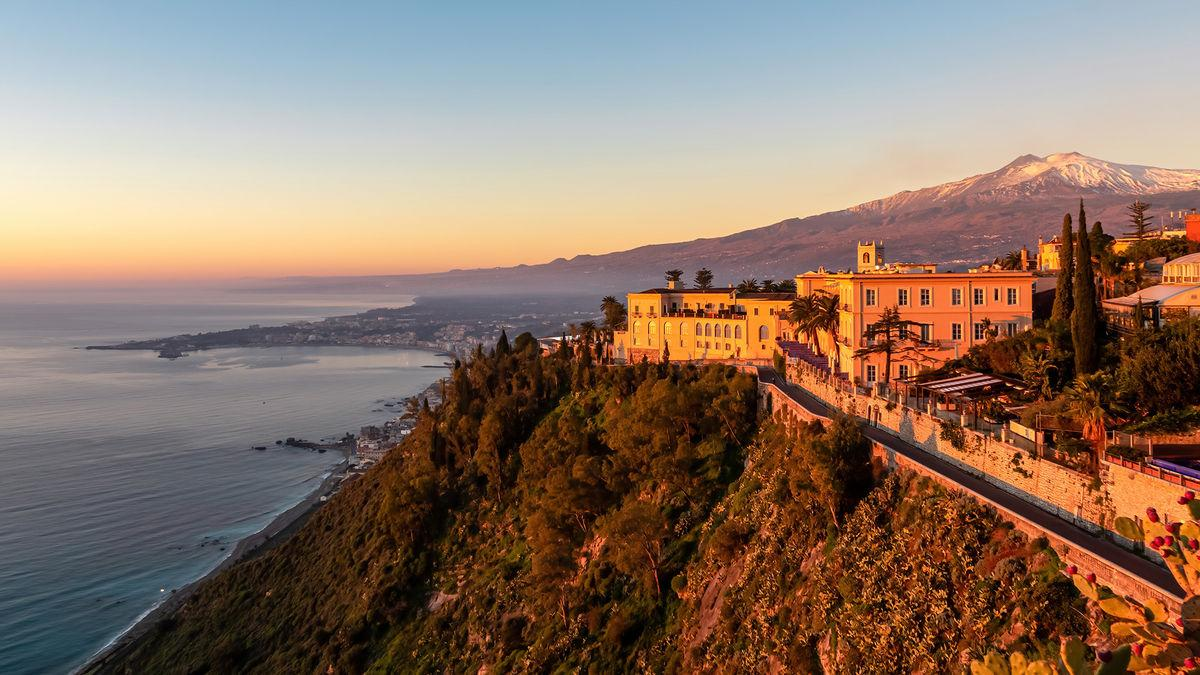
There are Mediterranean destinations whose beauty reveals itself gradually, and there are others that seem to have been designed for a single unforgettable first impression. Taormina belongs firmly to the latter. Suspended above Sicily’s Ionian coast, the town looks across a landscape in which sea, mountain and architecture appear almost theatrically arranged: Mount Etna rises in the distance, the coastline curves beneath steep green slopes, and the blue Mediterranean stretches towards the horizon.
Yet Taormina’s enduring fascination comes from more than its celebrated panorama. Its identity has been shaped by Greek and Roman history, medieval streets, aristocratic residences, gardens, writers, artists and generations of international travellers. Goethe helped establish its place in the European imagination, while later visitors ranging from Oscar Wilde to D. H. Lawrence contributed to its reputation as a cultured Mediterranean retreat.
Today, that history exists alongside some of Sicily’s most sophisticated hospitality. Grand hotels occupy former monasteries and private villas; restaurants interpret the produce of the island and the nearby sea; boats trace the coast around Isola Bella; and Etna remains close enough to turn a morning departure from Taormina into an exploration of vineyards and volcanic terrain.
For the luxury traveller, Taormina is not simply somewhere beautiful to stay. It is one of the rare Sicilian destinations where history, landscape, hospitality and access to the wider island can be experienced without sacrificing the pleasure of moving slowly.
The Ancient Theatre Defines Taormina’s Sense of Place
Few monuments in Europe possess a setting as dramatic as Taormina’s Ancient Theatre. Built originally in the Hellenistic period and substantially transformed under Roman rule, the theatre occupies a panoramic position overlooking the Ionian coast and Mount Etna. Sicily’s regional archaeological authority describes it as the island’s second-largest ancient theatre after Syracuse.

Its importance is not purely archaeological. The theatre establishes the visual language of Taormina itself. Ancient stone frames the volcano and sea beyond, creating a relationship between architecture and landscape that explains why the town has inspired painters, photographers and travellers for centuries.
The best experience is deliberately unhurried. Arriving earlier in the day can provide a quieter appreciation of the structure and its setting, while seasonal performances transform the monument into a living cultural venue rather than a preserved ruin.
From the theatre, Taormina’s historic centre unfolds naturally. Corso Umberto forms its principal pedestrian axis, passing boutiques, cafés, churches and small lanes before reaching Piazza IX Aprile. The square opens suddenly towards the coast, producing another of the town’s characteristic moments: an intimate urban space followed by an immense view.
This compact geography is part of Taormina’s luxury. A traveller can move from an archaeological monument to an aperitivo terrace, a garden, a boutique and dinner largely on foot, without the logistical complexity that accompanies many Mediterranean resort destinations.
Parco Archeologico di Naxos Taormina
Grand Hotels Preserve Taormina’s Cosmopolitan Heritage
Taormina’s international reputation was established long before contemporary luxury tourism. European aristocrats, writers, artists and wealthy travellers began arriving in increasing numbers during the nineteenth and early twentieth centuries, turning the town into one of the essential Mediterranean destinations of the Grand Tour tradition.
That heritage remains visible in its hotels.

San Domenico Palace, Taormina, A Four Seasons Hotel occupies a former Dominican convent whose origins date to the fourteenth century. Four Seasons describes the property as combining the historic convent with a later Grand Hotel wing, surrounded by gardens above the Ionian Sea. Its position places guests within the historic centre while retaining sweeping views towards Etna and the coast.
A short distance away, Grand Hotel Timeo, A Belmond Hotel, Taormina occupies another exceptional position beside the Ancient Theatre. Its terraces and gardens have become almost synonymous with the classic image of Taormina: formal hospitality framed by Etna and the Mediterranean.
Down at sea level, Villa Sant’Andrea, A Belmond Hotel, Taormina Mare provides a different interpretation of the destination. Set on Mazzarò Bay, it allows travellers to experience Taormina as both hill town and seaside retreat.
These properties matter because they preserve different chapters of Taormina’s identity. Luxury here does not need to be imported into the destination; it has been part of its hospitality culture for generations.
Isola Bella and Mazzarò Reveal Taormina from the Water
Taormina’s famous elevated position can make the sea appear almost like scenery. Descending towards Mazzarò changes that relationship completely.
The Taormina–Mazzarò cable car connects the historic town with the coastal area below, while Isola Bella lies nearby within one of the most recognisable bays in Sicily. The small island and surrounding nature reserve are protected for their environmental and cultural importance.

A private boat reveals the coastline particularly well. From the water, the steep geography becomes clearer: villas and hotels appear above rocky slopes, small bays interrupt the shoreline, and Taormina itself seems almost improbably high above the sea.
A half-day cruise can remain local, moving around Isola Bella, Capo Taormina and neighbouring bays with time for swimming. A longer charter can extend along Sicily’s Ionian coastline.
The experience is most successful when it is not overprogrammed. Taormina already provides the spectacle. A comfortable boat, a knowledgeable skipper, a quiet anchorage and sufficient time in the water are often more valuable than attempting to cover a long sequence of stops.
Mazzarò also allows travellers to combine the sea with sophisticated hotel hospitality. The contrast between a morning in the historic centre and an afternoon beside the water is one of Taormina’s defining advantages.
Sicilian Gastronomy Finds a Refined Expression in Taormina
Taormina’s culinary identity sits between several territories. The Ionian Sea supplies seafood; Etna contributes wines, pistachios and produce grown in volcanic soils; eastern Sicily brings citrus, almonds and long-established pastry traditions.
The strongest restaurants use this geography as a foundation rather than treating Sicilian cuisine as a fixed collection of traditional dishes.

Within San Domenico Palace, Taormina, A Four Seasons Hotel, Principe Cerami presents contemporary Sicilian fine dining under chef Massimo Mantarro. The restaurant currently holds two Michelin stars, with Michelin highlighting its modern interpretation of Sicilian flavours and ingredients.
At Grand Hotel Timeo, A Belmond Hotel, Taormina, Otto Geleng offers an intimate fine-dining experience centred on Sicilian ingredients and Mediterranean cooking. Michelin currently lists the restaurant with one star.
Yet Taormina should not be experienced exclusively through formal tasting menus. Granita in the morning, locally made pastries, seafood at lunch and an Etna wine at sunset can be equally revealing.
The most satisfying gastronomic itinerary moves between these levels naturally. Luxury is found not only in elaborate technique but also in access to excellent ingredients at precisely the right moment.
Mount Etna Gives Taormina Its Extraordinary Hinterland
Few luxury coastal destinations possess a hinterland comparable to Etna.
From Taormina, the volcano is not merely visible; it is close enough to become part of the journey. Its slopes introduce a completely different Sicily of lava fields, forests, historic villages and vineyards.

Etna’s UNESCO World Heritage designation recognises its exceptional geological importance and continuing volcanic activity. The protected area encompasses the volcano’s highest zones and an extraordinary landscape of craters, lava flows and other volcanic formations.
For travellers, however, Etna becomes particularly compelling through wine.
The volcanic soils, altitude and variations in exposure create distinctive growing conditions. Estates on the mountain produce wines from varieties including Nerello Mascalese, Nerello Cappuccio and Carricante, giving travellers an opportunity to understand the volcano through agriculture rather than observation alone.
A private Etna day can therefore combine a guided volcanic excursion with a vineyard visit and long lunch. The transition is remarkable: austere lava landscapes gradually give way to cultivated terraces and vineyards.
Taormina makes an unusually comfortable base for this experience because travellers can return from the mountain to the sea within the same day.
Taormina After Sunset Reveals a Different Kind of Elegance
Day visitors experience only one version of Taormina.
As the afternoon crowds diminish and the light changes over the Ionian coast, the town becomes more intimate. Corso Umberto remains animated, but smaller streets, hotel terraces and gardens provide quieter alternatives.

An aperitivo overlooking Etna is an obvious ritual, yet the most memorable evenings need not involve elaborate planning. Walking through the historic centre after dinner, when stone façades are illuminated and the daytime heat has faded, is part of the destination’s appeal.
The town also retains an important cultural dimension after dark. Performances at the Ancient Theatre periodically bring music, theatre and other events into one of the Mediterranean’s most extraordinary historic settings. Because programming changes seasonally, travellers interested in attending should consult the official calendar for their dates rather than building an itinerary around assumed performances.
There is also an advantage to staying within Taormina rather than visiting solely as a day trip. Early mornings and late evenings reveal the town when its scale feels more natural. Piazza IX Aprile, the lanes around Corso Umberto and the gardens become spaces to inhabit rather than attractions to photograph.
That difference matters in a destination as celebrated as Taormina. Luxury is partly the ability to experience a famous place outside its busiest hours.
Taormina Remains a Gateway to a Larger Sicily
Taormina could easily occupy several days without leaving its immediate surroundings, but its greatest strength may be the way it opens onto eastern Sicily.
Etna lies inland. The ancient foundations of Giardini Naxos are nearby. The coastline extends towards quieter seaside communities, while Catania and the Baroque southeast can form the next stage of a longer journey.
The Aeolian Islands can also be incorporated into a broader Sicilian itinerary, creating a remarkable progression from Taormina’s elevated terraces to Etna’s volcanic slopes and eventually to volcanic islands rising directly from the Tyrrhenian Sea.
This makes Taormina particularly effective at the beginning or end of a luxury journey through Sicily. It provides enough sophistication to recover from international travel while immediately introducing the island’s essential elements: ancient civilisation, volcanic geography, food, wine and the Mediterranean.
Its beauty is undeniable, but beauty alone does not explain its longevity as an international destination.
Taormina has endured because it offers something increasingly difficult to manufacture: a naturally theatrical setting enriched by centuries of history and a hospitality tradition that understands the value of that setting. The finest experiences do not compete with the landscape. They frame it.
That may ultimately be why the old idea of Taormina as Sicily’s balcony remains so appropriate. From here, travellers do not simply look at the island. They begin to understand how its sea, volcano, culture and history belong together.
Frequently Asked Questions
How many days should luxury travellers spend in Taormina?
Three to four nights provide a good introduction, allowing time for the historic centre, Ancient Theatre, Isola Bella and Mazzarò, together with a private coastal experience. Four or five nights are preferable if Mount Etna and its wineries are included without turning the stay into a succession of day trips.
Which area of Taormina is best for a luxury stay?
The historic centre is ideal for travellers prioritising restaurants, cultural sites and evening walks, while Mazzarò is better suited to guests who want immediate access to the sea. Properties such as San Domenico Palace and Grand Hotel Timeo favour the elevated historic experience; Villa Sant’Andrea provides a beachfront alternative in Mazzarò.
What is the best time of year to visit Taormina?
Late spring and early autumn are particularly attractive because they combine generally favourable conditions for sightseeing, Etna excursions and coastal experiences without concentrating the entire trip around midsummer. July and August provide the strongest beach atmosphere but are also among the busiest periods.
Is Mount Etna worth visiting from Taormina?
Yes. Etna is one of the strongest reasons to use Taormina as a base in eastern Sicily. A private excursion can combine volcanic landscapes with an Etna winery, providing a much deeper understanding of the relationship between Sicily’s geology, agriculture and wine culture.
Is Taormina suitable for a luxury beach holiday?
Yes, although it is better understood as a combination of cultural destination and coastal retreat rather than a conventional beach resort. Mazzarò and Isola Bella provide access to the sea, while the historic town sits high above the coast. This contrast is precisely what distinguishes Taormina from many Mediterranean beach destinations.
By Luxury Magazine Editorial Team