Sicilian cuisine has never lacked identity. What has changed over the past two decades is the way a generation of chefs has translated that identity into contemporary fine dining without stripping it of place, memory or cultural depth.
The island’s leading cooks work in radically different environments. Ciccio Sultano interprets Sicily from the Baroque streets of Ragusa Ibla. Pino Cuttaia has turned Licata into an international gastronomic destination. Martina Caruso cooks on Salina, where the Aeolian landscape becomes inseparable from the menu. Massimo Mantarro represents a refined interpretation of Sicily from Taormina, while Giuseppe Raciti works between citrus gardens and volcanic Etna territory. Tony Lo Coco brings Palermo-area traditions into a more personal contemporary language in Bagheria.
Their cooking cannot be reduced to the familiar vocabulary of pistachio, citrus, red prawns and capers. At the highest level, contemporary Sicilian cuisine is about history, geography and interpretation.
According to the current Michelin Guide, Sicily has 22 starred restaurants, demonstrating how widely fine dining has spread across the island—from Palermo and Bagheria to Taormina, Ragusa, Licata and the Aeolian Islands. (Guida Michelin)
Yet the most influential chefs are distinguished by more than stars. Their importance comes from having developed a recognisable culinary language: one capable of expressing Sicily while remaining unmistakably personal.
Ciccio Sultano Turns Sicilian History into Contemporary Cuisine
Few chefs have contributed as much to the international reputation of modern Sicilian fine dining as Ciccio Sultano.
His restaurant Duomo occupies an elegant setting in Ragusa Ibla, only steps from the Duomo di San Giorgio. The Michelin Guide currently awards Duomo two stars and describes Sultano as a profound interpreter of Sicily whose cuisine brings together identity, memory and the island’s future. (Guida Michelin)
Sultano’s importance lies partly in the breadth of his reference points.
Sicilian cuisine has been shaped by centuries of Mediterranean exchange, and his work often treats the island’s history as a living culinary archive rather than a decorative narrative. Arab influences, aristocratic traditions, rural ingredients and coastal cooking can coexist within the same broader vision.
Michelin highlights his current Stupor Mundi tasting itinerary as a synthesis of that approach, while the restaurant also retains an à-la-carte option. (Guida Michelin)
The setting strengthens the philosophy. Ragusa Ibla is part of southeastern Sicily’s great Baroque landscape, where architecture itself reflects destruction, rebuilding and cultural continuity. Sultano’s cuisine often seems to operate according to a similar principle: Sicilian traditions are not preserved untouched but reassembled for the present.
Val di Noto: Sicilian Baroque, a UNESCO World Heritage Site
Sultano is therefore more than one of Sicily’s most decorated chefs. He is one of the cooks who has helped make the island’s cultural history legible through food.
Pino Cuttaia Builds Fine Dining Around Memory and Essential Flavour
Where Sultano’s cuisine can feel historical and expansive, Pino Cuttaia often begins from something more intimate: memory.
At La Madia in Licata, Cuttaia has transformed a town outside Sicily’s most obvious luxury-tourism circuit into a genuine gastronomic destination. The restaurant currently holds two Michelin stars, and Michelin describes his cooking as deeply rooted in Sicily, focused on the essence of ingredients and the memory of familiar flavours rather than technical display for its own sake. (Guida Michelin)
This distinction is important.
Luxury cuisine can sometimes become detached from the traditions it claims to reinterpret. Cuttaia moves in the opposite direction. Childhood, home cooking and Sicilian everyday culture become starting points for highly controlled contemporary dishes.
The result has made Licata worth travelling to specifically for dinner. Michelin explicitly notes that Cuttaia’s vision has turned the town into a destination for food lovers from Italy and abroad. (Guida Michelin)
That achievement is itself significant. Sicily’s gastronomic map no longer follows only Palermo, Taormina or the most visited historic cities. A chef can create a destination through the strength and consistency of the kitchen.
Cuttaia’s cuisine also represents an important idea within contemporary Sicilian gastronomy: sophistication does not require abandoning simplicity. An ingredient, a childhood memory or a familiar flavour can become more powerful through refinement rather than reinvention.
Among Sicily’s leading chefs, his voice remains one of the most immediately recognisable.
Martina Caruso Makes Salina the Centre of Her Culinary World
Martina Caruso represents another direction entirely.
Her restaurant Signum is located in Malfa on Salina, one of the Aeolian Islands. The restaurant’s Michelin star was confirmed for the tenth consecutive year in the 2026 edition, according to Signum, and the property describes Caruso as both chef and patron. (Scent of Salina)
Caruso’s cooking is particularly compelling because the island is not merely the location of her restaurant—it is the central subject of her cuisine.
Signum describes a kitchen built around Salina’s seasons, local producers and ingredients including fish, vegetables, herbs and citrus. The restaurant’s own 2026 editorial material presents gastronomy as a language through which the island’s territory and memory are expressed. (Scent of Salina)
That relationship makes Caruso one of the clearest examples of contemporary island gastronomy in Italy.
The Aeolian Islands are volcanic, geographically isolated and highly individual. Salina is greener and more agricultural than some of its neighbours, with capers, Malvasia and cultivated landscapes adding a distinctive softness to its volcanic character.
Caruso does not attempt to make that identity universal. Instead, she allows specificity to become sophistication.
A dish at Signum belongs to Salina because the ingredients, climate and cultural memory belong there too.
This is also what makes travelling to the restaurant important. The ferry or yacht journey, the volcanic landscape, the villages and the sea all establish a sensory context before dinner begins.
The Most Exclusive Culinary Experiences in Sicily
Massimo Mantarro Represents Taormina’s Grand-Hotel Tradition
Taormina has long occupied a different place within Sicilian hospitality.
Its relationship with international travellers, historic hotels and Mediterranean glamour requires a culinary language capable of remaining Sicilian while speaking to a highly cosmopolitan audience.
Massimo Mantarro, Executive Chef at Principe Cerami at San Domenico Palace, embodies that balance.
The Michelin Guide’s current 2026 selection includes Principe Cerami among Taormina’s one-star restaurants, while Mantarro continues to lead the restaurant as executive chef. (Guida Michelin)
His style represents Sicily through a polished, technically precise lens suited to the setting of one of Taormina’s most internationally recognised luxury hotels.
The difference from a chef such as Cuttaia is instructive. Mantarro is not creating a reason to travel to an otherwise overlooked town; he is interpreting Sicily within a destination already associated with grand tourism.
That requires restraint.
The cuisine must reflect regional ingredients and flavour while avoiding the trap of turning Sicilian identity into a catalogue of clichés for international visitors.
Mantarro has also had an important influence through mentorship. Giuseppe Raciti, now chef at Michelin-starred Zash, trained under him at Principe Cerami before developing his own career. Zash’s official biography specifically identifies Mantarro as one of Raciti’s formative professional influences. (Zash)
This link between generations is another reason Mantarro belongs in a conversation about Sicily’s best chefs. His impact extends beyond his own restaurant.
Giuseppe Raciti Gives Etna Cuisine a Younger Contemporary Voice
The landscape around Mount Etna has become one of Sicily’s most dynamic gastronomic territories.
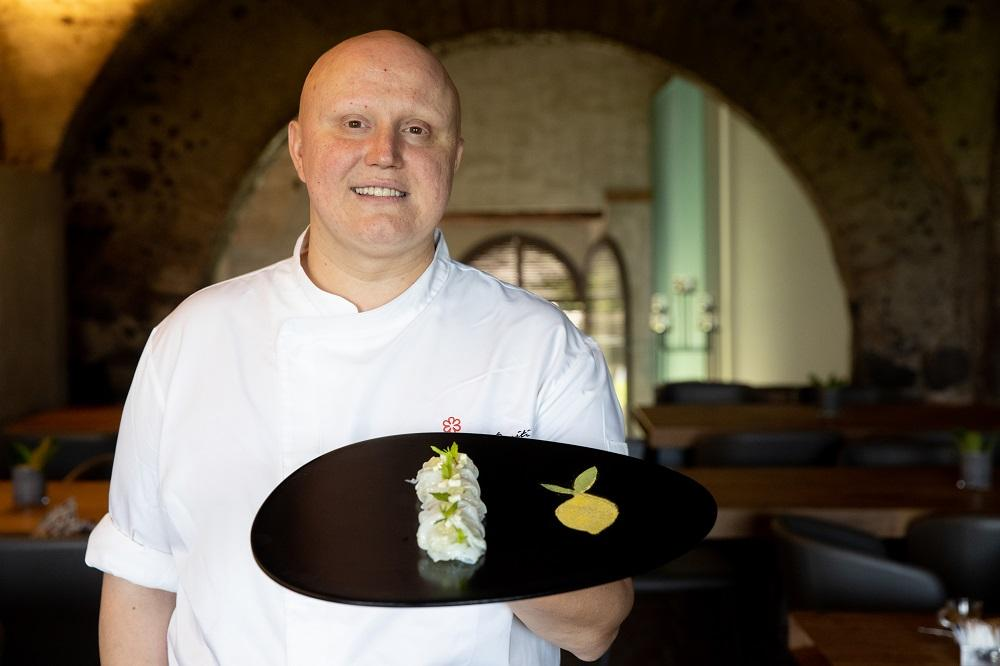
Volcanic wines have helped attract international attention, but the region’s cuisine has evolved alongside them. Giuseppe Raciti, chef of Zash near Riposto, represents that movement particularly well.
Zash confirms Raciti as its Michelin-starred chef for 2026. He joined the property as chef in 2014 and received his first Michelin star there in 2019. (Zash)
The restaurant itself occupies part of a former wine-production structure surrounded by citrus gardens, making the agricultural identity of eastern Sicily immediately visible.
Michelin describes Raciti’s cuisine as creative and seasonal, with Sicily placed firmly at the centre, while Zash itself frames his cooking around the intersection of creativity, tradition and territory. (Guida Michelin)
His career also demonstrates how Sicily’s contemporary restaurant scene has become increasingly interconnected.
Raciti trained with Massimo Mantarro after earlier experience with Ezio Santin, later developing a style that belongs specifically to his own generation and territory. (Zash)
At Zash, Etna is present without needing to dominate every plate. Citrus, seasonal produce and regional ingredients form part of a culinary landscape broader than volcanic symbolism alone.
That subtlety matters.
The best contemporary chefs working around Etna increasingly understand that the volcano is not a marketing theme. It is an ecosystem of altitude, agriculture, wine, orchards and local communities. Raciti’s cooking gains strength from being part of that environment.
Tony Lo Coco Connects Bagheria’s Memory with Contemporary Sicily
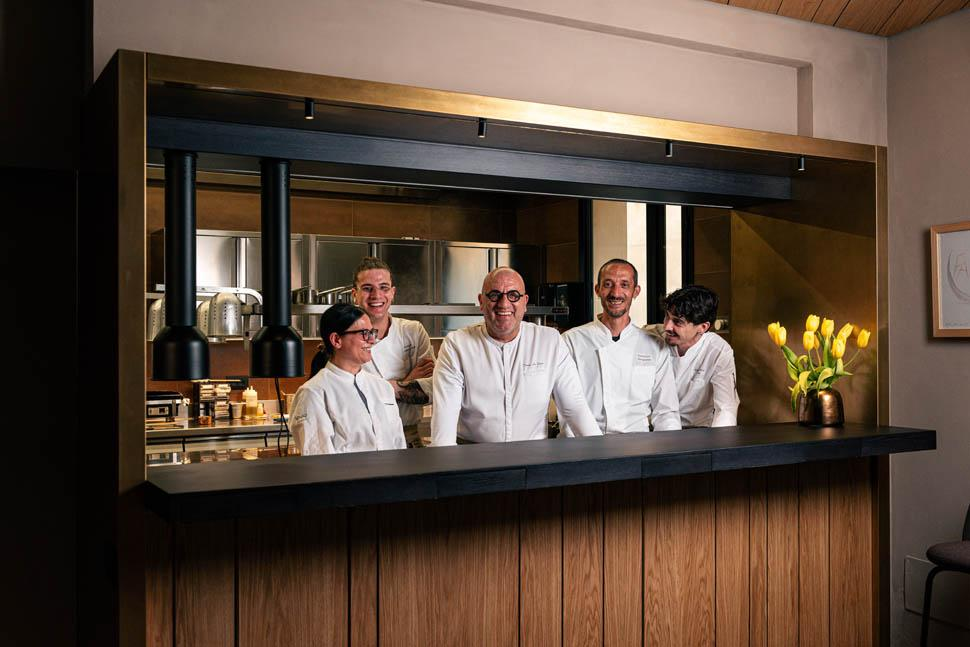
Tony Lo Coco has built his culinary identity around Bagheria, close to Palermo, rather than relocating to one of Sicily’s more obvious luxury destinations.
His restaurant I Pupi remains in the Michelin Guide’s current starred selection. In 2025 it moved into the lower part of Villa Palagonia, the extraordinary eighteenth-century Bagheria residence that gives the restaurant a new historical setting. (Guida Michelin)
Michelin characterises Lo Coco’s cuisine as Sicilian and contemporary, drawing on recipes and ingredients from both the island’s sea and inland territories while interpreting them personally. (Guida Michelin)
His background adds another dimension. Unlike chefs whose careers began through highly structured international brigades, Lo Coco developed much of his identity through family memory, travel and a comparatively independent path into professional cuisine.
That individuality is visible in the restaurant.
The move to Villa Palagonia has also strengthened I Pupi’s relationship with place. Bagheria has its own aristocratic, architectural and culinary history, and dining inside one of its defining historic complexes gives Lo Coco an even more distinctive framework.
He demonstrates that contemporary Sicilian cuisine does not need to separate itself from popular traditions in order to become refined.
Instead, familiar flavours can be reorganised through technique, imagination and personal narrative.
Marco Baglieri Gives Noto a Culinary Language of Its Own
Noto is one of Sicily’s most beautiful architectural destinations, yet Marco Baglieri has helped ensure that the city’s identity is not limited to Baroque façades.
At Crocifisso, Baglieri works with a cuisine closely connected to southeastern Sicily and to family traditions. Michelin currently includes Crocifisso among its selected starred restaurants in Sicily and describes Baglieri’s cooking as a contemporary interpretation of Sicilian flavours rooted particularly in Noto. (Guida Michelin)
Michelin’s profile of Baglieri highlights dishes inspired by local ingredients and family memory, including interpretations involving tuna, sardines, almonds and traditional southeastern preparations. (Guida Michelin)
His significance within this list is slightly different from that of Sultano or Cuttaia.
Baglieri represents a chef whose identity is tightly connected to one city and one regional culinary vocabulary.
Noto’s wider territory is extraordinarily fertile: almonds, citrus, olive oil, seafood from the southeastern coast and ingredients from the countryside all provide a strong base for contemporary cooking.
By maintaining that connection, Baglieri has helped strengthen Noto as a dining destination rather than allowing the city to rely exclusively on its architectural reputation.
It reinforces a wider pattern across Sicily: the best chefs increasingly make travellers stay longer in destinations they may once have treated as short cultural stops.
Sicily’s Strongest Chefs Share a Territory, Not a Single Style
It is tempting to search for one definition of modern Sicilian cuisine.
The island’s best chefs show why that would be a mistake.
Ciccio Sultano approaches Sicily through history and cultural layering. Pino Cuttaia works through memory and reduction to essential flavour. Martina Caruso expresses the agricultural and maritime character of Salina. Massimo Mantarro translates Sicily into the language of grand-hotel fine dining. Giuseppe Raciti represents an increasingly confident Etna generation. Tony Lo Coco connects family memory and contemporary interpretation, while Marco Baglieri gives the Baroque southeast a distinctly local culinary voice.
What they share is not a style but a conviction that territory matters.
This is also why the island’s restaurant scene is so attractive for luxury travellers. One does not need to remain in Palermo or Taormina to encounter ambitious cooking. The Michelin Guide’s current starred selection extends throughout Sicily and into the Aeolian Islands, with two-star restaurants including Duomo and La Madia and a wider group of one-star destinations across the island. (Guida Michelin)
Travellers can therefore structure an itinerary around chefs without creating a conventional restaurant tour.
Ragusa and Noto can be approached through architecture as well as food. Salina becomes an island stay rather than a dinner reservation. Zash connects naturally with Etna wineries and the eastern countryside. Bagheria can extend a Palermo itinerary, while Licata creates an unexpected gastronomic pause between Agrigento and southeastern Sicily.
Sicilian Restaurants Worth Travelling For
The most interesting development, however, is that these chefs no longer seem compelled to prove that Sicilian cuisine can belong within international fine dining.
That argument has already been won.
The stronger question today is how many different versions of Sicily contemporary chefs can reveal.
The answer—from Ragusa’s Baroque streets to a volcanic island in the Aeolian archipelago—is considerably more varied than a single definition of Sicilian cuisine could ever suggest.
Frequently Asked Questions
Who are the best-known chefs in Sicily?
Ciccio Sultano, Pino Cuttaia, Martina Caruso, Massimo Mantarro, Giuseppe Raciti and Tony Lo Coco are among the most established names currently shaping high-end Sicilian cuisine. Marco Baglieri is another important chef closely associated with southeastern Sicily.
Which chefs in Sicily currently have two Michelin stars?
The current Michelin Guide lists Duomo, led by Ciccio Sultano in Ragusa, and La Madia, led by Pino Cuttaia in Licata, among Sicily’s two-Michelin-star restaurants. (Guida Michelin)
Which Sicilian chef is most closely associated with the Aeolian Islands?
Martina Caruso is one of the strongest examples. She leads Signum on Salina, where her cooking is explicitly connected to the island’s ingredients, producers, seasons and culinary memory. (Scent of Salina)
Which chef represents the cuisine of Mount Etna?
There is no single chef who defines Etna cuisine, but Giuseppe Raciti at Zash is a particularly strong contemporary representative. His Michelin-starred cooking develops within the citrus-growing and volcanic landscape below Etna. (Zash)
Is Sicily a major fine-dining destination?
Yes. The current Michelin Guide lists 22 starred restaurants across Sicily, distributed across cities, smaller towns and islands rather than concentrated in one destination. (Guida Michelin)
By Luxury Magazine Editorial Team