Sicily’s celebrated landmarks are reason enough to cross the Mediterranean. Taormina looks towards Mount Etna, Palermo preserves extraordinary Arab-Norman architecture, Agrigento has its temples, and Noto turns Baroque stone into theatre. Yet beyond these familiar destinations lies another Sicily—quieter, more intimate and often considerably more surprising.
It is found in medieval villages built into mountainsides, archaeological landscapes hidden inside limestone canyons, tiny islands without conventional roads and salt lagoons where windmills are reflected in shallow water at sunset. Some places require a detour of only half an hour from established routes; others reward travellers prepared to dedicate an entire day to reaching them.
For luxury travellers, going off the beaten path does not mean abandoning comfort. Quite often, the opposite is true. A private driver makes Sicily’s interior accessible without logistical pressure; an archaeologist can transform a remote ruin into a compelling historical narrative; a yacht opens the least-developed Aeolian islands; and a carefully timed visit can turn an otherwise modest village into one of the most memorable moments of the journey.
Sicily: A Luxury Travel Guide to the Mediterranean’s Most Captivating Island
These 20 places reveal a Sicily that rarely announces itself loudly. Their luxury comes from access, space, authenticity and the increasingly valuable privilege of encountering somewhere that still feels connected to its own rhythm.
Above Taormina, a Quieter Sicily Begins
The first secret landscapes appear surprisingly close to one of Sicily’s most famous destinations.
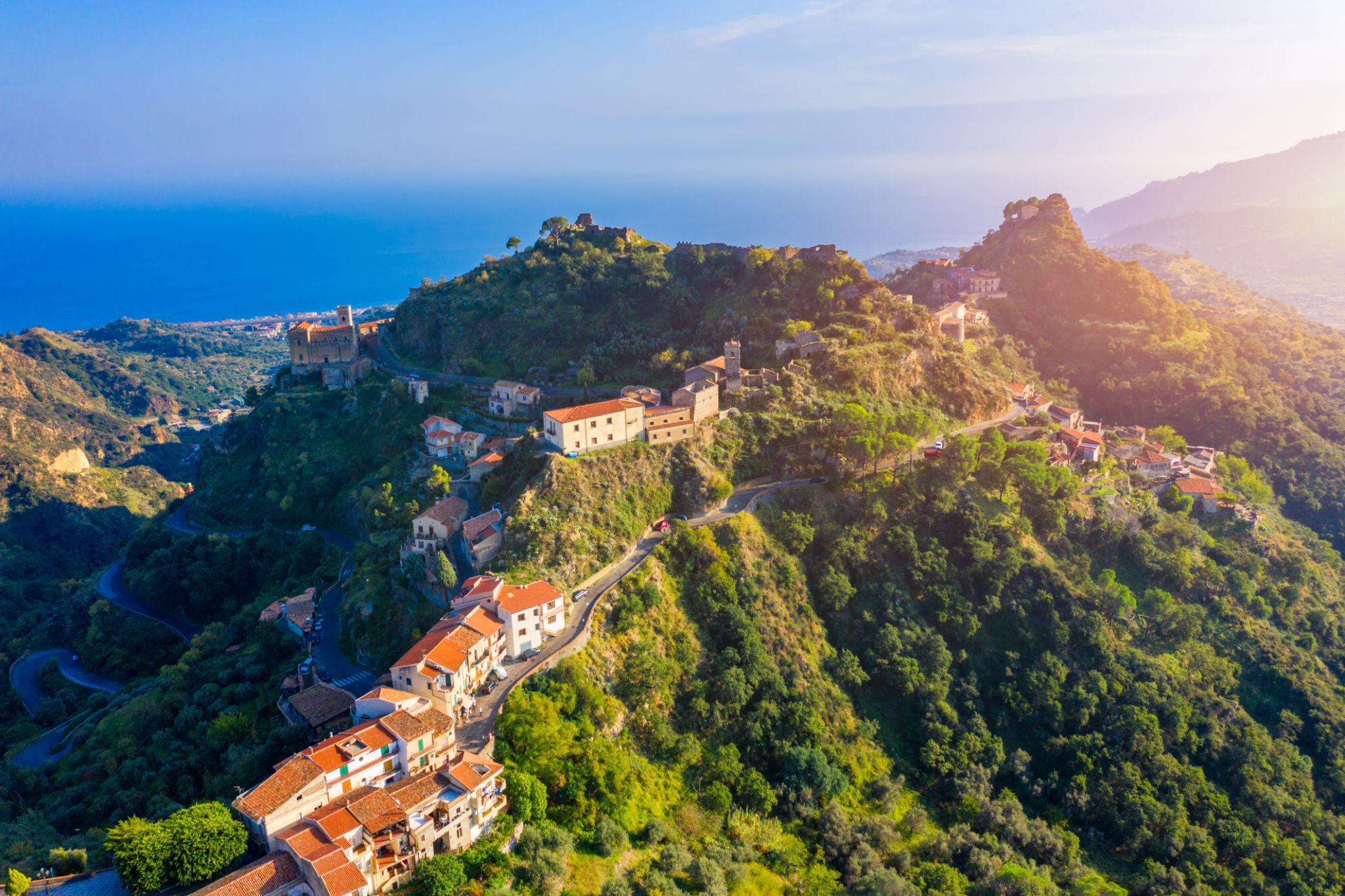
Castelmola rises above Taormina, yet its elevated position gives it an identity of its own. Stone houses, narrow lanes and panoramic terraces look towards Etna and the Ionian coastline from a perspective even higher than Taormina. Italia.it describes the medieval village as an escape from mass tourism, distinguished by its views, traditional cafés and historic atmosphere. (Italia.it)
Taormina: The Enchanted Balcony of Sicily’s Eternal Shores
For travellers staying in Taormina, Castelmola is particularly rewarding early in the morning or towards evening, when it can become an atmospheric extension of the day rather than another sightseeing stop.
Further north, Savoca occupies a hill surrounded by citrus groves and vineyards. Cinema enthusiasts know it as one of the Sicilian locations associated with Francis Ford Coppola’s The Godfather, but reducing the village to its film history misses much of its character. Its medieval fabric, churches, panoramas and quiet lanes deserve exploration independently of Hollywood. (Italia.it)
The third eastern discovery, Castiglione di Sicilia, belongs to a different landscape altogether. Positioned between the Alcantara territory and Etna’s wine country, it makes an excellent cultural addition to a private vineyard itinerary. Rather than returning directly to Taormina after a tasting, travellers can use these smaller Etna towns to understand how volcanic agriculture, stone architecture and village life belong to the same landscape.
Then comes Montalbano Elicona, further north in the Nebrodi territory. Its medieval character and castle make it one of the island’s most evocative inland villages, while its geographical isolation immediately separates it from coastal Sicily. It is officially included among the Sicilian villages recognised by I Borghi più Belli d’Italia. (Italia.it)
Nearby lies one of Sicily’s strangest landscapes: the Argimusco plateau. Massive weathered sandstone formations rise from open countryside, creating natural silhouettes that have inspired numerous interpretations and legends. The appeal is less about a conventional monument than the sensation of standing in a landscape that seems deliberately sculpted.
Together, Castelmola, Savoca, Castiglione di Sicilia, Montalbano Elicona and Argimusco reveal how quickly Sicily changes once the coastal road is left behind.
The Madonie and Central Sicily Preserve Villages Built for Slow Travel
Sicily’s interior remains one of the island’s greatest opportunities for travellers willing to move beyond the established luxury circuit.
Gangi is among its most dramatic hill towns. Houses, churches and palazzi appear to climb almost vertically across the mountainside, creating a dense composition of stone against the Madonie landscape. Italia.it describes the historic centre as a maze and highlights Palazzo Bongiorno, the cathedral, its crypt and the Torre dei Ventimiglia among the places worth exploring. (Italia.it)
Nearby Petralia Soprana offers a gentler expression of the Madonie. Its stone streets, churches and high-altitude views make it ideal for travellers interested in a Sicily defined by mountains rather than sea. The pleasure here is not in finding a sequence of major attractions but in allowing time for the village itself.
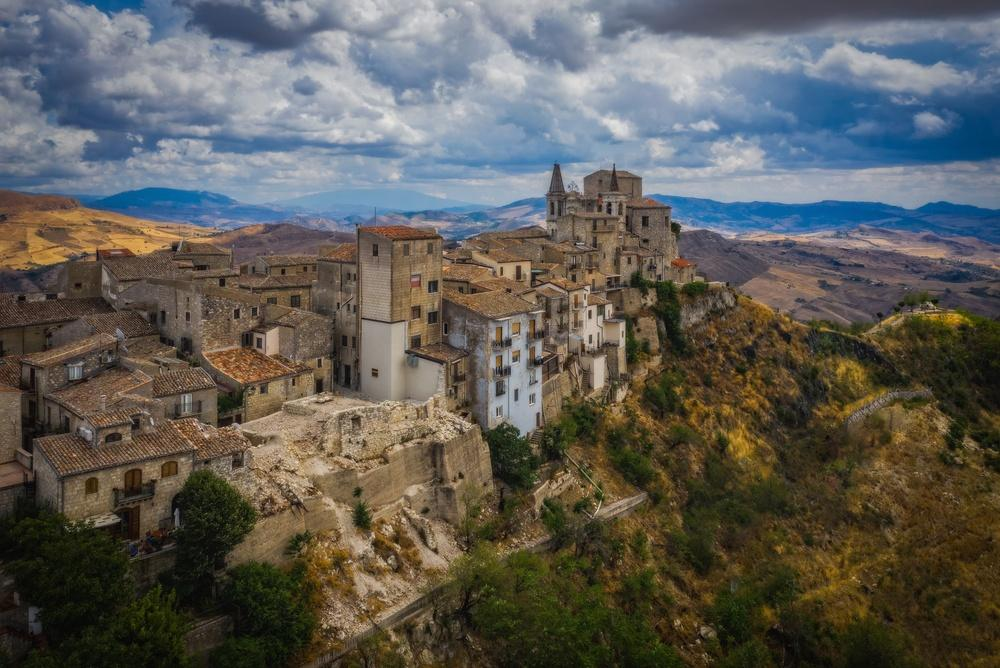
A private itinerary through the Madonie can connect both towns with a country lunch, local producers and walks through the surrounding landscape, creating an alternative to Sicily’s more familiar coastal touring.
Sperlinga, further into the island, is stranger still.
The village is intimately connected to the sandstone on which it stands. Its castle incorporates spaces excavated directly into the rock, while below it survives a rock-cut settlement composed of dozens of caves. Italia.it records at least 50 excavated spaces that once functioned as small homes, some of which have subsequently become part of an ethnographic museum. (Italia.it)
This is precisely the kind of place where a specialist guide adds more value than conventional luxury infrastructure. The architecture becomes understandable only when the relationship between rock, defence and domestic life is explained.
Further south, Sutera provides another compelling interior stop. Built against Monte San Paolino in central Sicily, it belongs to the network of villages officially recognised among Italy’s most beautiful borghi. (Italia.it) Its location makes it particularly interesting as part of a slow overland journey between Palermo, Agrigento and Sicily’s central landscapes.
Gangi, Petralia Soprana, Sperlinga and Sutera are not substitutes for Taormina or Palermo. That is their value. They introduce a Sicily where luxury means private access to landscapes and communities that mass itineraries frequently bypass.
Pantalica and the Hyblaean Mountains Hide Sicily in the Rock
Southeastern Sicily is usually associated with Noto, Ragusa and Modica, yet some of its most extraordinary places are found outside their Baroque centres.
Pantalica is the most important.
The archaeological landscape of Syracuse and the Rocky Necropolis of Pantalica is UNESCO-listed, and its thousands of rock-cut tombs occupy a dramatic system of limestone valleys. Rather than presenting archaeology inside a conventional urban setting, Pantalica combines ancient history with wilderness.
Many visitors see little more than the viewpoints. A more rewarding experience dedicates several hours to the landscape, descending towards the Anapo and Calcinara valleys and exploring areas such as the rock-cut settlements and the Anaktoron. Italia.it specifically recommends allowing enough time to move beyond the belvedere and into the canyon environment. (Italia.it)
Ferla provides a natural companion to Pantalica. The small Baroque village lies close to one of the entrances to the archaeological area and offers the possibility of pairing wilderness with an intimate historic centre rather than immediately returning to a larger city.
Palazzolo Acreide deserves still more time. One of the towns included within the UNESCO-listed Late Baroque Towns of the Val di Noto, it also preserves the archaeological legacy of ancient Akrai. The combination makes Palazzolo particularly rewarding for travellers who want the architectural character of southeastern Sicily without concentrating exclusively on its most famous destinations.
Cava d’Ispica reveals yet another relationship between civilisation and stone. Italia.it describes the long valley as an extraordinary archaeological and natural site containing caves, necropolises, prehistoric and medieval dwellings, rock churches and places of worship carved into the landscape. It remains comparatively removed from Sicily’s busiest circuits. (Italia.it)
Nearby Modica is famous for Baroque architecture and chocolate, but its rock-cut heritage is considerably less familiar. Historic cave houses, underground churches and districts adapted directly to the underlying stone reveal an older city beneath the celebrated façades. (Italia.it)
These five places—Pantalica, Ferla, Palazzolo Acreide, Cava d’Ispica and rock-hewn Modica—form one of the strongest alternative cultural itineraries in Sicily.
Vendicari and Noto Antica Reveal the Wilder Southeast
The Val di Noto is often presented through architecture, yet its surrounding landscape can be equally compelling.
Vendicari Nature Reserve provides the clearest change of pace. Its coastline is characterised by wetlands, Mediterranean vegetation, beaches, rocky stretches and exceptionally clear water, while its ecological importance makes it a destination for birdlife as well as swimming and walking.
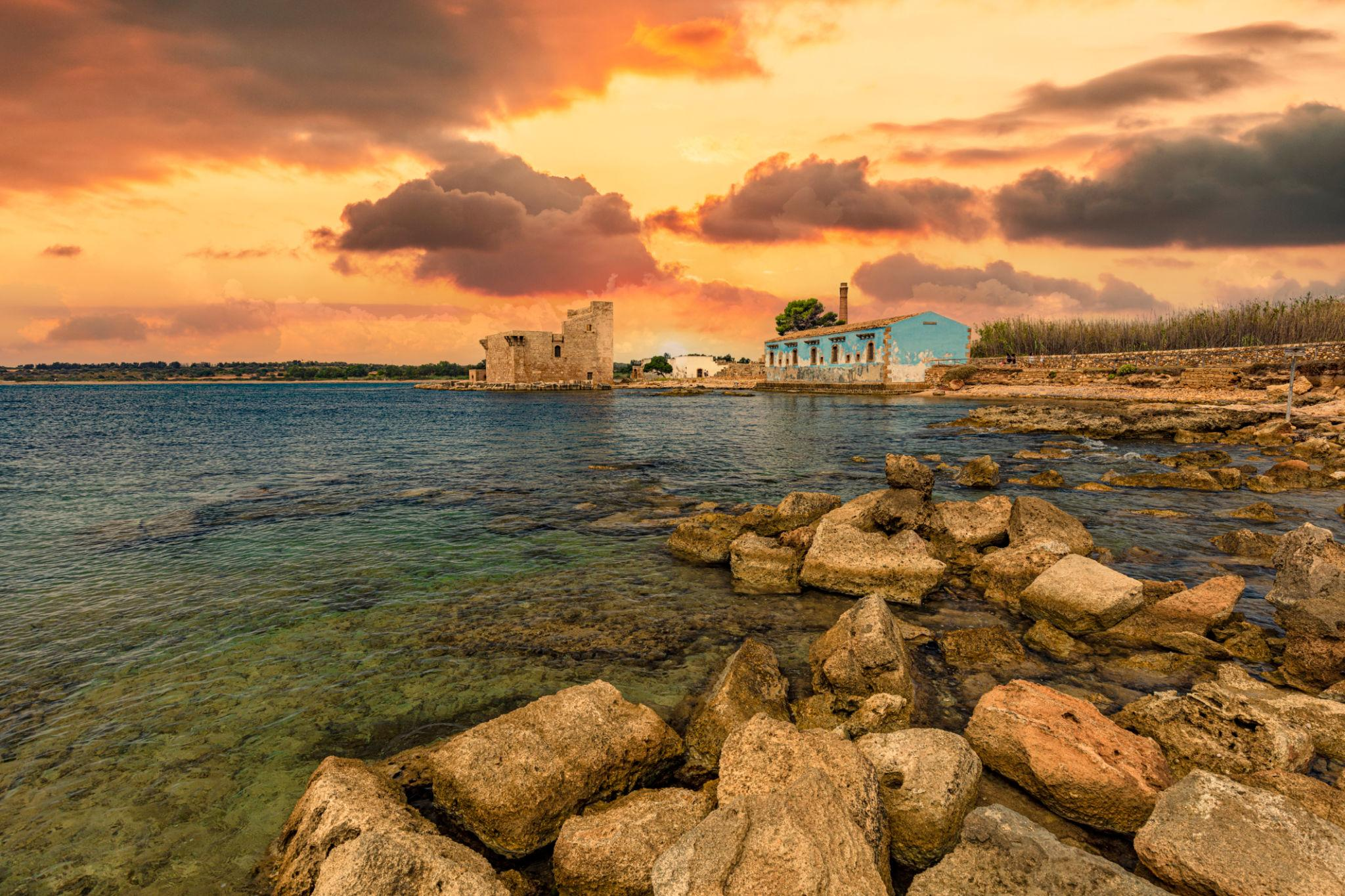
The luxury approach to Vendicari is deliberately minimal. There is no need to manufacture exclusivity through elaborate infrastructure. A private driver, an early arrival, suitable walking shoes and time to remain by the sea are enough.
It works particularly well when combined with a carefully planned lunch elsewhere in the Noto countryside, allowing the day to move between protected nature, agriculture and southeastern Sicilian gastronomy.
Noto Antica offers an entirely different kind of silence.
The original city of Noto was devastated by the catastrophic earthquake of 1693, after which the town was rebuilt at a new site in the extraordinary Baroque form seen today. Exploring the archaeological remains of the older settlement adds historical depth to the polished beauty of modern Noto.
The contrast is striking: one destination represents the triumph of eighteenth-century reconstruction, while the other preserves traces of the city that came before it.
For travellers already familiar with Noto Cathedral and Corso Vittorio Emanuele, Noto Antica provides precisely the kind of second-layer experience that makes a return journey to Sicily worthwhile.
Western Sicily Hides Phoenician History Among Salt and Vineyards
The landscape between Trapani and Marsala contains one of Sicily’s most unusual combinations of archaeology and nature.
Mozia, or ancient Motya, occupies the small island of San Pantaleo inside the Stagnone lagoon. The settlement was an important Phoenician commercial centre linking Mediterranean worlds, and today the island can be reached by a short boat crossing from the historic embarkation point near Marsala. Archaeological remains include fortifications, sacred areas and the famous marble Youth of Motya preserved in the island museum. (Visita Sicilia)
The surrounding Stagnone transforms the archaeological visit into something much more atmospheric. Shallow water, salt pans, islands and historic windmills create a landscape whose character changes throughout the day.
Further north, the Trapani and Paceco salt pans form a protected nature reserve managed by WWF and an important coastal wetland for migratory birds. The history of salt production has shaped the landscape for centuries. (Visita Sicilia)
The ideal time to experience this part of western Sicily is towards sunset, when the water basins begin reflecting the changing sky and the windmills become silhouettes. Visit Sicily specifically identifies the salt-road sunset as one of the area’s defining experiences. (Visita Sicilia)
Inland, Sambuca di Sicilia introduces another dimension. The historic village, also included among Sicily’s recognised Borghi più Belli d’Italia, belongs to a territory of vineyards, hills and layered cultural influences. (Italia.it)
A private western Sicily itinerary can therefore move from Phoenician archaeology on Mozia to salt landscapes and then inland towards wine country without depending on the conventional Palermo–Trapani–beach sequence.
These places demonstrate one of Sicily’s great strengths: extraordinary history is often embedded in landscapes that remain productive and inhabited rather than separated into isolated monuments.
Filicudi and Alicudi Preserve the Most Remote Face of the Aeolian Islands
The final secrets lie offshore. The Aeolian Islands are hardly unknown, but international attention is concentrated heavily on Panarea, Stromboli, Lipari and Salina. Filicudi and Alicudi occupy a different world.
Volcanic Sicily: Embracing the Fire and Beauty of Etna and the Aeolian Islands
Filicudi is volcanic, rugged and dramatically maritime. Its coastline is defined by coves, caves and rock formations, while its comparative remoteness protects an atmosphere that has largely disappeared from more fashionable Mediterranean islands. Visit Sicily describes Filicudi as remaining far from mass tourism and highlights its coastline and the imposing La Canna sea stack among its distinctive natural features. (Visita Sicilia)
A private boat is the natural way to experience it, particularly when incorporated into a longer Aeolian itinerary.
Alicudi takes the idea of remoteness further.

Visit Sicily describes it as the least inhabited and among the smallest of the Aeolian Islands, with a rugged volcanic landscape, no nightlife and no conventional tourist harbour. Movement is fundamentally different from the rest of Sicily: the settlement climbs the island through paths and steps rather than a normal road network. (Visita Sicilia)
This is not luxury in the traditional resort sense, and it should not be presented as such.
The luxury is isolation.
For travellers arriving aboard a private yacht, Alicudi can offer something increasingly difficult to find in the Mediterranean: an island where the absence of infrastructure is part of the experience rather than a problem waiting to be solved.
Visit Sicily now specifically promotes luxury sailing through the Aeolian archipelago, identifying Alicudi and Filicudi for their primitive, unspoiled atmosphere and private-yacht travel as a way of reaching secluded bays and experiencing the islands away from crowds. (Visita Sicilia)
Filicudi and Alicudi complete this alternative portrait of Sicily because they demand a different relationship with time. There is little reason to rush ashore, photograph a landmark and leave. The journey, anchorage, landscape and silence are the experience.
Across all 20 places, that principle remains remarkably consistent. Secret Sicily is not defined simply by low visitor numbers. It is found wherever the island reveals something that cannot be understood through a hurried itinerary: a castle carved into sandstone, prehistoric tombs hidden inside a canyon, a Phoenician island surrounded by salt water, a mountain village at dusk or an Aeolian shore reached only after leaving the familiar Mediterranean behind.
Frequently Asked Questions
Which hidden places in Sicily are most worth visiting on a first trip?
Travellers combining famous destinations with less familiar Sicily should consider Castelmola or Savoca from Taormina, Pantalica and Palazzolo Acreide while exploring the southeast, Mozia and the salt pans in western Sicily, and at least one Madonie village such as Gangi or Petralia Soprana. These can be incorporated into a first itinerary without making the journey excessively complicated.
Which part of Sicily is best for getting off the beaten path?
Central Sicily and the mountainous interior offer the greatest concentration of places removed from mainstream international tourism. The Madonie, Nebrodi and Enna territories are particularly rewarding. Southeastern Sicily is another strong choice once travellers move beyond Noto, Ragusa and Syracuse into Pantalica, Ferla and Cava d’Ispica.
Can secret Sicily still be experienced as a luxury trip?
Yes. Luxury in these destinations is better expressed through private transportation, specialist guides, excellent rural dining, boutique accommodation and carefully paced itineraries than through conventional five-star infrastructure. In remote islands such as Alicudi, the absence of resort-style development is precisely part of the appeal.
How many days are needed to explore Sicily beyond the main tourist destinations?
Ten to fourteen days allows several lesser-known destinations to be incorporated into a broader Sicily itinerary without excessive driving. Travellers specifically interested in the island’s interior, archaeological landscapes and remote islands could easily dedicate three weeks to the journey.
Which remote Sicilian destinations are best reached privately?
A private driver is particularly valuable for villages such as Gangi, Petralia Soprana, Sperlinga and Montalbano Elicona, as well as archaeological landscapes where public transport is impractical. In the Aeolian Islands, a private yacht offers the greatest flexibility for reaching Filicudi and Alicudi and adapting the itinerary to sea and weather conditions. (Visita Sicilia)
By Luxury Magazine Editorial Team