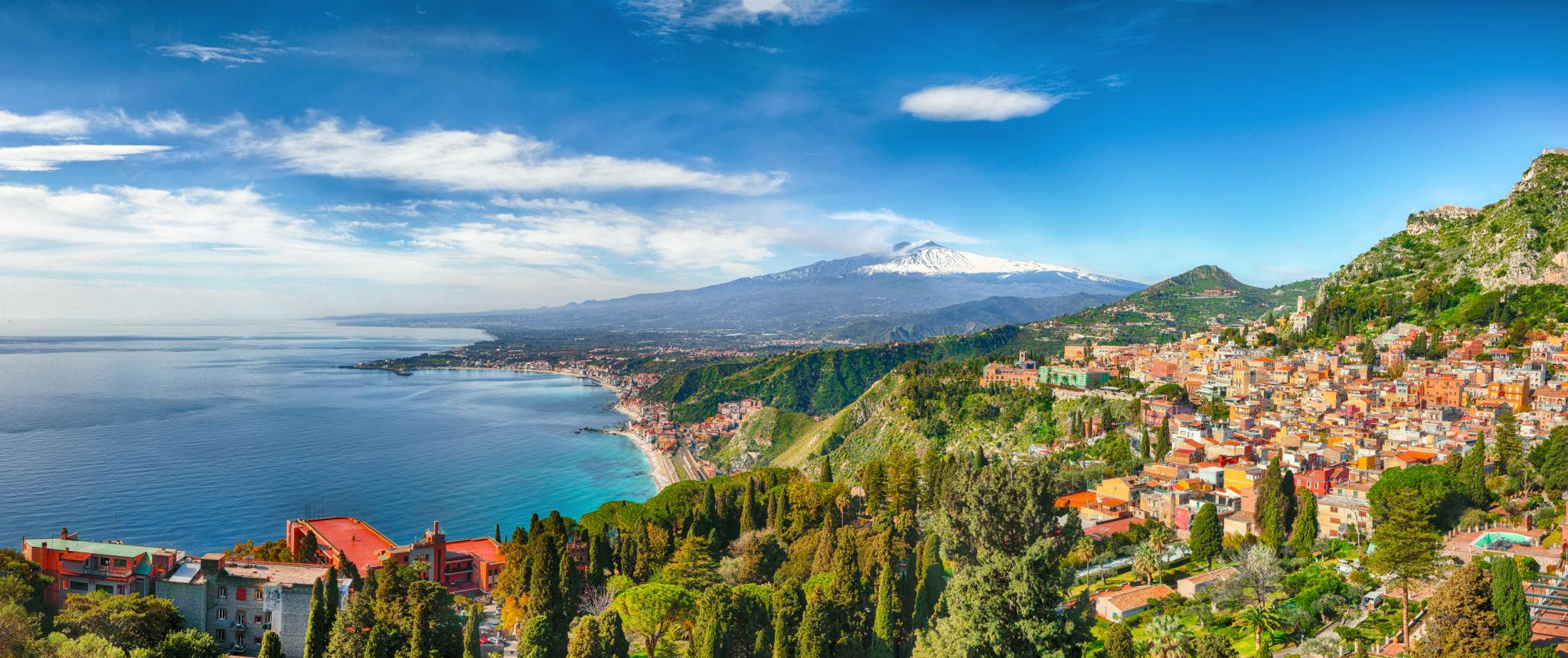
Sicily resists the idea of a single identity. It is Mediterranean yet unmistakably its own; Italian yet shaped by Greek, Roman, Arab, Norman, Spanish and Byzantine worlds. Volcanoes rise above vineyards, Greek temples stand among olive trees, Baroque cities glow in pale limestone, and fishing villages look towards islands created by the same geological forces that continue to shape Mount Etna.
For the luxury traveller, this complexity is Sicily’s greatest asset. The island does not depend on a single resort strip or one celebrated town. Instead, it rewards movement: from the terraces of Taormina to Etna’s volcanic vineyards, from Palermo’s palaces to Agrigento’s ancient temples, and from the architectural harmony of Noto to the elemental landscapes of the Aeolian Islands.
Luxury here is equally diverse. It can mean waking inside a former monastery overlooking the Ionian Sea, crossing the Aeolian archipelago aboard a private yacht, arranging a vineyard lunch on Etna, exploring Palermo with an art historian or spending several days beside a protected nature reserve with little reason to leave.
The result is an island that can support an ambitious journey without losing its sense of place. Sicily is not simply a destination to see. At its best, it is a destination to travel through.
Taormina Brings Together Sicily’s Sea, History and Grand-Hotel Tradition
For many international travellers, Taormina is the most natural introduction to Sicily. Its extraordinary position above the Ionian Sea brings together three defining elements of the island within a single panorama: Mediterranean coastline, ancient history and Mount Etna.
The Ancient Theatre remains its most recognisable monument, but Taormina’s appeal extends through the lanes around Corso Umberto, Piazza IX Aprile, historic gardens and the steep descent towards Mazzarò and Isola Bella.

At the highest end of its hospitality scene, San Domenico Palace, Taormina, A Four Seasons Hotel occupies a former fourteenth-century Dominican convent on a clifftop above the Ionian Sea. The property currently has three Michelin Keys and combines 111 rooms and suites with an infinity pool, spa, restaurants and gardens. (Four Seasons)
Its importance to a luxury Sicily itinerary goes beyond accommodation. The hotel currently arranges private boat journeys around Isola Bella and Grotta Azzurra, guided explorations of Taormina, 4×4 Etna excursions, winery experiences, helicopter flights and even stargazing on the volcano accompanied by a local astrophysicist. (Four Seasons)
Taormina works best when travellers resist the temptation to use it purely as a sightseeing base. Several nights allow the destination to change pace: the Ancient Theatre early in the day, the coast in the afternoon, Etna on a separate excursion and an evening left free for dinner and a walk through the historic centre.
This combination of cultural density and ease is what makes Taormina unusual. Within a relatively compact stay, Sicily can already be experienced from mountain, town and sea.
Mount Etna Reveals Sicily’s Volcanic Soul
Etna provides the dramatic counterpoint to Taormina’s elegance.
The transition from the coast to the volcano is one of the most compelling journeys in eastern Sicily. Vegetation changes with altitude, villages give way to forests and lava fields, and the Mediterranean landscape becomes increasingly austere as the mountain takes over.
Yet the greatest luxury of an Etna journey is not necessarily reaching the highest accessible elevation. It is having enough time to understand how the volcano has shaped the life around it.

Wine is central to that experience. Vineyards on Etna’s slopes grow in volcanic soils at varying elevations and exposures, with native grapes such as Nerello Mascalese and Carricante forming an important part of the region’s identity. A privately arranged day can move from old lava flows and geological landscapes to a winery lunch, allowing the relationship between volcano and agriculture to become tangible.
For an even more unusual perspective, San Domenico Palace currently offers a helicopter experience that flies over Taormina and Etna before continuing to a local winery for Sicilian sparkling wine and dinner. (Four Seasons)
Etna should therefore be treated as more than a day-trip attraction. Travellers particularly interested in wine may want to spend a night or two around the volcano itself, where the atmosphere after visitors have returned to the coast is markedly different.
This is the Sicily of black stone walls, vineyards, chestnut woods, rural estates and villages living in the shadow of an active volcano. It provides one of the island’s strongest expressions of terroir.
Palermo Reveals Sicily at Its Most Layered
If Taormina seduces immediately, Palermo rewards curiosity.
The Sicilian capital can appear chaotic beside the visual order of Noto or the polished atmosphere of Taormina, but its complexity is precisely what makes it essential. Markets, aristocratic palaces, churches, theatres and monumental architecture coexist within a city shaped by centuries of cultural exchange.
Its Arab-Norman heritage is particularly important. UNESCO’s serial World Heritage property encompasses nine structures in Palermo, Cefalù and Monreale, including the Royal Palace and Palatine Chapel, Palermo Cathedral and the cathedrals of Cefalù and Monreale. UNESCO describes them as an exceptional synthesis of Western, Islamic and Byzantine cultural traditions. (UNESCO World Heritage Centre)

A luxury visit should use private access and expert knowledge to make sense of that density rather than simply adding more monuments to the schedule. A specialist guide can connect the mosaics of the Palatine Chapel to Palermo’s wider multicultural history, while a food specialist can reveal another layer through markets, pastry traditions and street food.
The city’s grand-hotel heritage is represented by Villa Igiea, the historic Rocco Forte property overlooking the Gulf of Palermo. Its setting away from the densest part of the centre provides an effective contrast to days spent exploring the city.
Palermo is also the natural starting point for Monreale and Cefalù, but it deserves time in its own right. Teatro Massimo, private palazzi, contemporary galleries and long dinners give the city an after-dark dimension that disappears on a rushed day visit.
For travellers interested in Sicily’s cultural identity rather than only its landscapes, Palermo is indispensable.
Noto and Ortigia Define the Elegance of Southeastern Sicily
Southeastern Sicily changes the visual language of the journey.
Here the volcanic drama of Etna gives way to pale Baroque architecture, agricultural estates, almond and citrus landscapes and historic towns whose beauty is often best appreciated in the late-afternoon light.
Noto is the most immediately theatrical. Its churches and palazzi create one of Sicily’s defining Baroque ensembles, but a luxury itinerary should move beyond simply walking the main street. Private architectural tours, artist encounters, country estates and carefully chosen restaurants can connect the city to the creative and agricultural culture of the Val di Noto.

San Domenico Palace currently offers a private “Behind the Scenes of Noto” experience involving an encounter with Sicilian artist Sergio Fiorentino in his atelier, followed by a private exploration of the city. (Four Seasons)
Syracuse and Ortigia provide the natural complement.
Ortigia’s position on the water creates an entirely different atmosphere from Noto. Ancient foundations, Baroque façades, narrow streets, piazzas and the sea coexist within a compact historic centre that rewards walking rather than constant transfers.
The wider Syracuse area adds another layer through its Greek archaeological heritage. Together, Syracuse, Ortigia and Noto can easily justify several nights rather than a single excursion from Taormina.
That slower approach is particularly important in southeastern Sicily. Its luxury lies in rhythm: an archaeological visit in the morning, a long lunch, several hours in Ortigia, a boat around the coastline or an evening in Noto once the façades begin to glow.
Agrigento Combines Ancient Greece with Contemporary Wellness
Western and southern Sicily deserve equal attention, particularly for travellers interested in archaeology and landscape.
Agrigento’s Valley of the Temples is one of the great surviving expressions of the ancient Greek Mediterranean. Founded as a Greek colony in the sixth century BCE, ancient Akragas became one of the region’s leading cities. UNESCO describes its great sequence of Doric temples as one of the outstanding monuments of Greek art and culture. (UNESCO World Heritage Centre)
The site deserves more than a hurried stop between hotels. A specialist archaeological guide and carefully chosen timing—particularly towards the softer light of late afternoon—can turn the landscape into one of the defining cultural experiences of the trip.
The surrounding coast also provides some of Sicily’s strongest contemporary resort experiences.
Verdura Resort occupies an expansive setting on the southwest coast and combines resort hospitality with golf, wellness and curated Sicilian experiences. Its location makes it particularly useful for travellers wanting to balance archaeology and cultural touring with several slower days beside the Mediterranean.
Further along the Agrigento coast, ADLER Spa Resort SICILIA offers a more wellness-focused interpretation of luxury. The operating resort overlooks the coast near the Torre Salsa Nature Reserve and currently has a 3,200-square-metre spa with 13 treatment rooms, heated pools, Finnish sauna, steam bath and rooftop thalassotherapy pool. (ADLER Sicilia)
This part of Sicily makes an excellent midpoint in a longer itinerary. After several days of cities, archaeological sites and road travel, slowing down beside the sea gives the journey room to breathe.
The Aeolian Islands Are Best Experienced from the Sea
North of Sicily, the Aeolian Islands introduce another landscape entirely.
Lipari, Vulcano, Salina, Panarea, Stromboli, Filicudi and Alicudi form a volcanic archipelago recognised by UNESCO for its exceptional record of volcanic island-building and ongoing geological phenomena. The islands are so important to volcanology that Vulcano and Stromboli gave their names to the Vulcanian and Strombolian eruption types. (UNESCO World Heritage Centre)
For the luxury traveller, a private yacht is not merely an indulgence here; it is one of the most coherent ways to understand the archipelago.
Rather than attempting to visit every island, a more considered itinerary selects two or three. Panarea brings whitewashed architecture, intimate scale and a sophisticated summer atmosphere. Salina offers a greener landscape shaped by vineyards, capers and Malvasia. Stromboli provides the extraordinary spectacle of an active volcanic island rising almost directly from the sea.
The boat itself allows the landscape to dictate the rhythm. Mornings can begin at anchor, lunch can be taken ashore, and the afternoon can follow volcanic cliffs and coves before an evening arrival at another island.
Weather and volcanic conditions inevitably matter, so flexibility should be built into the itinerary. Access to volcanic areas should always follow current official restrictions and qualified local guidance.
That uncertainty is part of the authenticity of the Aeolians. These are not manicured resort islands. Their luxury comes from space, natural drama, maritime freedom and the privilege of experiencing landscapes that remain visibly alive.
Sicily Rewards Travellers Who Give the Island Time
The most important decision in planning luxury travel in Sicily is not choosing the most expensive hotel. It is deciding how much of the island to attempt.
A seven-night trip is better concentrated around one or two regions. Taormina, Etna and the southeast work particularly well together; Palermo and western Sicily form another natural journey. Trying to include Palermo, Taormina, Noto, Agrigento and the Aeolian Islands within a single week turns luxury travel into logistics.
Ten to fourteen nights provide considerably more freedom. A journey might begin with three nights in Taormina, continue through Etna and southeastern Sicily, move west towards Agrigento for archaeology and wellness, and finish in Palermo. The Aeolian Islands are best added when there is sufficient time to dedicate several days to the sea.
Private drivers are valuable for longer overland sectors, particularly when wine estates, archaeological sites and rural destinations are involved. Helicopters can be useful selectively, but Sicily should not be crossed so efficiently that the landscape disappears from the experience.
Season matters as well. Late spring and early autumn are particularly appealing for travellers combining cities, archaeology, vineyards and the coast. High summer brings the strongest beach and yachting atmosphere but also greater heat and demand. Outside peak season, Sicily becomes quieter and more cultural, although seasonal hotels, restaurants and maritime services should always be checked for the intended dates.
Ultimately, the most successful luxury itinerary leaves space between reservations. Sicily is an island where an unexpected vineyard lunch, a quiet coastal road or an evening piazza can become as memorable as the experience that was booked months in advance.
Frequently Asked Questions
Which part of Sicily is best for luxury travel?
Taormina offers the most concentrated combination of grand hotels, sea views, fine dining and access to Mount Etna. Palermo is stronger for urban culture and history, while Noto and Ortigia suit travellers seeking architecture, gastronomy and a slower southeastern itinerary. The Agrigento coast is particularly compelling for resort wellness, and the Aeolian Islands are ideal for private-yacht travel.
How many days are ideal for a luxury trip to Sicily?
Ten to fourteen nights is ideal for a first journey covering several regions without excessive rushing. With seven nights, it is better to concentrate on eastern Sicily or one other defined region rather than attempting to cross the entire island.
What is the best time of year for a luxury holiday in Sicily?
May, June, September and early October are particularly attractive for combining culture, wine, outdoor experiences and the coast. July and August suit travellers prioritising beach clubs, yachts and summer atmosphere, although they are generally hotter and busier.
Which luxury hotels stand out in Sicily?
San Domenico Palace in Taormina is one of the island’s defining grand hotels, while Villa Igiea provides a historic luxury base in Palermo. Verdura Resort is particularly suited to a longer resort stay on the southwest coast, and ADLER Spa Resort SICILIA is a strong choice for travellers prioritising wellness and nature. All four are currently operating. (Four Seasons)
Is Sicily suitable for private yacht travel?
Yes. The Aeolian Islands are particularly well suited to a multi-day private yacht itinerary, while Taormina’s Ionian coastline works well for shorter charters around Isola Bella and neighbouring bays. Four Seasons currently offers private luxury boat experiences from Taormina, including half-day coastal excursions. (Four Seasons)
By Luxury Magazine Editorial Team