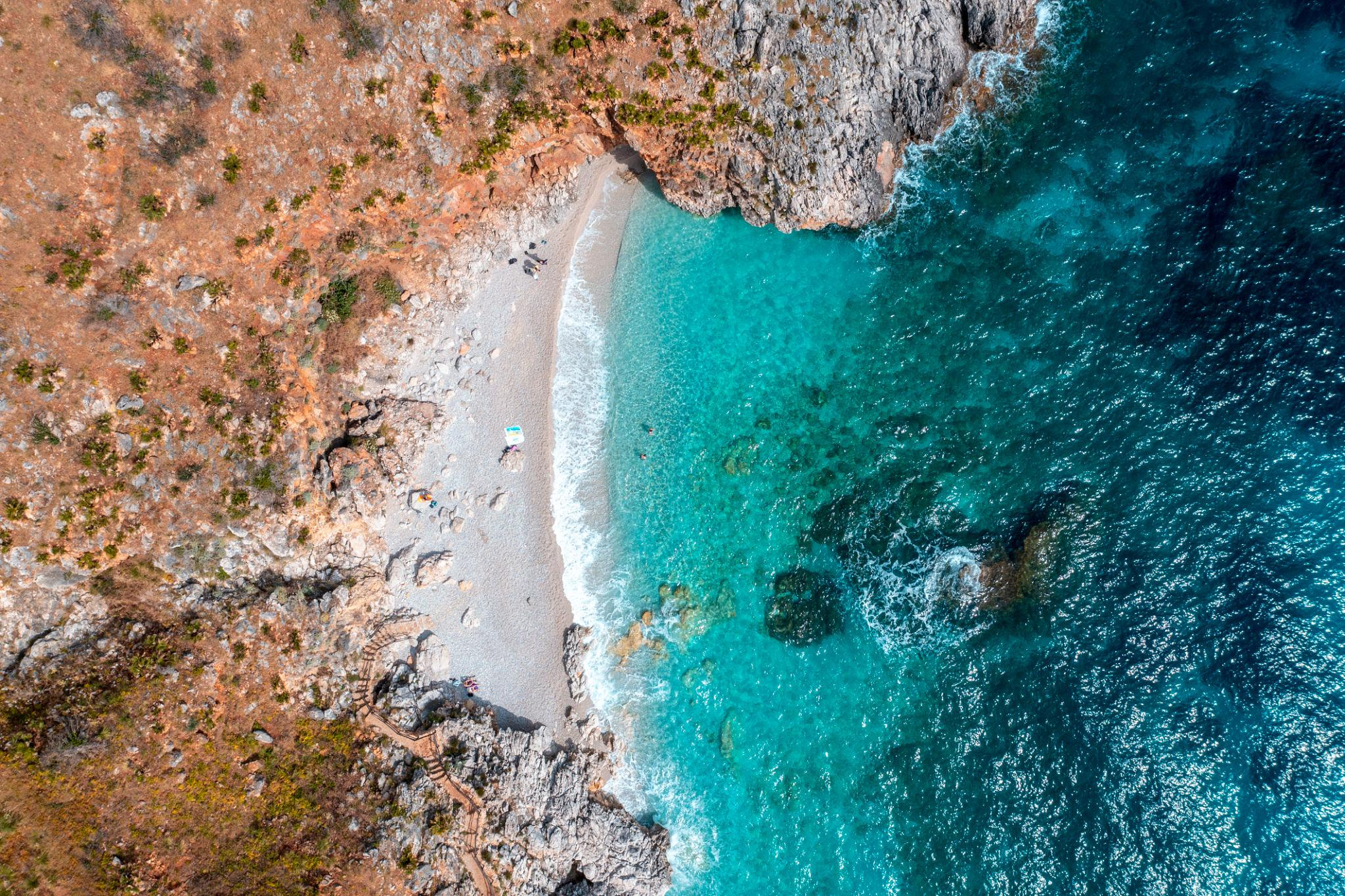
Sicily’s coastline is too varied to be reduced to a single image of Mediterranean perfection. Around Taormina, the sea meets volcanic rock and steep green slopes. In western Sicily, long pale beaches give way to limestone cliffs and hidden coves. The Egadi Islands offer almost unreal shades of turquoise, while Lampedusa feels closer to North Africa than mainland Italy. In the southeast, protected reserves preserve beaches where Mediterranean scrub reaches almost to the water.
This diversity is precisely what makes the island so compelling for travellers who choose a destination partly for its sea.
The most beautiful beaches in Sicily are not necessarily the easiest to reach or the most heavily serviced. Some are best approached on foot through a nature reserve, others from a private boat, and a few are most memorable when combined with a historic town, a long coastal lunch or several nights on an island.
What unites them is a strong sense of place. These are beaches that could not easily be mistaken for anywhere else.
Isola Bella Gives Taormina Its Most Iconic Coastal Landscape
Few Sicilian beaches are as instantly recognisable as Isola Bella, directly below Taormina.
The small rocky island is connected to the mainland by a narrow strip of pebbles whose appearance changes with sea conditions. Dense vegetation covers the islet, while steep slopes rise behind the bay towards Taormina’s historic centre. Visit Sicily describes the beach as gravelly and stony, with calm Ionian waters surrounding one of the town’s defining natural landmarks. (Visit Sicily)
Its beauty comes from composition rather than conventional softness. Isola Bella is not a broad sandy beach designed for long barefoot walks; it is a compact, theatrical bay where rock, vegetation and clear water create a distinctly eastern Sicilian landscape.
For luxury travellers, the best way to experience it is often to divide the day between shore and sea. Swimming early in the morning reveals the bay before its busiest hours, while a small private boat later provides a better sense of how dramatically Taormina rises above the coastline.
This is also one of those beaches that gains meaning from the destination surrounding it. The Ancient Theatre, Corso Umberto and the terraces of upper Taormina remain only a short distance away, making it possible to move between culture and coast within the same day.
Luxury Magazine’s guide to Taormina and the Ionian coastline offers the wider context for travellers planning several days around Isola Bella rather than treating it as a single beach stop. (Luxury Magazine)
San Vito Lo Capo Combines White Sand with Western Sicilian Drama
On Sicily’s northwestern coast, San Vito Lo Capo offers an almost opposite beach experience.
Here the attraction is scale and softness: a broad crescent of pale sand, transparent water and the dramatic mass of Monte Monaco rising behind the town. Visit Sicily places San Vito Lo Capo among the island’s most celebrated beaches and highlights the clear seabed and striking blue tones of this stretch of coast. (Visit Sicily)
San Vito has become one of Sicily’s best-known seaside destinations for good reason. The water is generally shallow close to shore, the sand makes it suitable for long beach days, and the town sits directly behind the waterfront, allowing lunch or an evening walk without complicated transfers.
Its popularity, however, changes the experience in high summer.
Travellers seeking tranquillity should consider early morning, late afternoon or shoulder-season stays rather than arriving only for the busiest central hours of July and August. A longer stay also makes it easier to combine the main beach with the more rugged coastline towards the Zingaro Reserve.
That contrast is important. San Vito is polished and accessible; only a short distance away, western Sicily becomes far wilder.
The Zingaro Reserve Protects Sicily’s Most Beautiful Secret Coves
The Riserva Naturale dello Zingaro, extending between Scopello and San Vito Lo Capo, contains some of Sicily’s most rewarding coves precisely because development has been kept away from the shoreline.
There is no coastal road through the reserve. Visitors move on foot along paths bordered by Mediterranean vegetation, descending towards small bays such as Cala Tonnarella dell’Uzzo, Cala Marinella, Cala della Disa and Cala Capreria. Visit Sicily describes a roughly seven-kilometre coastal route with an almost complete absence of modern construction and waters ranging from emerald to deep cobalt. (Visit Sicily)
The result feels radically different from a serviced beach resort.
There are no rows of luxury cabanas defining the experience. The luxury is space, clear water, silence and the knowledge that reaching the beach requires some effort.
This makes planning important. Footwear, water, sun protection and realistic expectations about walking distances matter, particularly in hot weather. Travellers wanting the coastline without the hike can also explore parts of this area from the sea, where the coves appear as small interruptions in an otherwise rugged shoreline.
The Zingaro is one of the clearest examples of why Sicily’s best beaches should not be judged only by sand quality. Landscape, biodiversity and the absence of development can be more memorable than conventional comfort.
Cala Rossa on Favignana Has Some of Sicily’s Most Extraordinary Water
Among the Egadi Islands, Cala Rossa on Favignana is famous less for a traditional sandy beach than for the extraordinary colour and transparency of its sea.
Limestone cliffs and former quarry landscapes frame water that can shift between turquoise, aquamarine and deep blue depending on depth and light. The broader Egadi archipelago forms part of one of Sicily’s major marine environments, where swimming, snorkelling and boat travel are central to the experience. (Visit Sicily)

Cala Rossa is especially beautiful from the water.
A private boat allows travellers to move between Favignana’s coves rather than treating the island as a single beach destination. It also provides flexibility when particular bays become busy or when wind conditions make another side of the island more comfortable.
On land, access to Cala Rossa involves rocky terrain, so this is not the ideal choice for visitors seeking effortless resort-style bathing. But that is part of its identity. Favignana’s greatest appeal lies in the relationship between limestone, sea and open horizon rather than manicured infrastructure.
A few days in the Egadi Islands make more sense than a rushed excursion. Cala Rossa can then be experienced early, followed by smaller coves, cycling or a slow lunch in town before returning to the water later in the day.
For readers considering Sicily primarily from the sea, Luxury Magazine’s feature on Sicily’s most beautiful coastlines by yacht is the natural extension of this part of the journey.
Calamosche Preserves the Quiet Beauty of Southeastern Sicily
Near Noto, Calamosche sits inside the Vendicari Nature Reserve and offers one of southeastern Sicily’s most balanced combinations of sand, clear water and protected landscape.
Visit Sicily describes it as a roughly 200-metre cove enclosed by two rocky promontories, surrounded by Mediterranean scrub and known for generally calm, transparent water. (Visit Sicily)

The absence of heavy construction is fundamental to its character.
Calamosche is reached through the reserve rather than directly from a seafront road, so the transition from dry Mediterranean vegetation to sheltered bay becomes part of the experience. The surrounding Vendicari landscape also includes wetlands, migratory bird habitats, archaeological remains and stretches of wilder coastline. (Visit Sicily)
This makes the beach especially suitable for travellers exploring the Baroque southeast.
A morning in Noto can be followed by an afternoon in Vendicari, while Marzamemi and other coastal villages provide natural stops later in the day. The combination of architecture, countryside and beach creates one of Sicily’s most complete regional itineraries.
Calamosche should be approached as a protected natural setting rather than a conventional beach club destination. Carrying what is needed, respecting designated paths and avoiding expectations of extensive services allows the experience to remain what makes it special in the first place.
Scala dei Turchi Is More Landscape than Beach
Some Sicilian beaches are memorable because of the water. Scala dei Turchi, near Realmonte and Porto Empedocle, is memorable because of the rock.
The famous white cliff is formed from marl, a soft calcareous and clay-rich material shaped by wind and sea into smooth terraces. Against that brilliant white surface, the Mediterranean appears unusually saturated in blue and turquoise. (Visit Sicily)
This is one of Sicily’s great coastal icons, but it should not be understood simply as a place for sunbathing.
The cliff is environmentally fragile, and visitors should respect all current access rules and protection measures. Visit Sicily explicitly warns against removing marl or treating it as a cosmetic substance, underlining the need to preserve the formation itself. (Visit Sicily)
From a luxury-travel perspective, seeing Scala dei Turchi from the water can be more compelling than trying to occupy the landscape physically. Offshore, its sculptural shape becomes clearer, particularly during late-afternoon light when the white stone takes on warmer tones.
Its location also makes it easy to connect with Agrigento and the Valley of the Temples, creating one of Sicily’s most dramatic pairings of archaeology and coastline.
Spiaggia dei Conigli Makes Lampedusa Worth the Journey South
No serious selection of Sicily’s most beautiful beaches can ignore Spiaggia dei Conigli on Lampedusa.
The beach sits within the protected Isola di Lampedusa nature reserve and is known for exceptionally clear, shallow water and a pale sandy shore facing the small Isola dei Conigli. The surrounding area is also an important nesting habitat for loggerhead sea turtles, Caretta caretta. (Visit Sicily)
What makes the experience remarkable is how different Lampedusa feels from the rest of Sicily.
The island lies far south in the Mediterranean, and the colours, arid terrain and clarity of the water give the coastline a distinctly North African character. The official tourism authority itself describes the area as one of Sicily’s exceptional natural beach environments. (Visit Sicily)
Protection is central to the experience. In summer, access to Spiaggia dei Conigli is regulated through limited-entry time slots and requires advance booking during controlled periods. (Visit Sicily)
That makes this one of the beaches where planning ahead is essential.
Lampedusa should also not be reduced to a single famous bay. Travellers who make the journey should stay long enough to explore the island by boat and discover smaller coves accessible from the sea. In that context, Spiaggia dei Conigli becomes the highlight of a wider marine journey rather than an isolated photograph.
Sicily’s Most Beautiful Beaches Reward Different Kinds of Travellers
Choosing one “best” Sicilian beach is almost impossible because the coast offers fundamentally different experiences.
For classic white sand and easy swimming, San Vito Lo Capo is difficult to surpass. For iconic scenery, Isola Bella and Scala dei Turchi are stronger. Travellers who value wilderness should prioritise Zingaro and Vendicari, while Cala Rossa is one of the most compelling choices for crystalline island water. Spiaggia dei Conigli delivers the most remote sense of escape.
There are also many beaches outside this shortlist that deserve attention. Visit Sicily highlights Torre Salsa for its long, comparatively wild southern coastline; Sampieri for a sandy shore framed by dunes, pine trees and industrial archaeology; Mondello for its combination of pale sand, turquoise water and Liberty-era architecture; and Capo d’Orlando for its extensive Tyrrhenian beach facing the Aeolian Islands. (Visit Sicily)
That breadth is one reason a beach-focused Sicily itinerary works better when divided into regions rather than attempting to circle the entire island quickly.
A western journey can combine San Vito Lo Capo, Zingaro, Scopello and Favignana. An eastern and southeastern route can bring together Taormina, Isola Bella, Vendicari and Calamosche. A southern itinerary can connect Agrigento with Scala dei Turchi and Torre Salsa, while Lampedusa deserves its own separate stay.
For travellers who prefer comfort and service to untouched coves, Luxury Magazine’s guide to the best beach clubs in Sicily provides a complementary perspective, moving from natural beaches to cabanas, restaurants and polished seaside hospitality. (Luxury Magazine)
The important point is not to turn Sicily into a checklist of famous beaches.
The island rewards a slower approach. Staying long enough to see a bay early in the morning, from the water and again in softer evening light can completely change the experience. Wind direction and sea conditions also matter, particularly on islands and exposed coastlines, so flexibility is often more valuable than rigid scheduling.
Sicily’s coastline is at its best when the landscape dictates the day.
Frequently Asked Questions
What is the most beautiful beach in Sicily?
There is no objective single winner, but Spiaggia dei Conigli, Cala Rossa, San Vito Lo Capo, Isola Bella and Calamosche are among the island’s most distinctive beaches. Each offers a very different landscape, from pale sand and shallow water to volcanic rock and protected Mediterranean coves. (Visit Sicily)
Which beach in Sicily has the clearest water?
Cala Rossa on Favignana and Spiaggia dei Conigli on Lampedusa are particularly famous for exceptionally transparent water. Many coves within the Zingaro and Vendicari reserves also offer excellent clarity, depending on weather and sea conditions.
What are the best beaches near Taormina?
Isola Bella is the most iconic choice, while Mazzarò and the wider Taormina coastline provide additional swimming areas and serviced beach options. Travellers wanting more comfort can also choose one of the luxury beach clubs along this stretch of coast. (Visit Sicily)
Which Sicilian beaches are best for a quieter experience?
Calamosche, parts of the Zingaro Reserve and Torre Salsa are strong options for travellers who value natural surroundings over extensive facilities. Visiting early in the day or outside peak July–August periods generally improves the sense of tranquillity.
Does Spiaggia dei Conigli require a reservation?
During the controlled summer period, yes. Current official information states that access is regulated by time slots with limited numbers in order to protect the reserve and sea-turtle nesting habitat. Travellers should verify the current booking arrangements before visiting. (Visit Sicily)
By Luxury Magazine Editorial Team