Suspended between Mount Etna and the Ionian Sea, Taormina occupies one of the most theatrical positions in the Mediterranean. The Sicilian town rises high above the coastline, its historic streets framed by stone façades, flowering balconies and terraces that open suddenly onto vast expanses of blue. Below, the coast folds around Mazzarò and Isola Bella; inland, Etna creates a monumental presence that changes character with the weather and light.
Yet Taormina’s appeal extends beyond its scenery. Its identity has been shaped by centuries of Greek, Roman, medieval and later European influence, creating a destination where archaeology and aristocratic travel traditions coexist with contemporary hospitality. The Ancient Theatre remains its defining monument, but the pleasures of Taormina are equally found along Corso Umberto, over a long Sicilian lunch, in the gardens of an historic hotel or during an early swim in the Ionian Sea.
For luxury travellers, this combination is particularly compelling. Taormina does not require constant activity. Its finest experiences often emerge from slowing down and allowing the landscape, architecture and distinctive rhythm of eastern Sicily to become part of the journey.
The Ancient Theatre and Taormina’s Extraordinary Sense of Place
Few monuments explain a destination as completely as the Ancient Theatre of Taormina. Positioned high above the sea, it combines archaeology with one of Sicily’s most remarkable natural panoramas. The original structure dates to the Hellenistic period, while much of what visitors see today reflects major Roman reconstruction during the imperial era. The archaeological park records a cavea measuring 109 metres in diameter, making the monument exceptional in scale as well as setting. (Parchi Archeologici Sicilia)
Its importance, however, is not simply archaeological. Through the openings of the surviving stage structure, the landscape becomes part of the architecture: the Ionian coast extends into the distance while Mount Etna dominates the horizon. The effect explains why the theatre has become inseparable from the visual identity of Taormina.
The monument also remains a living cultural venue rather than a static ruin. Performances and special programming continue to bring audiences into the ancient space, and in summer 2026 the archaeological park introduced a calendar of selected evening openings extending until midnight. (Parchi Archeologici Sicilia)
For travellers interested primarily in the site itself, morning visits offer cooler conditions and comparatively gentle light. Evening access, when scheduled, creates an entirely different atmosphere as the stone changes colour and the surrounding landscape becomes more dramatic.
The experience also reveals something fundamental about Taormina: here, culture and landscape are rarely separate. Architecture is repeatedly framed by sea, mountain and vegetation, giving even historically significant sites an unusually sensual Mediterranean quality.

Corso Umberto and the Elegance of Taormina’s Historic Centre
Taormina’s principal pedestrian artery, Corso Umberto, runs through the historic centre between Porta Messina and Porta Catania. Although relatively compact, it acts as the town’s social spine, connecting churches, palazzi, boutiques, cafés and narrow streets that disappear uphill or descend toward the sea.
Walking here is less about reaching a particular attraction than experiencing the rhythm of the town. Stone buildings reveal balconies filled with bougainvillea; small courtyards appear behind discreet entrances; cafés spill into pedestrian spaces; and glimpses of the coastline emerge unexpectedly between buildings.
Piazza IX Aprile provides the most celebrated pause along the route. Its distinctive paving and panoramic terrace make it one of Taormina’s great gathering places. The square works equally well as a morning viewpoint and as an early-evening meeting point, when visitors begin their passeggiata and the town shifts from sightseeing to aperitivo and dinner.

Taormina’s centre is most rewarding when explored beyond Corso Umberto as well. Small lanes climb toward quieter residential areas, while stairways descend between old buildings and gardens. This is where the destination becomes more intimate, particularly outside the busiest hours of the day.
For luxury travellers, an early morning walk can be one of the simplest yet most satisfying experiences in town. Before the principal streets become busy, Taormina feels markedly different: quieter, more local and architecturally clearer. The same streets can then be revisited after dinner, when terraces and historic façades take on an entirely different character.
Isola Bella and the Ionian Coast Below Taormina
If the Ancient Theatre defines Taormina from above, Isola Bella defines it from the water.
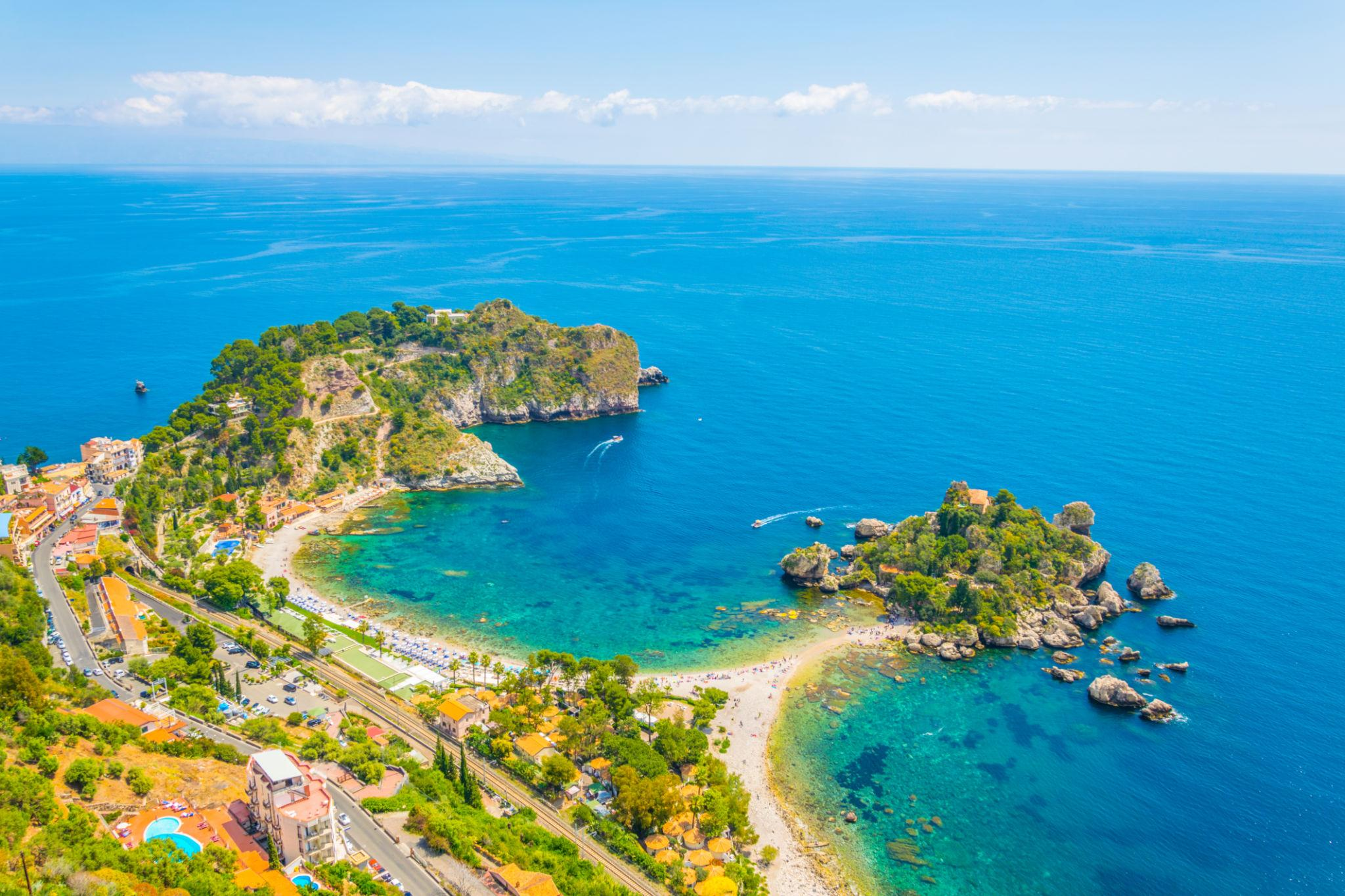
The small island sits immediately off the coast beneath the town, connected to the shore by a narrow strip whose appearance changes with sea conditions. Dense Mediterranean vegetation, rocky formations and exceptionally clear water create a landscape that feels far removed from the activity of Corso Umberto, despite being only a short distance away.
The protected site underwent a temporary closure following adverse weather in early 2026, but the archaeological park announced its reopening to visitors from 20 June 2026; current official information lists Isola Bella and its naturalistic museum as accessible. (Parchi Archeologici Sicilia)
The surrounding coastline is best experienced slowly. Swimming, a small boat excursion or simply spending several hours beside the bay allows visitors to appreciate how dramatically Taormina rises above the sea.
Nearby Mazzarò offers another important coastal base. Its sheltered bay has long been associated with Taormina’s seaside culture, and the connection between upper Taormina and Mazzarò makes it possible to combine a morning in the historic centre with an afternoon beside the water without devoting an entire day to transportation. The cable car remains the most direct public connection between the two levels of the destination. (Travel Taormina)
This vertical relationship is one of Taormina’s distinctive luxuries. Breakfast can take place on a terrace high above the coast, lunch beside the sea, and dinner back among the historic streets, with each setting offering a different perspective on the same landscape.
Grand Hotels and Taormina’s Tradition of Mediterranean Hospitality
Taormina’s reputation as an international resort was established long before contemporary luxury tourism. Writers, artists, aristocrats and later film personalities were drawn to the town, helping create a hospitality culture in which historic architecture, gardens and panoramic terraces became as important as formal service.
That tradition remains visible in several of the destination’s leading hotels. San Domenico Palace, Taormina, A Four Seasons Hotel occupies a former 14th-century Dominican convent and has become one of the town’s defining luxury addresses. Its architecture and gardens overlook the Ionian Sea, while the historic structure creates a sense of place that could not easily be reproduced in a purpose-built resort.
Grand Hotel Timeo, A Belmond Hotel, sits beside the Ancient Theatre and traces its history to the 19th century. Its elevated gardens and terraces capture one of Taormina’s classic combinations: Mediterranean vegetation, historic architecture and expansive views toward Etna and the coast.
Villa Sant’Andrea, also part of Belmond, offers a complementary experience at sea level in Mazzarò. Rather than choosing between historic Taormina and the coast, some travellers use the two settings to experience both dimensions of the destination.
The distinction is important when selecting accommodation. Staying in the historic centre places restaurants, boutiques and cultural sites within convenient reach and gives evenings a distinctly urban-resort atmosphere. Choosing the coastline instead prioritises swimming, privacy and direct contact with the sea.
Neither is inherently more luxurious. The better choice depends on whether the traveller wants Taormina to feel primarily like a historic Mediterranean town with access to the beach, or a seaside retreat with access to a historic town.
Sicilian Gastronomy Between Sea, Mountain and Tradition
Taormina’s dining culture is shaped by a broader eastern Sicilian landscape that stretches from the Ionian Sea to the fertile slopes of Mount Etna. This geography provides chefs with seafood, citrus fruit, vegetables, herbs, pistachios and wines from volcanic vineyards within a relatively compact territory.
For travellers, that means dining should not be treated merely as an evening activity. Food is one of the most direct ways to understand the region.
Traditional pasta alla Norma, associated with nearby Catania, brings together tomato, aubergine, basil and salted ricotta. Swordfish and other seafood reflect the Ionian coastline, while granita—particularly accompanied by brioche—belongs as naturally to breakfast as to an afternoon break.
More refined restaurants increasingly interpret these ingredients through contemporary techniques, but the strongest menus tend to preserve a recognisable connection with Sicily. Luxury dining here works particularly well when it remains geographically grounded rather than becoming generically international.
Etna wines add another dimension. The volcanic soils surrounding the mountain support an increasingly prominent wine culture, with Nerello Mascalese among the key red grapes and Carricante central to many Etna whites. A restaurant with a thoughtful regional wine list can therefore turn dinner into an introduction to the landscape beyond Taormina itself.
This is also why an Etna winery visit works so well as a complement to a stay on the coast. Within the same journey, travellers move from subtropical seaside scenery to vineyards planted against the presence of an active volcano.
Beyond Taormina: Etna, Castelmola and the Eastern Sicilian Landscape
Taormina works exceptionally well as a base because several contrasting experiences lie within reach.
Castelmola rises above Taormina and provides an even higher perspective over the coastline. Its narrow streets and small-scale historic character make it a useful counterpoint to the more cosmopolitan atmosphere below. The journey is short, but the change in perspective is considerable.
Mount Etna requires more time. Rather than approaching Europe’s largest active volcano as a quick photographic excursion, luxury travellers should consider devoting a substantial part of a day to the region. Depending on conditions and interests, an itinerary can combine volcanic landscapes with a private guide, vineyard visits and lunch at an Etna estate.
Giardini Naxos offers another layer of history. Ancient Naxos was the first Greek colony in Sicily, and its archaeological area connects the modern coastline with the earliest stages of Greek settlement on the island. Together with the Ancient Theatre, it helps place Taormina within a much larger historical narrative. The archaeological park encompasses both Naxos and Taormina sites. (Parchi Archeologici Sicilia)
These excursions also prevent a common mistake: treating Taormina as an isolated resort. Much of its appeal comes precisely from its position within eastern Sicily. The volcano, coastline, archaeological sites, villages and vineyards are not peripheral attractions but elements of the same landscape.
The Best Time to Experience Taormina
Taormina changes considerably with the seasons.
Late spring and early autumn offer an appealing balance for travellers interested in both cultural exploration and the coast. Temperatures are generally more comfortable for walking than during the height of summer, while the Mediterranean atmosphere remains central to the experience.
July and August bring Taormina’s most energetic period. Beach life is at its height, restaurants and hotels operate at full rhythm, and cultural programming adds another dimension to the Ancient Theatre and surrounding area. The trade-off is greater demand, making advance planning especially valuable for preferred hotels, restaurants, beach facilities and private experiences.
September can be particularly attractive because the sea retains much of its summer warmth while the destination gradually moves beyond the peak holiday period. October shifts the emphasis further toward gastronomy, culture, Etna and slower exploration.
Whatever the season, the most successful Taormina itineraries avoid excessive scheduling. The town is compact, but its atmosphere rewards time: an extra coffee overlooking the sea, a long lunch, a swim that lasts into the afternoon or an evening walk through the historic centre often becomes as memorable as a formally organised excursion.
That is ultimately Taormina’s enduring quality. Its luxury is not confined to grand hotels or exclusive experiences. It comes from the unusual concentration of history, landscape, food and Mediterranean life within a remarkably small territory—and from the ease with which a traveller can move between them.
Frequently Asked Questions
How many days should you spend in Taormina?
Three nights provide enough time to experience the historic centre, Ancient Theatre and coast without rushing. Four or five nights are preferable if the itinerary also includes Mount Etna, wineries, boat excursions or a full day dedicated to the beach.
Is Taormina suitable for a luxury holiday?
Yes. Taormina has a long tradition of high-end hospitality, including internationally recognised luxury hotels, private coastal experiences, fine dining, beach clubs and access to private excursions around Mount Etna and eastern Sicily.
What is the most important attraction in Taormina?
The Ancient Theatre is Taormina’s defining cultural landmark. Its Hellenistic origins, substantial Roman reconstruction and extraordinary position overlooking the coastline make it important both archaeologically and visually. (Visit Sicily)
Is Isola Bella currently open?
Yes. Isola Bella temporarily closed following weather-related damage in early 2026, but the archaeological park announced its reopening from 20 June 2026. Current official visitor information lists the site and naturalistic museum as accessible. (Parchi Archeologici Sicilia)
Is it better to stay in central Taormina or near the beach?
Central Taormina is preferable for travellers who prioritise restaurants, shopping, historic streets and evening atmosphere. Mazzarò and the coast are better for guests who want immediate access to the sea. Luxury properties exist in both settings.
Can Taormina and Mount Etna be combined in one trip?
Yes, and the combination is highly recommended. Taormina provides the coastal and cultural experience, while Etna adds volcanic scenery, vineyards and a markedly different landscape. A dedicated day for the Etna area is generally more rewarding than trying to fit it into a short excursion.
Is a car necessary in Taormina?
Not for exploring the historic centre itself. Taormina is highly walkable within its central pedestrian areas, while the cable car connects the upper town with Mazzarò. Private transfers or a car with driver become more useful for Etna, wineries and wider exploration of eastern Sicily.
By Luxury Magazine Editorial Team.