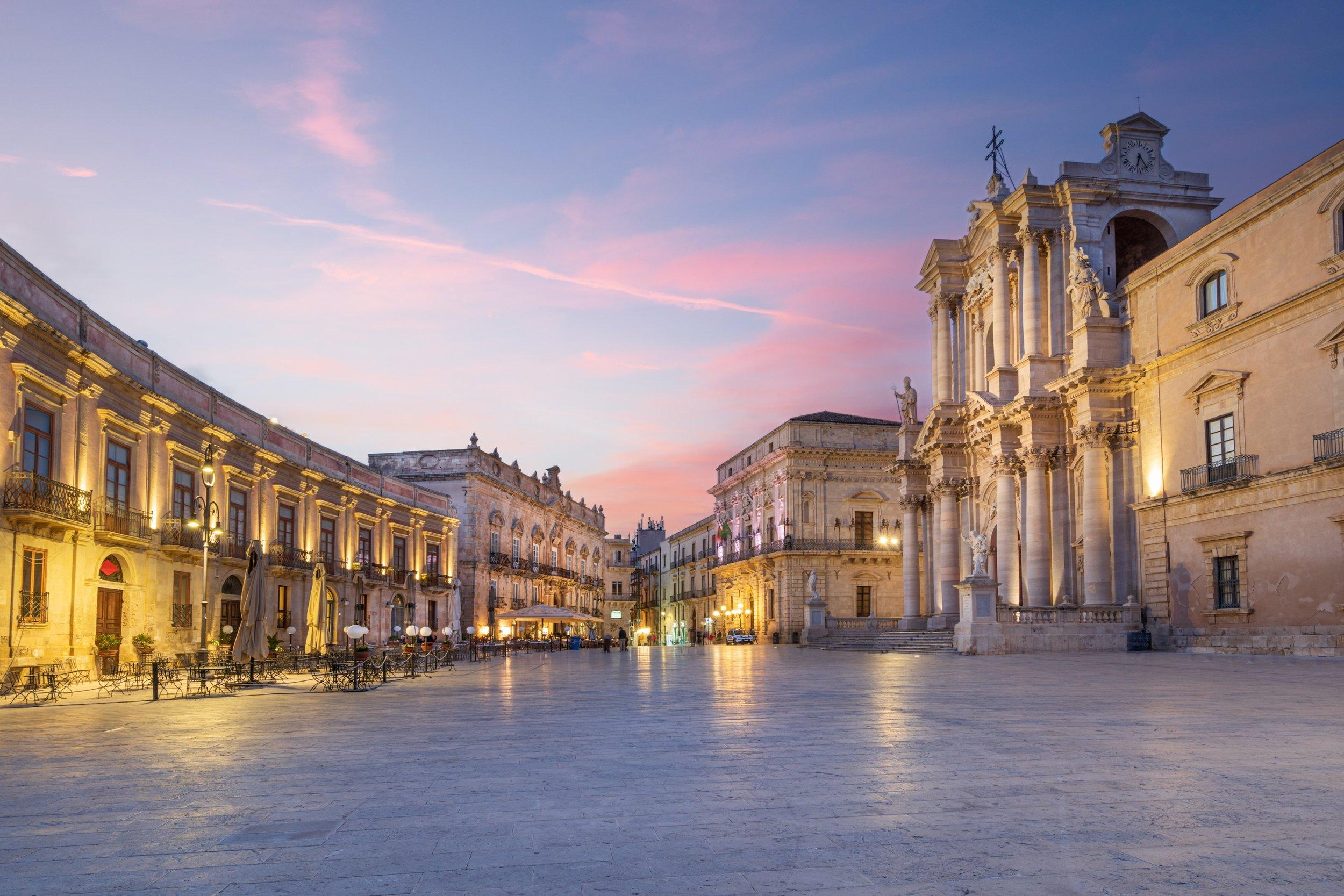
On Sicily’s southeastern coast, Syracuse occupies a rare position in the Mediterranean imagination. It is simultaneously an ancient Greek city, a Roman archaeological landscape, a Baroque destination and a contemporary seaside city. At its heart lies Ortigia, the compact island where limestone streets, noble palaces and church façades meet the blue expanse of the Ionian Sea.
Few destinations in Sicily reveal so many historical layers within such a concentrated area.
Syracuse was founded by Greek settlers from Corinth in the eighth century BC and became one of the most important cities of the ancient Mediterranean. UNESCO, which inscribed Syracuse and the Rocky Necropolis of Pantalica on the World Heritage List in 2005, describes the ensemble as exceptional testimony to Mediterranean civilisation across approximately three millennia. Ancient Syracuse preserves Greek and Roman monuments alongside evidence of Byzantine, Arab-Muslim, Norman, Swabian, Aragonese and later periods. (UNESCO World Heritage Centre)
That depth could easily make Syracuse feel like a destination defined primarily by archaeology. Instead, the opposite is true. History remains visible everywhere, but contemporary life continues around it. Markets fill with local produce in the morning, boats cross the harbour, restaurants open onto narrow streets, and Piazza Duomo becomes an elegant evening gathering place.
This coexistence of antiquity and Mediterranean life is what makes Syracuse—and especially Ortigia—one of Sicily’s most sophisticated cultural destinations.
Neapolis Reveals the Scale of Ancient Syracuse
Understanding Syracuse begins outside Ortigia, at the archaeological area of Neapolis.
The remains here reveal the scale and importance of the ancient city in a way that Ortigia’s intimate streets cannot. The archaeological park occupies part of what was once one of Syracuse’s five principal districts and contains some of its most important surviving monuments.
The Greek Theatre is the defining presence.

Carved substantially into the rock, the theatre existed by the fifth century BC, while its present form largely reflects later development dating to the third century BC. Nearby stand the remains of the Roman Amphitheatre and the vast Altar of Hieron II, demonstrating how the city continued evolving after the Greek period. (Parchi Archeologici Sicilia)
The surrounding latomie—ancient stone quarries—add another dimension. Vegetation now grows where limestone was once extracted, creating a landscape in which archaeology and nature overlap. Among the best-known spaces is the Orecchio di Dionisio, or Ear of Dionysius, a striking artificial cave whose unusual form and acoustics have inspired stories for centuries. (Parchi Archeologici Sicilia)
A private archaeological guide is particularly worthwhile here. Neapolis becomes considerably more meaningful when its surviving structures are reconstructed through historical explanation rather than experienced simply as isolated ruins.
It also establishes an important contrast with Ortigia. Neapolis demonstrates the physical scale of ancient Syracuse; Ortigia shows how the city’s history continued to accumulate rather than disappear.
Ortigia Contains Three Millennia Within a Small Island
Crossing into Ortigia changes the character of the journey completely.
The archaeological landscape gives way to a dense urban fabric of narrow lanes, piazzas, balconies and waterfront promenades. Yet the ancient city has not vanished beneath the later one. It survives inside it.
UNESCO identifies Ortigia as the nucleus of Syracuse’s original Greek foundation and notes that the island has been inhabited for around three millennia. It preserves traces of the ancient city alongside buildings shaped by successive Mediterranean cultures. (UNESCO World Heritage Centre)
One of the clearest reminders is the Temple of Apollo, whose remains stand close to the entrance of the island. But the most extraordinary example appears farther inside Ortigia.
Piazza Duomo occupies the ancient sacred heart of Syracuse. The Cathedral incorporates the surviving structure and columns of the fifth-century BC Temple of Athena. The ancient sanctuary was adapted for Christian worship centuries later, while the façade seen today reflects the Baroque reconstruction that followed the devastating earthquake of 1693. (UNESCO World Heritage Centre)
Val di Noto: Sicilian Baroque, a UNESCO World Heritage Site
The result is not simply a building containing archaeological fragments. Greek columns remain physically embedded within the cathedral walls.
This is Syracuse in miniature: one civilisation does not erase another but becomes part of it.
The surrounding Piazza Duomo heightens the effect. Its pale stone, curving proportions and aristocratic façades create one of Sicily’s most elegant public spaces. During the day it is architectural; towards evening it becomes social. Tables fill, people cross the square on their passeggiata and the illuminated cathedral assumes an entirely different character.
The Myth of Arethusa Still Belongs to the Waterfront
Syracuse is inseparable from mythology, and nowhere is this more tangible than at the Fonte Aretusa.
The freshwater spring lies close to the sea on Ortigia’s western waterfront. Papyrus grows from the water, creating an unusual green enclave between the historic city and the harbour.

Its cultural significance extends far beyond its appearance. According to Greek mythology, the nymph Arethusa fled the river god Alpheus and was transformed into a spring in Ortigia by Artemis. Alpheus, transformed into a river, was said to travel beneath the sea to reunite with her.
For the ancient Greeks, myth provided a language through which geography, water and divine presence could be understood. In Syracuse, that connection remains unusually visible because the places associated with those stories still belong to the city’s everyday landscape.
This is one of the pleasures of walking Ortigia rather than approaching it through a conventional sightseeing schedule. A Greek temple can appear beside a modern street; a mythological spring sits beside the promenade; Baroque façades conceal ancient structures.
The island continually compresses different eras into the same view.
From Fonte Aretusa, the waterfront becomes particularly attractive towards sunset. The western side of Ortigia faces across the Porto Grande, creating one of the city’s best settings for an evening walk. Boats move through the harbour while the limestone architecture begins reflecting softer light.
It is a simple experience, but one that explains much of Ortigia’s appeal.
Castello Maniace Marks the Point Where the City Meets the Sea
Continue south and Ortigia gradually narrows towards Castello Maniace.
The fortress occupies the island’s extreme tip, projecting into the sea and giving the southern waterfront a markedly different atmosphere from the ornate streets around Piazza Duomo.

Its position is fundamental. From here, the relationship between Syracuse and the Mediterranean becomes unmistakable. Ortigia was not merely a beautiful place beside the sea; its protected harbours and strategic position helped determine its importance throughout history.
The fortress belongs to the medieval layer of that story and is associated with Frederick II. UNESCO specifically identifies Syracuse’s fortifications among the architectural evidence demonstrating the city’s succession of civilisations. (UNESCO World Heritage Centre)
The walk towards Castello Maniace is almost as rewarding as the monument itself. Streets become quieter as the island tapers south, balconies look towards the water and glimpses of the Ionian Sea repeatedly appear between buildings.
For couples, this part of Ortigia is particularly appealing in late afternoon. For photographers, early morning can be equally rewarding, when the streets are quieter and the relationship between architecture and water is easier to appreciate.
Seeing Ortigia from offshore adds another perspective entirely. A private boat around Syracuse’s coastline reveals the compact shape of the historic island, its fortifications and the way its buildings seem to rise directly from the sea.
Sicily by Yacht: The Most Beautiful Coastlines to Explore by Sea
Ortigia’s Markets and Restaurants Express a Living Mediterranean Culture
Syracuse would be less compelling if its cultural identity ended with its monuments.
Instead, Ortigia remains a living Mediterranean neighbourhood, and food provides one of the most immediate ways to experience it.
The market area near the entrance to the island introduces a more animated side of the destination. Fish and seafood, vegetables, cheeses, olives, herbs and other Sicilian ingredients create a sensory contrast to the formality of Piazza Duomo.
This everyday food culture is essential to understanding the city.
Syracuse sits within one of Sicily’s richest gastronomic regions. The surrounding southeast produces citrus fruits, almonds, olive oil, cheeses, vegetables and wines, while the proximity of the Ionian Sea keeps seafood central to local cooking.
For luxury travellers, the most rewarding approach is not necessarily to pursue elaborate dining at every meal. Ortigia is well suited to contrast: a refined dinner one evening, a market-focused lunch the following day, then an aperitivo overlooking the sea.
The setting should remain part of the experience.
A restaurant hidden in a historic lane feels different from one overlooking the harbour, just as an evening in Piazza Duomo creates a different rhythm from lunch near the market. Allowing these environments to vary prevents a stay from becoming a succession of formal reservations.
It also makes Syracuse particularly suitable for longer stays. After the principal monuments have been visited, the city still offers reasons to remain.
Pantalica Extends the Story Beyond the City
The UNESCO designation deliberately joins Syracuse with another extraordinary place: the Rocky Necropolis of Pantalica.
Located inland from the city, Pantalica changes the scale of the experience entirely. Instead of temples, palaces and urban streets, travellers encounter deep limestone ravines and thousands of rock-cut tombs.
UNESCO records more than 5,000 tombs, most dating from the thirteenth to seventh centuries BC, as well as later Byzantine remains. The site preserves evidence of communities that predate Greek Syracuse and adds another chronological layer to the region’s extraordinary history. (UNESCO World Heritage Centre)
The contrast with Ortigia could hardly be greater.
One is compact, urban and surrounded by sea; the other is rugged, inland and defined by rock and vegetation. Yet together they explain why UNESCO considers the area exceptional testimony to the development of Mediterranean civilisation over three millennia. (UNESCO World Heritage Centre)
Pantalica is therefore not simply an optional archaeological excursion for specialists. It can become an important part of a luxury itinerary precisely because it removes travellers from the polished urban experience.
A private excursion combining archaeological interpretation with the Hyblaean landscape creates a very different day from walking Ortigia. It can also be integrated with smaller southeastern towns and countryside experiences rather than approached as an isolated attraction.
This is where Syracuse begins connecting naturally with the wider Val di Noto and southeastern Sicily.
Syracuse Rewards Travellers Who Stay Beyond a Single Day
Syracuse is frequently incorporated into itineraries as a day trip, but doing so leaves much of its character unexplored.
Two nights provide enough time for the essential contrast: Neapolis during one part of the day and Ortigia during another. Three nights create a more convincing luxury experience, particularly when a boat excursion, Pantalica or the surrounding southeast is added.
The choice of where to stay is straightforward for most leisure travellers. Ortigia places restaurants, piazzas and the waterfront within walking distance and allows the island to be experienced early in the morning and late at night, when its atmosphere is markedly different from peak visiting hours.
Time of day matters.
Neapolis is best explored when temperatures are comfortable, particularly outside winter. Ortigia rewards early mornings, when the streets are relatively quiet, and late afternoons that transition naturally into dinner. Piazza Duomo deserves to be seen in daylight and again after dark.
Spring and autumn are particularly attractive for combining archaeology with long walks. Summer brings the full Mediterranean atmosphere and makes boat excursions and swimming more appealing, although sightseeing is better structured around cooler parts of the day.
Syracuse also works exceptionally well as part of a longer southeastern itinerary. Noto lies within the same cultural landscape, while Ragusa, Modica and Scicli extend the journey into the heart of Sicily’s Baroque southeast.
The mistake is attempting to experience all of this too quickly.
Syracuse is compelling precisely because it is layered. The Greek Theatre becomes more meaningful after walking through the modern city. The cathedral becomes more remarkable once its ancient Temple of Athena is understood. Fonte Aretusa changes when mythology is added to geography. Ortigia’s waterfront acquires another dimension when viewed from the sea.
This is what separates Syracuse from a destination that is merely beautiful.
Its sophistication comes from accumulation.
Greek civilisation, Roman power, medieval fortification, Baroque reconstruction and contemporary Mediterranean life continue to occupy the same territory. UNESCO’s description of Syracuse as testimony to approximately three millennia of Mediterranean civilisation may sound academic, but walking through Ortigia makes the idea remarkably tangible. (UNESCO World Heritage Centre)
In the evening, that history becomes almost effortless. The archaeological sites close, the stone of Piazza Duomo catches the last light, fishing boats return towards the harbour and tables begin filling along the streets.
Syracuse stops feeling like an ancient city being visited and becomes what it has been for thousands of years: a Mediterranean city being lived in.
Frequently Asked Questions
How many days are needed for Syracuse and Ortigia?
Two nights provide a good introduction, allowing time for both the Neapolis archaeological area and Ortigia. Three nights are preferable for travellers who also want to include a private boat excursion, Pantalica or a slower exploration of southeastern Sicily.
Is Syracuse the same place as Ortigia?
Ortigia is the historic island at the heart of modern Syracuse. It contains many of the city’s best-known historic landmarks, including Piazza Duomo, the Cathedral, Fonte Aretusa and Castello Maniace. The archaeological area of Neapolis lies on the mainland.
Why is Syracuse a UNESCO World Heritage Site?
UNESCO inscribed Syracuse and the Rocky Necropolis of Pantalica in 2005. The property preserves exceptional evidence of Mediterranean civilisation across approximately three millennia, including Greek and Roman archaeology, later architectural traditions and the prehistoric rock-cut necropolis at Pantalica. (UNESCO World Heritage Centre)
What are the essential places to see in Syracuse?
For a first visit, the principal experiences are the Greek Theatre and archaeological area of Neapolis, Piazza Duomo and the Cathedral in Ortigia, Fonte Aretusa, the Temple of Apollo and the waterfront towards Castello Maniace. Travellers with additional time should consider Pantalica and the wider southeastern Sicilian countryside.
What is the best time of year to visit Syracuse and Ortigia?
Spring and early autumn are particularly attractive because they combine pleasant conditions for archaeological visits and walking with a lively Mediterranean atmosphere. Summer is ideal for combining Ortigia with the sea, although archaeological sightseeing is more comfortable in the morning or later in the day.
By Luxury Magazine Editorial Team