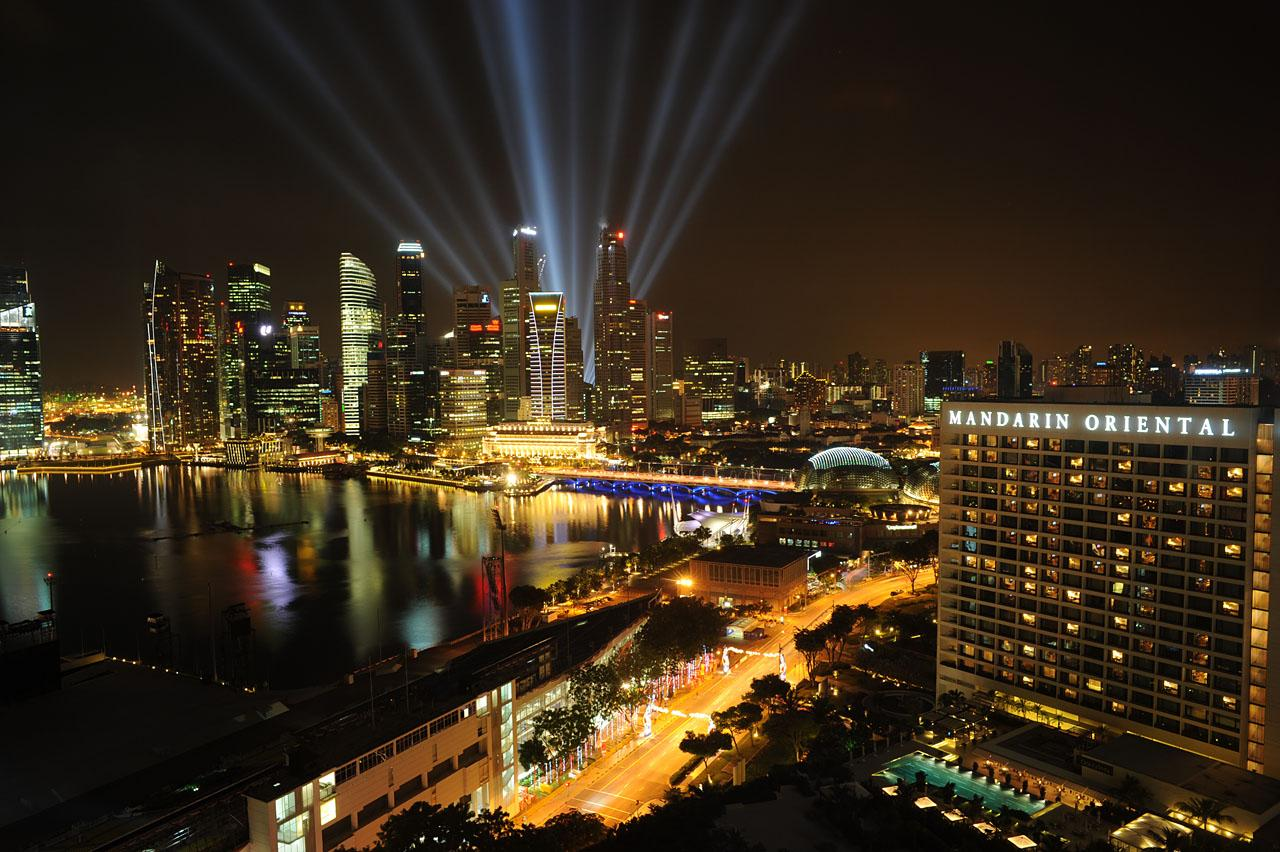
Mandarin Oriental, Singapore and a New Chapter in Marina Bay
Few luxury hotels in Singapore have undergone such a comprehensive transformation while retaining such a strong connection with their original identity as Mandarin Oriental, Singapore. First opened in 1987, the hotel reopened in September 2023 following a six-month, multi-million-dollar transformation that reimagined its guestrooms, suites, public spaces, restaurants and wellness facilities.
Today, the property presents a distinctly contemporary interpretation of Singaporean luxury, while remaining recognisable for its celebrated fan-shaped architecture, Marina Bay position and panoramic views.
Located at 5 Raffles Avenue opposite the Esplanade – Theatres on the Bay, the hotel sits at the centre of Singapore’s waterfront district, close to the Central Business District, luxury shopping and many of the city’s major cultural attractions. The current property comprises 510 rooms and suites, including 46 suites and 41 residential suites. (Mandarin Oriental)
The transformation was led by principal designer Jeffrey Wilkes of DESIGNWILKES, whose approach was to reinterpret the interiors through recognisably Singaporean references rather than simply giving the hotel a contemporary international aesthetic. Peranakan architecture, black-and-white houses, tropical greenery and the Angsana tree all influenced the design language. (Mandarin Oriental)
For travellers discovering Singapore through its most refined hotels, the result is a property that feels deeply connected to its destination while maintaining the understated sophistication associated with Mandarin Oriental.
Architecture with a Distinctive Sense of Place
The hotel’s architectural story begins with American architect John Portman, whose original 1987 design created the building’s characteristic fan-shaped form and soaring, light-filled atrium. Portman was known for developing a highly theatrical approach to large-scale hospitality architecture, and the Mandarin Oriental’s interior atrium remains one of the property’s defining spatial characteristics. (Mandarin Oriental)
The 2023 transformation did not attempt to erase that architectural history. Instead, Jeffrey Wilkes and DESIGNWILKES worked with the existing structure while introducing a more contemporary visual language inspired by Singapore.
The result can be seen throughout the property. The guestrooms use colour palettes and patterns derived from their surrounding views: cooler blue tones accompany Marina Bay-facing rooms, warmer shades reference the sunlight and sea, while city-facing rooms incorporate botanical motifs inspired by Singapore’s reputation as a Garden City. Batik-inspired patterns and other local references add another layer of cultural detail. (Mandarin Oriental)
In the public areas, natural light and greenery soften the scale of the building. One particularly distinctive detail is the installation of crystal spheres containing Vanda Joaquim orchids, Singapore’s national flower, above the Lobby Lounge.
The design therefore works on two levels. The architecture remains unmistakably that of a landmark late-20th-century city hotel, while the interiors have been redesigned to make the property feel specifically Singaporean.
This relationship between architecture, interiors and destination is increasingly central to contemporary luxury hospitality, as explored in our guide to Singapore’s most distinctive design hotels.
Rooms and Suites Above Marina Bay
The 510 guestrooms and suites are designed to make Singapore’s skyline an integral part of the stay. Floor-to-ceiling windows frame views of Marina Bay, the sea or the city, while the interiors use different palettes and patterns according to their orientation. (Corporate Site)
The hotel offers 423 rooms, 46 suites and 41 residential suites. The residential collection provides a more apartment-like experience, with expansive living areas and facilities intended for longer stays. (Mandarin Oriental)
Among the most distinctive accommodations is the Royal Marina Bay Penthouse, located on the hotel’s uppermost floor. The four-bedroom residence measures 393 square metres and has a private balcony with panoramic views across Marina Bay and the Singapore Strait. It also features a living room, dining room, chef’s kitchen, custom-designed furniture and a hot tub. (Mandarin Oriental)
The Presidential Suite provides another high-level interpretation of the hotel’s residential concept, with a spacious bedroom, living area, dining room for eight, kitchen, hot tub and private balcony overlooking Marina Bay. (Corporate Site)
For guests seeking a more intimate club experience, selected suites and rooms provide access to HAUS 65, the hotel’s private club lounge. The lounge was introduced as part of the 2023 transformation and was developed as a sophisticated social space incorporating cultural, culinary and artistic programming. (Mandarin Oriental Photos)

Dining from Cantonese Tradition to Contemporary Japanese Cuisine
Dining is one of the strongest components of the current Mandarin Oriental, Singapore experience. The property has ten dining spaces, ranging from fine dining and Japanese cuisine to a pastry boutique, afternoon tea and sophisticated cocktails. (Mandarin Oriental)
The most significant recent culinary development is Cherry Garden by Chef Fei, which received its first MICHELIN Star in the 2026 Michelin Guide Singapore. The restaurant specialises in Cantonese cuisine with subtle Chaoshan influences, under the culinary direction of Chef Fei. The dining room combines contemporary refinement with references to traditional Chinese architecture, including old-world stone walls and wooden trellises. (Corporate Site)
The recognition is particularly recent: Cherry Garden by Chef Fei made its Michelin debut with one star in the 2026 selection, published in August 2026. (MICHELIN Guide)
Zuicho offers a very different culinary experience. The Japanese fine-dining restaurant presents an immersive kappo-style format under Michelin-starred Chef Kenji Takahashi, while Dolce Vita focuses on contemporary Italian cuisine in a more relaxed setting overlooking the pool. (Mandarin Oriental)
Elsewhere, embu serves local and international flavours throughout the day, while The Mandarin Cake Shop concentrates on pastries, cakes, chocolates and artisan bread. Lobby Lounge provides the hotel’s traditional afternoon-tea setting, while MO BAR combines cocktails with views of the Singapore skyline. (Corporate Site)
BAY@5, meanwhile, occupies an outdoor position with panoramic views of Marina Bay, giving the dining programme another connection with the hotel’s waterfront location.
For a luxury traveller, the attraction is therefore not simply the number of restaurants but the range of experiences available without leaving the property: Cantonese fine dining, Japanese kappo, Italian cuisine, Singaporean flavours, afternoon tea and cocktails can all form part of the same stay.

The Spa at Mandarin Oriental, Singapore
The hotel’s wellness offering provides a quieter counterpoint to its urban surroundings. The Spa at Mandarin Oriental, Singapore currently comprises six treatment rooms and offers massages, personalised facials and wellness treatments combining Asian traditions with contemporary techniques. The spa is currently open daily from 9:30am to 9pm. (Corporate Site)
The facilities include a thermal area, relaxation spaces and access to the hotel’s wider wellness infrastructure. The hotel also maintains an outdoor swimming pool, fitness centre and wellness terrace, allowing guests to incorporate movement and recovery into a city stay. (Mandarin Oriental)
The spa’s treatment programme includes advanced facial treatments from Swiss Perfection and Biologique Recherche, while manicures and pedicures are offered in collaboration with Margaret Dabbs. (Mandarin Oriental Photos)
The Spa has also been recognised by Forbes Travel Guide for 13 consecutive years, according to Mandarin Oriental’s current spa information. (Corporate Site)
This would be an appropriate place for Luxury Magazine to link to a future dedicated article, The Best Luxury Spas in Singapore: A Guide to Exceptional Wellness, which could sit alongside the hotel’s individual profile within the broader Singapore wellness content cluster.
For travellers planning treatments during a city break, a complementary article such as How to Prepare for a Luxury Spa Stay: A Complete Wellness Guide can provide useful practical context without interrupting the hotel-focused narrative.

HAUS 65 and the Art of Private Hospitality
HAUS 65 occupies an important role in the hotel’s contemporary identity. Developed during the 2023 transformation, the private club lounge was conceived as a sophisticated environment for guests seeking a more intimate setting within the larger hotel.
Its programming incorporates culinary, wine, artistic and cultural experiences. The original concept included wine tastings led by sommeliers and winemakers, alongside a calendar developed with the Mandala Club. (Mandarin Oriental Photos)
The lounge also complements the hotel’s suite offering, with current hotel information confirming complimentary HAUS 65 access for its suite collection. (Mandarin Oriental)
This private-club approach reflects an important change in contemporary luxury hotels. The most exclusive spaces are no longer necessarily defined by grand decoration alone. Instead, privacy, personal service, curated programming and a sense of belonging increasingly form part of the luxury proposition.
At Mandarin Oriental, Singapore, HAUS 65 provides precisely that more discreet layer of hospitality above the hotel’s broader public spaces.
Marina Bay as Part of the Experience
The hotel’s location opposite the Esplanade – Theatres on the Bay gives it an unusually direct relationship with Marina Bay. The Central Business District is easily accessible, while major attractions, luxury shopping and cultural venues are close by. The hotel is also approximately a 20-minute drive from Changi International Airport under normal conditions, according to the property’s current information. (Mandarin Oriental)
For leisure travellers, the location provides a natural base for exploring the waterfront and Singapore’s cultural landmarks. For business travellers, proximity to the financial district is equally significant.
The views, however, remain the defining feature. From guestrooms, suites, the penthouse, restaurants and outdoor spaces, the hotel repeatedly returns the guest’s attention to Singapore’s skyline.
This is particularly evident from the Royal Marina Bay Penthouse, where the private balcony looks across Marina Bay and Singapore Strait. Mandarin Oriental has even commissioned Singaporean composer Jonathan Shin to create The Exceptional Bay Symphony, a piece inspired by the view from the penthouse. (Mandarin Oriental)
It is an unusually literal expression of the hotel’s approach: the landscape outside is not simply scenery but part of the property’s identity.

A Reimagined Singapore Landmark
Mandarin Oriental, Singapore occupies an interesting position within the city’s luxury-hotel landscape. Its original identity dates to 1987, but the property today is substantially shaped by the transformation completed in 2023. Rather than treating that history as something to preserve unchanged, the hotel has used it as the foundation for a contemporary interpretation of Singaporean hospitality. (Mandarin Oriental)
The architecture of John Portman remains fundamental. The Marina Bay position remains unchanged. But the interiors now draw directly from Singapore’s cultural vocabulary, while the dining collection has evolved with Cherry Garden by Chef Fei’s 2026 Michelin Star and Zuicho’s Japanese kappo concept. The spa, residential suites and HAUS 65 add further layers to the contemporary experience. (Corporate Site)
For international travellers, the appeal lies in this balance between recognisable Mandarin Oriental service traditions and a strong sense of destination. It is a hotel that does not attempt to separate itself from Singapore. Instead, its design, cuisine, views and wellness experiences repeatedly bring the city into the stay.
Within a broader exploration of the best luxury hotels in Singapore, Mandarin Oriental, Singapore therefore occupies a distinctive place: a long-established Marina Bay address that has been thoroughly reinterpreted for a new generation of luxury travellers.
Frequently Asked Questions
When did Mandarin Oriental, Singapore open?
Mandarin Oriental, Singapore originally opened in 1987. The hotel underwent a major six-month transformation and reopened to the public on 8 September 2023. (Mandarin Oriental)
How many rooms does Mandarin Oriental, Singapore have?
The hotel currently has 510 rooms and suites, including 46 suites and 41 residential suites. (Mandarin Oriental)
What is Mandarin Oriental, Singapore known for?
The hotel is particularly associated with its fan-shaped architecture by John Portman, Marina Bay location, panoramic views, Singapore-inspired interiors and extensive dining and wellness facilities. (Mandarin Oriental)
Does Mandarin Oriental, Singapore have a Michelin-starred restaurant?
Yes. Cherry Garden by Chef Fei was awarded One MICHELIN Star in the 2026 MICHELIN Guide Singapore, recognising its Cantonese cuisine with Chaoshan influences. (Corporate Site)
Does Mandarin Oriental, Singapore have a spa?
Yes. The Spa at Mandarin Oriental, Singapore has six treatment rooms and offers massages, personalised facials and wellness treatments. The spa is currently open daily from 9:30am to 9pm. (Corporate Site)
What is the Royal Marina Bay Penthouse?
The Royal Marina Bay Penthouse is a four-bedroom, 393-square-metre residence on the hotel’s uppermost floor. It has a private balcony with panoramic views of Marina Bay and Singapore Strait, as well as a living room, dining room, chef’s kitchen and hot tub. (Mandarin Oriental)
By Luxury Magazine Editorial Team