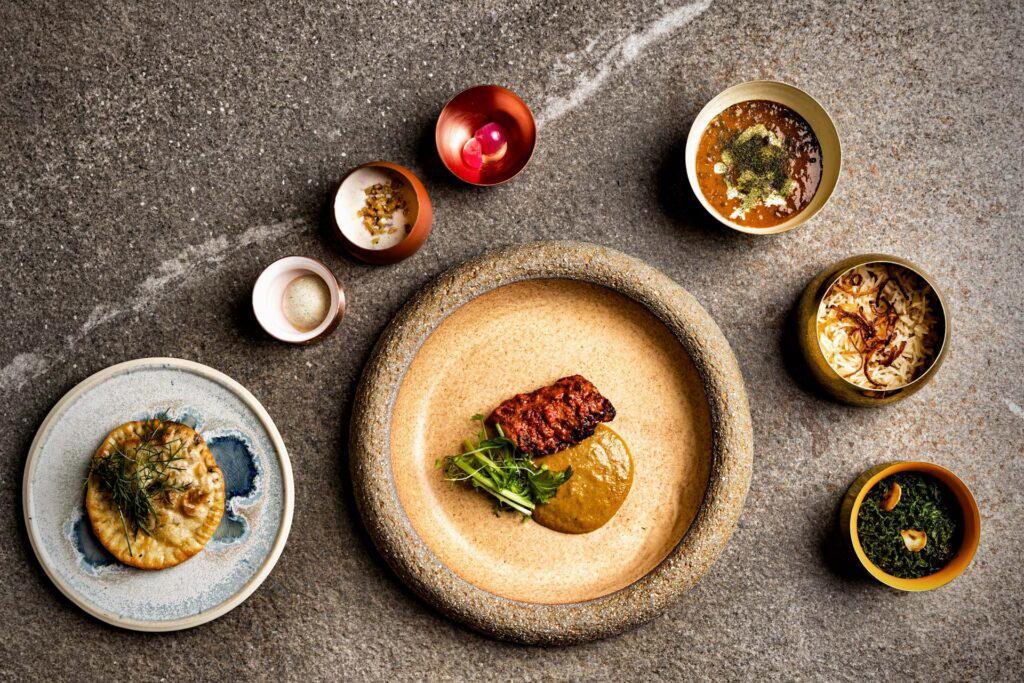
Indian cuisine occupies a distinctive position in Singapore’s culinary landscape. The city’s Indian heritage is deeply connected to its history, particularly through Little India and the communities that have shaped Singaporean food culture over generations. Yet today’s luxury dining scene extends far beyond traditional curry houses and neighbourhood restaurants.
A new generation of chefs is bringing Indian flavours into tasting menus, contemporary dining rooms and sophisticated beverage programmes. Some draw from South Indian traditions, others from North Indian cuisine or the coastal regions, while others interpret Indian food through techniques acquired in European and Japanese kitchens.
Among these restaurants, Thevar currently provides the clearest example of Indian cuisine at Michelin’s highest contemporary level in Singapore. Other long-established names, including Rang Mahal, demonstrate a different approach centred on heritage, hospitality and refined à la carte dining.
Together, they show how Indian cuisine in Singapore can move between tradition and innovation without losing its cultural character.
Thevar: Contemporary Indian Cuisine with a Malaysian Indian Identity
Thevar occupies a particularly significant position in Singapore’s contemporary Indian dining scene.
Located at 16 Mohamed Sultan Road, the restaurant is led by Chef-Owner Mano Thevar, whose culinary identity is closely connected to his Malaysian Indian upbringing in Penang. His early experiences with hawker food, including nasi kandar and other local dishes, became part of the foundation for the cuisine he would later develop in Singapore. (thevar.sg)
Thevar currently holds two Michelin stars in the 2026 Michelin Guide Singapore, making it the only Indian restaurant in the current Singapore selection with two stars. The guide describes its cuisine as innovative, with a creative multi-course menu rooted in Indian traditions and crafted with European techniques. (MICHELIN Guide)
The distinction is important. Thevar does not attempt to reproduce Indian cuisine in a conventional fine-dining setting. Instead, Thevar’s cuisine is built around the flavours of Indian food from the Malay Peninsula and combines them with techniques Thevar developed through his international culinary training. (thevar.sg)
Signature preparations include Chettinad chicken roti and Brittany lobster with curry beurre blanc, demonstrating the restaurant’s characteristic combination of Indian flavour profiles and contemporary European technique. Michelin specifically highlights the Chettinad chicken roti as one of the restaurant’s defining dishes. (MICHELIN Guide)
The current Experience Menu is priced at S$298++ and includes seafood, vegetables, meat courses and desserts, with approximately two and a half hours recommended for the complete experience. A five-course Executive Menu is also available at lunch on Friday and Saturday. (thevar.sg)

Indian Heritage Meets European Technique
Thevar’s cuisine is especially interesting because the restaurant’s Indian identity is not limited to ingredients or spices.
Chef Mano Thevar trained in kitchens including Guy Savoy and Waku Ghin and spent time at the two-Michelin-starred Pure C in the Netherlands. These experiences gave him a strong technical foundation in French and Japanese cooking. His own restaurant became an opportunity to apply that technical knowledge to the food culture with which he grew up. (thevar.sg)
The result is a cuisine that can move from a familiar Indian preparation to an unexpected technical interpretation without losing the flavour profile that makes the dish recognisable.
This philosophy is also visible in the restaurant’s current menu. The Experience Menu includes dishes such as tomato chaat, Obsiblue prawn uttapam, shirako vadai and crispy-scale amadai with Kerala-style ishtu. The menu then progresses towards more substantial courses such as Chettinad chicken roti and Mysore-spiced rack of lamb. (thevar.sg)
Rather than describing this simply as fusion, it is more useful to understand Thevar as a personal interpretation of Indian cuisine shaped by Singapore and the chef’s international experience.
That distinction is particularly relevant to luxury travellers who are increasingly interested in restaurants where cultural identity and fine-dining technique coexist.

Rang Mahal: Five Decades of Indian Fine-Dining Heritage
While Thevar represents contemporary tasting-menu culture, Rang Mahal offers a very different expression of refined Indian dining.
Established in 1971, Rang Mahal has more than five decades of history in Singapore. The restaurant originally opened at the former Imperial Hotel before moving to Pan Pacific Singapore in 2000, where it became associated with modern Indian fine dining in the city. In September 2025, Rang Mahal entered its current chapter at Naumi Hotel Singapore. (rangmahal.com.sg)
Rang Mahal Restaurant & Bar is now located at 41 Seah Street within Naumi Hotel Singapore. Its current interior takes inspiration from the mythical gardens of India, creating a setting that is more traditional in its cultural references while maintaining a contemporary hospitality environment. (rangmahal.com.sg)
Its menu also differs significantly from Thevar’s tasting-menu format. Rang Mahal brings together dishes from North, South and coastal India, allowing diners to explore a broader representation of the country’s culinary traditions. (rangmahal.com.sg)
Current dishes include paneer mirchi tikka, tandoori prawns, slow-cooked lamb bhuna, coastal prawn moilee, Old Delhi butter chicken and Hyderabadi biryani. The restaurant also maintains substantial vegetarian choices. (rangmahal.com.sg)
This makes Rang Mahal relevant to a different kind of luxury dining occasion. Rather than a tightly choreographed tasting menu, the experience allows guests to explore India’s regional diversity through a more traditional restaurant format, complemented by contemporary presentation and a dedicated wine and cocktail programme.

The Art of the Indian Tandoor
Fine Indian dining is not defined exclusively by tasting menus. The tandoor remains one of the cuisine’s most important culinary instruments, and contemporary Indian restaurants use it to create dishes where smoke, char, fermentation and spice can become central components of the dining experience.
At Rang Mahal, the current menu includes tandoori prawns, chicken tikka, lamb seekh kebab and paneer mirchi tikka. The restaurant combines traditional tandoor preparation with carefully controlled presentation and premium ingredients. (rangmahal.com.sg)
The technique is particularly well suited to luxury dining because the tandoor produces a combination of texture and aroma that is difficult to reproduce through conventional cooking. The intense heat creates charred exterior notes while retaining moisture within the ingredient.
At the same time, contemporary Indian restaurants increasingly treat the tandoor as part of a wider culinary system rather than simply a grilling device. Marinades, spice blends, chutneys, fermented ingredients and sauces can all be used to build layers around the central preparation.
This is one reason Indian fine dining can offer such a broad range of sensory experiences without relying on excessive presentation. The cuisine already possesses a complex vocabulary of aroma, heat, acidity, smoke and texture.

Indian Fine Dining Beyond a Single Regional Tradition
One of the most important characteristics of Singapore’s Indian dining scene is its regional diversity.
Indian cuisine encompasses an extraordinary range of culinary traditions, from the rich Mughlai cooking of North India to the seafood-oriented cuisines of Kerala and the south, the vegetarian traditions of Gujarat and Rajasthan, and the distinctive flavours of Tamil Nadu and Chettinad.
Singapore adds another layer because Indian food has developed alongside Malay, Chinese, Peranakan and other Southeast Asian culinary traditions.
Thevar is particularly representative of this interaction. Its cuisine draws from Chef Mano Thevar’s Malaysian Indian background, meaning that the food is already shaped by a culinary culture that developed outside India while retaining strong connections to Indian traditions. (thevar.sg)
Rang Mahal takes a broader approach, presenting dishes from North, South and coastal India within one restaurant. Its current menu includes Rajasthani palak, coastal prawn moilee, Old Delhi-style dishes and Hyderabadi biryani. (rangmahal.com.sg)
This regional breadth is one of the reasons Singapore is such an interesting destination for Indian cuisine. A luxury traveller does not need to choose between a single definition of Indian food; the city offers several different interpretations within a relatively compact dining landscape.

The Growing Role of Indian-Inspired Beverage Pairings
The modern Indian fine-dining experience increasingly extends beyond food.
Indian cuisine presents particular challenges and opportunities for wine pairing because spices, acidity, heat, sweetness and fermentation can interact unpredictably with conventional wine structures. This has encouraged some restaurants to approach beverages as part of the cuisine rather than as a separate accompaniment.
Thevar is a particularly interesting example. Michelin’s recent coverage of Singapore’s non-alcoholic fine-dining scene notes that the restaurant creates drinks around the same spices, herbs and ingredients used in its food. Its spiced moru lassi, for example, is served alongside the signature Chettinad chicken roti. (MICHELIN Guide)
This approach allows the beverage programme to reinforce the identity of the food. Instead of simply selecting a wine that can tolerate spice, the pairing itself can become an extension of the Indian culinary vocabulary.
Rang Mahal takes a broader wine-and-cocktail approach. Its current wine list includes Champagne, Sauvignon Blanc, Italian reds and other international selections intended to accompany its modern Indian menu. (rangmahal.com.sg)
For guests who prefer non-alcoholic dining, this evolution is particularly significant. Modern fine dining increasingly treats tea, fermentation, fruit, herbs and spices as sophisticated beverage ingredients in their own right.

The Indian Fine-Dining Experience in Singapore
The distinction between traditional Indian restaurant and contemporary Indian fine dining is becoming increasingly fluid.
At one end of the spectrum, restaurants such as Rang Mahal preserve the pleasures of regional dishes, tandoor cooking and family-style dining while presenting them within an elegant contemporary setting. At the other, Thevar uses a tasting-menu format to investigate Indian flavours through European and Japanese techniques.
Neither approach needs to replace the other.
Indeed, the contrast is part of what makes Singapore’s Indian dining scene compelling. A traveller can experience highly technical contemporary cuisine at Thevar and then explore a much broader selection of Indian regional dishes at a restaurant such as Rang Mahal.
The wider Michelin landscape reinforces this distinction. The 2026 Singapore Guide contains 97 Bib Gourmand establishments and a broad range of Michelin-starred restaurants, reflecting a dining culture that encompasses everything from hawker food to highly technical tasting menus. (MICHELIN Guide)
Within that spectrum, Indian cuisine has a particularly strong cultural foundation. Little India remains an important centre of Indian food and heritage, while contemporary restaurants have demonstrated that Indian culinary traditions can occupy a place within Singapore’s most sophisticated dining environments.
Singapore’s Most Refined Asian Tasting Menus

Planning an Indian Fine-Dining Experience
For travellers seeking a contemporary Indian tasting menu, Thevar is currently open for dinner Monday through Saturday, with lunch available Friday and Saturday. Its current Experience Menu is S$298++ per guest, while the five-course Executive Menu is available at lunch for S$228++. The restaurant recommends approximately two and a half hours for the full experience. (thevar.sg)
Thevar’s current address is 16 Mohamed Sultan Road, in a restored shophouse with an intimate dining room and open kitchen. Its dress code is smart casual, with the restaurant recommending more polished attire for the dining experience. (thevar.sg)
Rang Mahal offers a broader à la carte experience at Naumi Hotel Singapore, with lunch and dinner menus covering North Indian, South Indian and coastal influences. Its current lunch and dinner thalis also provide a way to experience several dishes in one sitting. (rangmahal.com.sg)
Dietary requirements should always be discussed when making a reservation. Thevar currently states that its tasting menu includes seafood and meat and that it cannot accommodate several major restrictions, including vegan, gluten-free, dairy-free and allium-free diets. (thevar.sg)
For travellers planning a gastronomic itinerary, Indian fine dining can also provide an interesting counterpoint to Singapore’s French, Japanese, Nordic and Southeast Asian restaurants.
Frequently Asked Questions
Which Indian restaurant in Singapore has Michelin stars?
Thevar currently holds two Michelin stars in the 2026 Michelin Guide Singapore. It is the Indian restaurant with the highest Michelin distinction in the current Singapore selection. (MICHELIN Guide)
What type of Indian cuisine does Thevar serve?
Thevar serves a contemporary interpretation of Indian cuisine rooted particularly in Chef Mano Thevar’s Malaysian Indian heritage. The restaurant combines Indian flavours and traditions with techniques developed through his experience in French and Japanese kitchens. (thevar.sg)
Does Thevar offer a tasting menu?
Yes. Thevar currently offers an Experience Menu priced at S$298++ for lunch and dinner, with a five-course Executive Menu available at lunch on Friday and Saturday for S$228++. (thevar.sg)
Is Rang Mahal still open in Singapore?
Yes. Rang Mahal is currently operating at Naumi Hotel Singapore at 41 Seah Street. The restaurant was established in 1971 and moved to its present location in September 2025. (rangmahal.com.sg)
Where can travellers experience different regional Indian cuisines in Singapore?
Rang Mahal offers dishes representing North, South and coastal Indian traditions, while Thevar focuses on a contemporary interpretation influenced by Malaysian Indian cuisine. Singapore’s wider Indian dining scene also extends into Little India, where traditional restaurants, hawker stalls and regional specialists provide a much broader culinary perspective. (MICHELIN Guide)
By Luxury Magazine Editorial Team