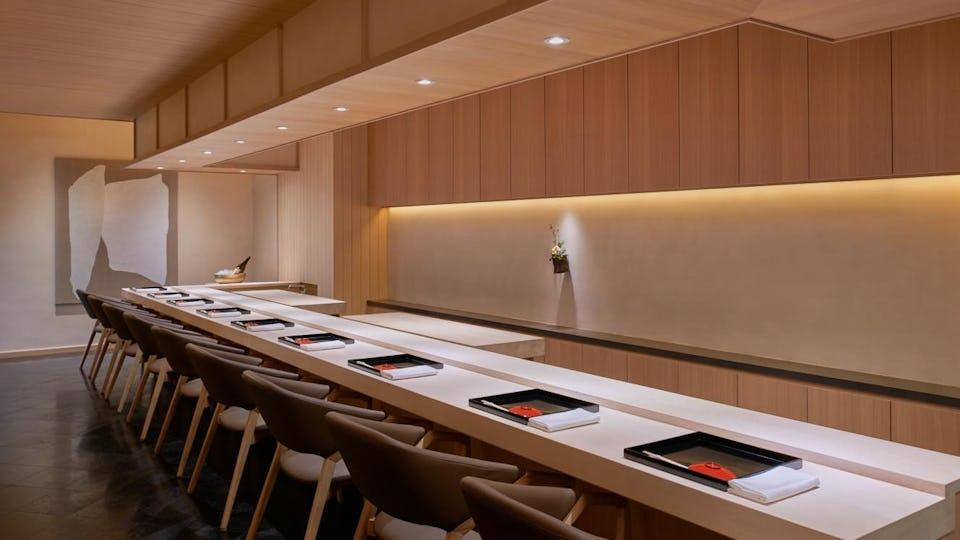
Singapore has become one of Asia’s most compelling destinations for Japanese fine dining. Alongside contemporary Japanese restaurants and kaiseki establishments, the city has developed an impressive collection of intimate omakase counters where seasonality, sourcing, knife work, rice preparation and the relationship between chef and guest define the experience.
The 2026 Michelin Guide lists 13 sushi restaurants in Singapore and its surrounding area, including two restaurants with two Michelin stars: Shoukouwa and Sushi Sakuta. The selection also includes newer addresses such as Sushi Kimura+ and established counters such as Sushi Ichi. (MICHELIN Guide)
Rather than ranking these experiences, this guide explores several of the city’s most distinctive addresses, from classical Edomae sushi to contemporary French-influenced omakase and highly intimate chef-led counters.
Shoukouwa: Edomae Sushi at One Fullerton
Shoukouwa occupies an elegant position at One Fullerton, overlooking the Marina Bay waterfront. Its culinary philosophy is firmly rooted in Edomae sushi, with the restaurant sourcing premium seafood from Tokyo’s Toyosu Market and flying it to Singapore daily.
The emphasis is on seasonality and the natural quality of the seafood. Shoukouwa works with a limited group of specialist suppliers, allowing its chefs to select fish according to the moment in the Japanese calendar rather than maintaining a static menu. The restaurant’s official philosophy is centred on serving seafood at its peak. (shoukouwa.com.sg)
The experience is deliberately intimate. Guests sit at the counter while the chef prepares each piece according to the intended progression of the meal. This creates a very different rhythm from conventional fine dining, where courses may arrive at the table from a larger kitchen.
Shoukouwa has retained two Michelin stars since 2016 and remains one of only two Japanese restaurants in Singapore with two stars in the 2026 guide, alongside Sushi Sakuta. (Time Out Worldwide)
Its location adds another dimension. One Fullerton sits at the edge of Marina Bay, placing a highly traditional Japanese sushi experience within one of Singapore’s most recognisable contemporary waterfront environments.

Sushi Sakuta: Seasonal Omakase and Japanese Craftsmanship
Sushi Sakuta offers another highly focused interpretation of Japanese omakase.
Located at Millenia Walk, the restaurant is built around a nine-seat counter fashioned from a 200-year-old cypress tree from Nara. There is also a private dining room, giving the restaurant two distinct formats while maintaining the same emphasis on Japanese craftsmanship. (MICHELIN Guide)
Chef-owner Yoshio Sakuta leads an all-Japanese kitchen team and creates a seasonal omakase menu based exclusively on Japanese fish. Even the sushi rice receives unusually precise attention: the restaurant uses a blend of two Japanese rice cultivars in a carefully calibrated ratio to achieve its intended texture. (MICHELIN Guide)
Sushi Sakuta was promoted from one to two Michelin stars in the 2025 guide after only two years in the Michelin selection, and it retained the distinction in 2026. Michelin specifically highlighted the restaurant’s season-driven omakase, all-Japanese kitchen team and 200-year-old Nara cypress counter. (MICHELIN Guide)
The result is an experience built around control and consistency rather than theatrical presentation. The counter places the preparation directly in front of the diner, making small details such as the temperature of the rice, the cut of the fish and the timing of each serving particularly noticeable.
The setting itself reinforces that philosophy. Natural wood, restrained design and the long cypress counter create an environment in which the food remains the central focus.
For travellers interested specifically in tasting-menu culture, Sushi Sakuta also provides a useful counterpoint to the more expansive experiences featured in The Best Tasting Menus in Singapore.

Sushi Kimura+: An Eight-Seat Return to Intimacy
The return of Chef Tomoo Kimura has added another distinctive chapter to Singapore’s Japanese dining scene.
Sushi Kimura+ reopened at Conrad Singapore Orchard in 2025 after the original Sushi Kimura closed in 2024. The new restaurant is considerably more intimate, with an eight-seat counter designed around a highly personal omakase experience. (Hilton)
Chef Kimura’s approach is based on Edomae-style sushi, with particular attention to ageing, curing and precise preparation. Seafood and seasonal produce are flown from Japan four times a week, while the menu changes according to the season. (Hilton)
One of the restaurant’s signatures is akami zuke, lean tuna briefly marinated in soy sauce and mirin before being paired with Yamagata rice seasoned with aged Kyoto vinegars. Michelin describes the dish as a particularly clear expression of Kimura’s precision and control. (MICHELIN Guide)
The eight-seat format changes the atmosphere considerably. With Chef Kimura personally working across such a small counter, there is a greater sense of direct interaction between chef and diner. It also allows the progression of the meal to be observed at very close range.
The restaurant’s new location at Conrad Singapore Orchard adds another layer of luxury, placing the intimate sushi counter within one of Singapore’s established high-end hotel environments.
Sushi Kimura+ currently holds one Michelin star in the 2026 guide. (MICHELIN Guide)

Omakase @ Stevens: Japanese Tradition with French Technique
Not every exceptional omakase experience in Singapore follows a strictly traditional sushi format.
At Omakase @ Stevens, Chef Kazuki Arimoto combines his Japanese background with classical French techniques. The Osaka-born chef trained in leading kitchens in Tokyo before bringing his experience to Singapore. The restaurant’s 6- or 8-course omakase is built around seasonal Japanese ingredients and presented in a more contemporary culinary language. (MICHELIN Guide)
The restaurant has just 16 seats, arranged around a pine-wood counter overlooking the open kitchen. This keeps the chef and preparation at the centre of the experience while allowing the cuisine to move beyond conventional sushi. (MICHELIN Guide)
Omakase @ Stevens received its first Michelin star in the 2025 guide, with Chef Kazuki also receiving the Michelin Young Chef Award that year. It retained its Michelin star in the 2026 selection. (Omakase @ Stevens)
The restaurant’s current seasonal programme illustrates the breadth of its interpretation. Rather than limiting the experience to sushi and sashimi, the menu can incorporate cooked seafood, meat, rice and other preparations, while maintaining Japanese seasonality as its underlying principle.
This makes Omakase @ Stevens particularly interesting for diners who appreciate Japanese technique but want a tasting menu with a wider European culinary vocabulary.
Its current official programme lists dinner from Monday to Saturday, with an eight-course autumn seasonal menu for 2026. (Omakase @ Stevens)

Sushi Ichi: Traditional Edomae in a Luxury Hotel Setting
Sushi Ichi offers another interpretation of classical Japanese sushi, this time within the Marriott Tang Plaza Hotel on Orchard Road.
The restaurant’s counter is made from a 300-year-old cypress tree, while the wooden ornaments on the walls were handcrafted by a renowned carpenter in Nara. The design establishes a connection with Japanese craftsmanship before the first course is served. (MICHELIN Guide)
The cuisine follows the Edomae tradition, with seasonal seafood and vegetables sourced from Japan. Sushi Ichi also pays particular attention to rice, using either red or white vinegar according to the intended preparation. Even its sauces are shipped from its Japanese flagship restaurant to maintain consistency. (MICHELIN Guide)
The omakase format is recommended by Michelin, and the restaurant currently holds one Michelin star in the 2026 guide. (MICHELIN Guide)
Its hotel setting makes Sushi Ichi particularly convenient for travellers staying around Orchard Road, while the counter maintains the intimacy associated with traditional Japanese sushi restaurants.
This balance between international luxury hospitality and Japanese culinary discipline is characteristic of Singapore’s high-end dining scene. The restaurant does not need to reinterpret Japanese cuisine dramatically; instead, it concentrates on maintaining the standards and rituals of an established culinary tradition.

The Craft Behind an Exceptional Omakase
The appeal of omakase lies partly in its simplicity. The diner does not construct the meal course by course. Instead, the chef determines the sequence according to the ingredients available, the season and the intended progression.
This makes seasonality particularly important.
At Shoukouwa, seafood arrives from Tokyo’s Toyosu Market and is selected according to peak periods. Sushi Sakuta works exclusively with Japanese fish and builds its menu around the seasons. Sushi Kimura+ similarly receives seafood and seasonal produce from Japan several times a week. (shoukouwa.com.sg)
Rice is equally important. In a sushi-focused omakase, rice is not simply a supporting ingredient. Its temperature, moisture, texture and acidity influence the balance of every piece of nigiri.
Sushi Sakuta uses two Japanese rice cultivars in a precise blend, while Sushi Kimura+ uses Yamagata rice seasoned with a blend of aged Kyoto vinegars. Sushi Ichi also uses carefully selected rice and vinegar combinations. (MICHELIN Guide)
The counter itself is another essential component. These restaurants place the diner close enough to observe the chef’s movements, knife work and timing. In the most intimate rooms, there may be fewer than ten seats.
This physical proximity changes the experience. The meal becomes not only a sequence of dishes but an observation of technique.
A Japanese Dining Tradition with Different Singaporean Expressions
Singapore’s Japanese omakase scene is remarkably varied despite its common foundations.
Shoukouwa represents a highly focused Edomae approach, with seafood arriving daily from Tokyo. Sushi Sakuta combines seasonal Japanese fish with an exceptionally crafted counter environment. Sushi Kimura+ places Chef Tomoo Kimura at the centre of an eight-seat experience, while Omakase @ Stevens introduces French technique into its Japanese culinary framework. Sushi Ichi maintains a more traditional Edomae vocabulary within a luxury hotel setting.
These differences are important because they demonstrate that omakase is not a single fixed dining format. The chef’s background, sourcing philosophy, rice preparation, service style and relationship with guests can all change the character of the meal.
The broader Singapore restaurant scene provides the same diversity. The 2026 Michelin selection includes 13 sushi restaurants, while Japanese restaurants such as Omakase @ Stevens and Sushi Kimura+ sit alongside the city’s broader collection of Michelin-starred Asian and European restaurants. (MICHELIN Guide)
For readers exploring the wider culinary landscape, our guide to Singapore’s Most Exceptional Fine Dining Restaurants provides the broader context, while the present guide concentrates specifically on the intimacy and craftsmanship of Japanese omakase.

Planning a Japanese Omakase Experience in Singapore
Advance planning is particularly important for omakase restaurants because many operate with very limited seating. Sushi Sakuta’s main counter has nine seats, Sushi Kimura+ has eight, and Omakase @ Stevens has 16. (MICHELIN Guide)
The experience also varies considerably according to the restaurant. Shoukouwa and Sushi Sakuta focus strongly on sushi and Japanese seafood, while Omakase @ Stevens offers a broader multi-course interpretation incorporating French technique.
Dietary restrictions should be communicated when making a reservation. Omakase menus are built around the chef’s planned progression, making last-minute substitutions more difficult than in an à la carte restaurant. Omakase @ Stevens, for example, asks guests to provide dietary information at least 48 hours in advance and states that it cannot provide non-seafood, vegetarian or vegan options. (Omakase @ Stevens)
For a traveller planning a wider gastronomic itinerary, an omakase dinner can provide a particularly focused counterpoint to Singapore’s larger tasting-menu restaurants. The experience is less about the number of courses and more about the quality of individual ingredients, the chef’s technique and the rhythm of the meal.
Frequently Asked Questions
What is omakase dining?
Omakase is a Japanese dining format in which the guest entrusts the selection and progression of the meal to the chef. In high-end sushi restaurants, the experience is generally shaped around seasonal seafood, rice, knife work and the chef’s preferred sequence of preparations.
Which Japanese restaurants in Singapore have two Michelin stars?
Shoukouwa and Sushi Sakuta both hold two Michelin stars in the 2026 Michelin Guide Singapore. They are the two Japanese restaurants in the current selection with that distinction. (MICHELIN Guide)
What is the difference between Shoukouwa and Sushi Sakuta?
Both focus on highly refined Japanese sushi and seasonal seafood, but their settings and individual culinary approaches differ. Shoukouwa sources seafood daily from Tokyo’s Toyosu Market, while Sushi Sakuta operates around a nine-seat counter and uses an all-Japanese team under Chef-owner Yoshio Sakuta. (shoukouwa.com.sg)
Is Sushi Kimura+ still operating in Singapore?
Yes. Sushi Kimura+ currently operates at Conrad Singapore Orchard on Cuscaden Road. Chef Tomoo Kimura returned to Singapore with the new eight-seat restaurant in 2025, and it received one Michelin star in the 2026 guide. (Hilton)
Does Japanese omakase in Singapore always mean sushi?
No. While sushi is central to many of Singapore’s most prestigious omakase counters, the format can also encompass cooked seafood, meat, tempura, rice and other seasonal preparations. Omakase @ Stevens, for example, combines Japanese roots with classical French techniques in a broader 6- or 8-course format. (MICHELIN Guide)
By Luxury Magazine Editorial Team