Sicily has a particular relationship with evening light. Mountains, volcanic islands, pale limestone cities and an immense coastline give sunset a different character depending on where on the island the day comes to an end. In western Sicily, the sun disappears directly towards the Mediterranean, turning salt pans into mirrors of copper and rose. In the Aeolian Islands, it falls behind volcanic silhouettes. Along the northern coast, medieval towns glow between mountain and sea, while in the east the final light settles across Mount Etna and the Ionian landscape.
The most memorable Sicilian sunsets are therefore not simply viewpoints. They are places where geography, architecture and atmosphere come together for a brief period each evening.
Some are best experienced from a yacht. Others deserve an aperitivo on a terrace, a quiet walk along the waterfront or a deliberately late dinner reservation. A few require almost nothing beyond arriving early enough to watch the colours change.
The Most Romantic Places in Sicily
Marsala and the Stagnone Turn Sunset into a Landscape of Reflections
If one place deserves to be considered Sicily’s definitive sunset landscape, it is the Stagnone lagoon outside Marsala.
The reason is geographical but also visual. Shallow salt basins extend across the landscape, separated by narrow embankments and punctuated by traditional windmills. As daylight begins to disappear, the pools reflect the sky rather than simply sitting beneath it. Pink, orange and violet can appear simultaneously in the clouds and water, while salt mounds and windmills become silhouettes.

Sicily’s official tourism authority explicitly identifies the Marsala salt pans as one of the island’s exceptional sunset locations, describing the changing colours of the water and the timeless landscape of pools, canals and windmills. (Visita Sicilia)
The experience becomes more interesting because the Stagnone is not merely scenic. The lagoon surrounds islands that include San Pantaleo, ancient Mozia, a former Phoenician settlement reached by a short boat crossing. The wider landscape therefore combines natural environment, salt-making tradition and archaeology. (Visita Sicilia)
A sophisticated afternoon can begin with Mozia before returning across the lagoon as the light starts to soften. Alternatively, couples can arrive later and dedicate the entire experience to sunset, perhaps combining it with an aperitivo or a private excursion on the lagoon.
Unlike many famous viewpoints, the Stagnone does not depend on elevation. Its beauty comes from horizontality. Sky and water seem to merge, and the windmills give the immense open landscape just enough architectural definition.
For photographers, the minutes after the sun touches the horizon can be as rewarding as the sunset itself. Reflections remain in the basins while the silhouettes become increasingly pronounced.
This is not merely somewhere to stop on the way to Marsala. It deserves to be planned as an experience in its own right.
Pollara on Salina Frames the Sun Inside a Volcano
In the Aeolian Islands, sunset acquires a completely different character.
Salina is the greenest of the major islands in the archipelago, known for its agricultural landscape, capers and Malvasia wine. On its western side, Pollara occupies the remains of an ancient volcanic crater whose partially submerged form creates one of the Aeolians’ most distinctive coastal landscapes.

The official Visit Sicily sailing itinerary specifically recommends watching the sunset at Pollara, describing the bay as having formed within a partially submerged prehistoric crater. (Visita Sicilia)
The geological setting is what makes the experience exceptional. Instead of watching the sun disappear from an ordinary beach, travellers see evening light interact with volcanic cliffs, sea and the silhouettes of neighbouring islands.
Salina also encourages the right pace for sunset. There is little reason to hurry from one attraction to another. An afternoon can move slowly from swimming to an aperitivo, followed by sunset and dinner. The island’s Malvasia provides an especially appropriate connection between landscape and local culture.
For yacht travellers, the perspective changes again. Watching Salina’s western coast from the water allows the island itself to become part of the sunset composition.
Volcanic Sicily: Embracing the Fire and Beauty of Etna and the Aeolian Islands
Cefalù Creates the Classic Mediterranean Sunset
Cefalù offers one of Sicily’s most complete combinations of town, beach, mountain and evening light.
Its historic centre sits directly beside the Tyrrhenian Sea beneath La Rocca, while the Norman cathedral rises above the terracotta rooftops. Unlike viewpoints where sunset requires a special excursion, Cefalù allows the entire evening to develop naturally on foot.

Sicily’s official tourism portal specifically recommends finding a place beside the sea to wait for sunset and highlights the illuminated coastal path along the cliffs as another location from which to contemplate the evening. (Visita Sicilia)
The simplest plan is often the best. Spend the afternoon exploring the old town, walk towards the waterfront as the light begins to soften and remain by the sea until the illuminated harbour starts replacing daylight.
From the beach, Cefalù becomes a silhouette of rooftops, cathedral towers and La Rocca. From the historic waterfront, the relationship is reversed: the old town surrounds the viewer while the horizon becomes the focus.
The experience is particularly suited to couples because dinner can follow without transportation or complicated logistics. Sunset is not an isolated activity but the transition between a day beside the sea and an evening in the medieval centre.
Spring and early autumn bring another advantage: the atmosphere remains Mediterranean while the waterfront can feel less intensely occupied than during the height of summer.
Cefalù proves that an extraordinary sunset does not always need remoteness. Sometimes its greatest luxury is being able to walk from the sea directly into one of Sicily’s most atmospheric historic towns.
Erice Watches Western Sicily Change Colour from Above
Where Cefalù experiences sunset at sea level, Erice watches it from the mountains.
The medieval town rises above Trapani and the western Sicilian coast, its stone streets and fortified architecture contrasting dramatically with the open landscape below. On clear evenings, the elevated position creates extensive views towards the sea and surrounding territory.
The journey up is part of the experience. As elevation increases, Trapani, the salt pans and western coastline begin to form a broad panorama. By late afternoon, the hard Mediterranean brightness starts to soften, and the landscape becomes increasingly layered.

Erice also introduces unpredictability. Its elevation means mist and clouds can sometimes envelop the town, producing an atmosphere completely different from the brilliant sunset travellers may have expected. Yet even that can be memorable: medieval lanes disappearing into cloud have a romance of their own.
On clear days, however, the western orientation makes the town an exceptional place to watch the final light spread across the coast.
The best strategy is to arrive well before sunset. Erice deserves more than a viewpoint stop. Walking its stone lanes, visiting its historic centre and allowing the afternoon to transition gradually into evening makes the final panorama more meaningful.
It can also be paired naturally with Trapani and the salt pans. A traveller could experience Erice from above on one evening and the Stagnone reflections from water level on another, creating two entirely different interpretations of western Sicily at sunset.
Scala dei Turchi Turns White Stone into Gold
Near Realmonte on Sicily’s southern coast, Scala dei Turchi creates one of the island’s most recognisable geological landscapes.
The cliff is formed from brilliant white marl, shaped over time by sea and weather into smooth, stepped forms. Visit Sicily describes its composition as a soft calcareous and clay-rich marl whose intense whiteness heightens the blue tones of the surrounding Mediterranean. (Visita Sicilia)
At sunset, that whiteness becomes the essential element.
The cliff does not simply sit beneath the evening sky; it reflects and absorbs its changing colours. White surfaces can move through cream, gold and rose while the sea becomes progressively darker.
The most refined way to experience the landscape may be from a distance or from the water rather than treating the cliff as somewhere that must physically be climbed. Access arrangements and protection measures around fragile natural sites can change, so travellers should always respect current local restrictions and designated viewing areas.
A boat provides another perspective entirely. From offshore, the sculptural shape of the cliff can be appreciated as part of the wider Agrigento coastline, particularly when low evening light emphasises its contours.
Scala dei Turchi also pairs naturally with the archaeological landscape of Agrigento. The combination creates one of Sicily’s strongest contrasts: ancient Greek architecture inland and a luminous geological monument beside the Mediterranean.
It is worth allowing separate time for both rather than racing from the temples to the coast simply to reach sunset.
Taormina Offers a Different Kind of Sunset Drama
Taormina requires a distinction. Its location on Sicily’s eastern Ionian coast means it does not provide the same direct west-facing, sun-into-the-sea spectacle as Marsala or Salina.
Its beauty at sunset is instead about the transformation of the landscape.
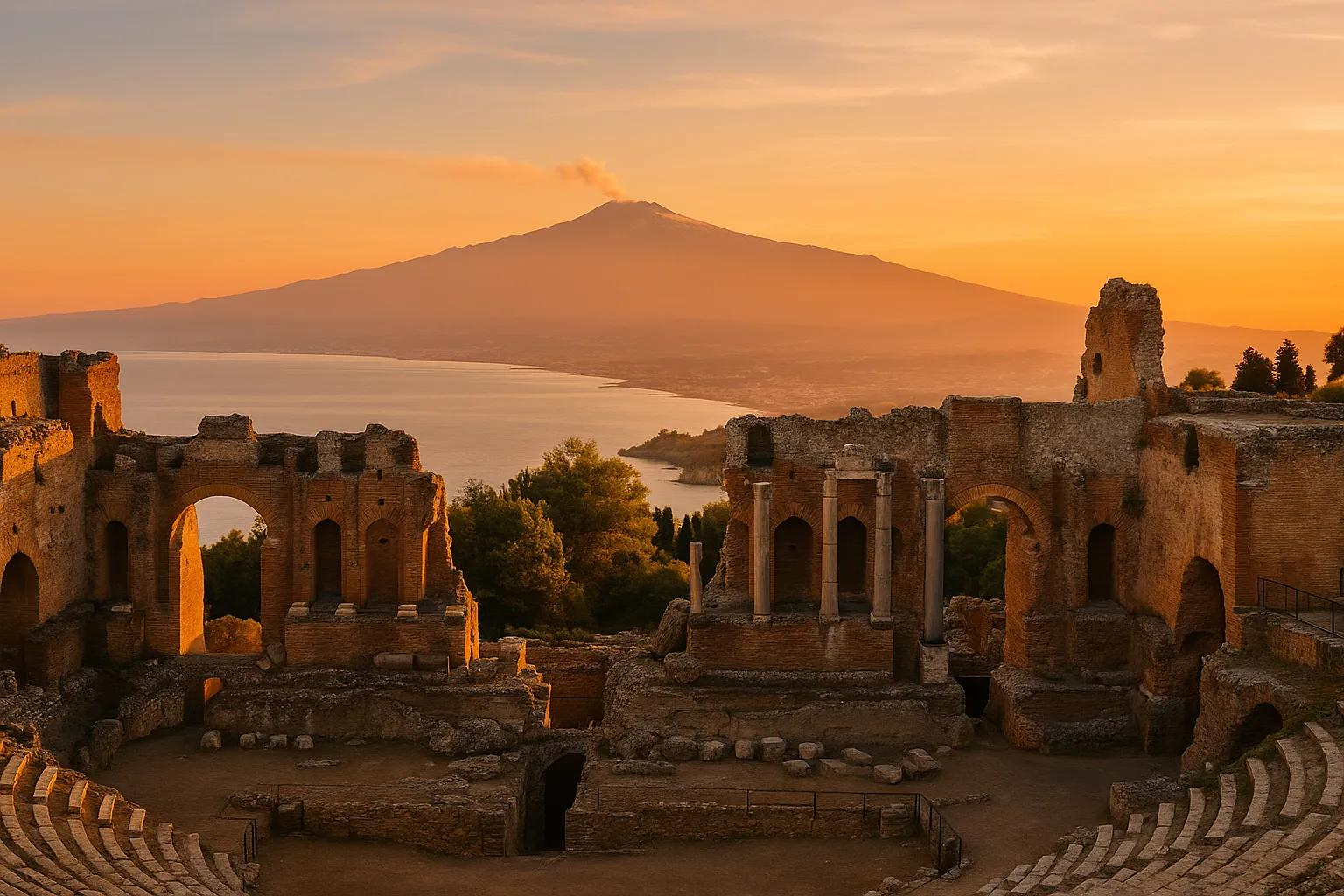
As the sun moves behind the Sicilian interior, Mount Etna, the coastline and the stone of Taormina begin changing colour. The Ancient Theatre becomes especially atmospheric in the late light, while elevated terraces reveal layers of mountain, sea and coastline rather than a single western horizon.
That distinction makes Taormina worth including. A list of Sicily’s finest sunsets should not simply rank places where the sun visibly disappears into the sea. Evening light can be equally compelling when it illuminates a landscape from the side or from behind.
Taormina’s position high above the Ionian Sea makes this particularly dramatic. Piazza IX Aprile, panoramic hotel terraces and elevated viewpoints around the town all offer different interpretations of the transition from day to night.
The destination becomes even more atmospheric immediately afterwards. Corso Umberto begins its evening passeggiata, terraces fill for aperitivo and the historic centre changes from a sightseeing destination into a social one.
Taormina: The Enchanted Balcony of Sicily’s Eternal Shores
For couples, the advantage is obvious: sunset does not end the experience. It begins the evening.
Western Sicily Offers the Strongest Sunset Road Trip
Travellers who want to make sunset a genuine theme rather than a single photograph should consider western Sicily.
The geography is naturally favourable. From Cefalù on the north coast, a journey can continue through Palermo towards Scopello, Trapani, Erice and Marsala. Each location offers a different relationship with the setting sun.
Trapani itself occupies an unusual position between seas and faces towards the Egadi Islands. Torre di Ligny, at the far western extremity of the city, looks across the surrounding waters, while nearby salt landscapes extend south towards Marsala. Visit Sicily specifically recommends the Via del Sale for its Mediterranean sunsets. (Visita Sicilia)
Marsala then provides the climax with the Stagnone.
For travellers continuing by yacht, the Egadi Islands add another layer. Favignana, Levanzo and Marettimo move the experience offshore, where sunset is no longer framed by Sicily’s coastline but by open water and island silhouettes.
Sicily by Yacht: The Most Beautiful Coastlines to Explore by Sea
The luxury lies in leaving enough flexibility to respond to conditions. Clouds, wind and haze can completely change a sunset, and the most memorable evening may not occur at the viewpoint originally selected.
Sicily’s Finest Sunsets Are Experiences, Not Checkpoints
The mistake with sunset travel is turning a fleeting natural event into another item on an itinerary.
Sicily rewards the opposite approach.
At the Stagnone, arrive early enough to understand the salt-making landscape before it becomes a silhouette. On Salina, swim during the afternoon and allow Pollara to become the natural conclusion to the day. In Cefalù, walk from the cathedral towards the sea without rushing. At Erice, explore the medieval town before searching for the horizon. Around Scala dei Turchi, respect the landscape and consider seeing it from the water. In Taormina, remain after the last light because the transition into evening is part of the experience.
Season matters as well. Summer provides long evenings and the strongest Mediterranean holiday atmosphere, but also greater visitor numbers. May, June, September and early October can offer an appealing balance between pleasant weather and a slower rhythm.
The position of the sun also shifts significantly throughout the year, so a viewpoint that produces a particular alignment in midsummer will not create precisely the same composition in spring or autumn. For photographers and travellers planning a special occasion, checking the sunset direction and time for the exact date is worthwhile.
But precision should not overwhelm the experience.
The finest Sicilian sunsets are memorable precisely because the island gives the light something extraordinary to work with: the mirrored geometry of salt pans, a prehistoric volcanic crater, a Norman cathedral beside the sea, medieval stone high above Trapani, brilliant white marl or the silhouette of Mount Etna.
The sun is the same. Sicily continually changes the stage.
Frequently Asked Questions
Where is the most beautiful sunset in Sicily?
The Stagnone and salt pans near Marsala are among the strongest choices. Their western position, shallow reflective basins and historic windmills create an unusually distinctive sunset landscape, and Sicily’s official tourism authority specifically highlights the area for its sunsets. (Visita Sicilia)
Where can couples watch a romantic sunset in Sicily?
Pollara on Salina, Cefalù, the Marsala salt pans and Erice are particularly atmospheric. Pollara combines volcanic scenery with the sea, while Cefalù allows sunset to transition naturally into dinner and an evening in the historic centre.
Which Sicilian island has the best sunset?
Salina is one of the most compelling choices, especially at Pollara. The bay lies within a partially submerged ancient volcanic crater, and Visit Sicily specifically recommends its sunset as part of an Aeolian sailing itinerary. (Visita Sicilia)
Is Taormina good for sunset?
Yes, although Taormina offers a different experience from west-facing locations such as Marsala. The attraction is the changing evening light across Mount Etna, the Ionian coastline, the Ancient Theatre and the elevated town rather than watching the sun descend directly into the sea.
What is the best season for watching sunsets in Sicily?
Sunsets can be enjoyed year-round, but late spring through early autumn makes it easier to combine them with outdoor dining, beaches and yacht excursions. June and September are particularly attractive for travellers seeking a Mediterranean atmosphere without concentrating exclusively on the busiest weeks of high summer.
By Luxury Magazine Editorial Team