The Mediterranean has always provided unusually fertile ground for hotel design. Architecture here must respond not only to aesthetics but also to intense sunlight, sea views, dry landscapes, historic buildings and centuries-old traditions of living between interior and exterior spaces.
The most convincing luxury design hotels understand this relationship.
Rather than importing an international aesthetic and placing it beside the sea, they draw from their surroundings. Whitewashed Cycladic volumes appear in Mykonos. Local stone and Ottoman references shape a hillside retreat in Bodrum. An old Ibizan finca retains its sabina beams and terracotta floors. On Hvar, contemporary architecture is deliberately broken into smaller structures so that a substantial resort becomes less intrusive within the landscape.
Design also extends beyond architecture. Furniture, gardens, lighting, art, craftsmanship and even the route through a property influence how a hotel feels.
The following hotels represent different interpretations of Mediterranean design, from contemporary minimalism to sensitive restoration. They are not included simply because they are luxurious or photogenic. In each case, design contributes directly to the experience of the destination.
Kalesma Mykonos: Contemporary Cycladic Architecture
Kalesma provides one of the clearest examples of contemporary hospitality architecture drawing from the traditional language of the Cyclades without simply reproducing it.
Positioned above Aleomandra on Mykonos, the property was conceived less as a conventional resort than as a contemporary village. Low whitewashed volumes follow the hillside, while paths, terraces and gathering spaces create the impression of a settlement that has developed gradually rather than a single monumental hotel building. (Kalesma Mykonos)

The material palette reinforces that relationship with place. Limewashed walls and sandblasted stone are balanced by oak, rattan, lava and darker metal elements. Curved forms reference traditional Cycladic geometry, while the architecture has been positioned to interact with the island’s wind and exceptional natural light. (Kalesma Mykonos)
An original aloni, or threshing floor, has also been preserved within the property, maintaining a physical connection with Mykonos’s agricultural past.
This is what makes Kalesma particularly interesting from a design perspective. Its architecture does not attempt to compete with the Aegean landscape. Buildings remain relatively low, views are framed deliberately and indoor and outdoor spaces flow into one another.
The hotel’s newer rooms and suites have continued that direction under Studio Bonarchi, which has also designed Kalesma’s Open-Air Wellness Sanctuary. (Kalesma Mykonos)
For travelers interested in contemporary Greek architecture, Kalesma demonstrates how Cycladic visual language can evolve without losing its relationship with place.
Kalesma Mykonos official website
Amanruya Bodrum: Mediterranean and Ottoman Design in the Landscape
Amanruya approaches the Mediterranean from a very different architectural tradition.
Set among olive groves, cypress and pine forest on the northern coast of the Bodrum Peninsula, the resort has been designed to resemble a village gradually ascending through the landscape.
Its architecture draws simultaneously from Mediterranean and Ottoman traditions. Courtyards, terraces, stone walls and changes in elevation create a sequence of intimate spaces rather than a conventional hotel block. Aman describes the resort as inspired by regional architecture and traditional building methods. (Aman)
The individual pavilions continue this language.
Local stone and wood, terracotta roofs, white walls and marble floors are complemented by Ottoman-influenced details such as dark timber beams, traditional kilim rugs and mangal fireplaces. Each freestanding pavilion has its own garden and swimming pool, allowing architecture and landscaping to work together rather than separating accommodation from the surrounding environment. (Aman)

The result is intentionally restrained.
Amanruya does not depend on decorative spectacle. Much of its visual identity comes instead from proportion, stone, vegetation, shadow and the transition between enclosed courtyards and Aegean views.
There is an important current consideration for travelers: Aman states that Amanruya is presently closed while resort enhancements are underway, with a reopening date still to be announced. (Aman)
Its inclusion here is therefore architectural rather than a recommendation for an immediate stay.
Travelers exploring this part of Turkey can also continue with our Best Design and Architecture Hotels in Bodrum guide for a broader look at how contemporary hospitality is responding to the peninsula’s landscape and architectural heritage.
Atzaró Agroturismo Ibiza: The Reinvention of the Ibizan Finca
Not all significant hotel design begins with new architecture.
Atzaró Agroturismo demonstrates the opposite approach: preserving the architectural vocabulary of an old rural property while adapting it for contemporary hospitality.
The estate originated as a centuries-old finca and working farm. When transformed into a luxury agroturismo, the restoration retained elements including white-limed walls, exposed sabina-wood beams, natural stonework and spaces adapted from the original agricultural buildings. (Atzaró Agroturismo Hotel)
The interiors continue the connection.
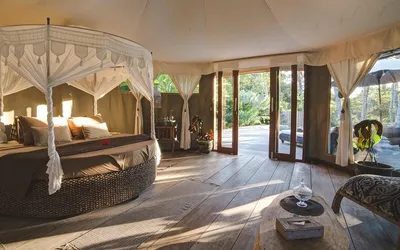
Terracotta flooring, natural woods, handcrafted details and subdued earthy colors create rooms that feel connected with Ibiza’s countryside rather than designed according to a generic resort formula. The hotel’s rooms are individually configured, with private terraces, gardens and, in some categories, pools. (Atzaró Agroturismo Hotel)

Landscape is equally important to the design.
Atzaró occupies a 13-hectare estate of gardens, orange groves, terraces, courtyards and agricultural spaces. Rather than functioning as scenery surrounding the architecture, these elements determine how guests move through and experience the property. (Atzaró Agroturismo Hotel)
This makes Atzaró particularly relevant to the evolution of Balearic luxury.
Ibiza’s traditional architecture was created for agricultural life rather than international hospitality. Atzaró demonstrates how that heritage can become the foundation for a luxury hotel without erasing the characteristics that made the original finca distinctive.
Its strongest design lesson is therefore not minimalism or visual drama, but continuity.
Readers interested in the wider evolution of Spanish hospitality can explore our Luxury Hotel Design Trends in Spain feature, which examines the growing importance of local materials, adaptive reuse and destination-sensitive architecture.
Atzaró Agroturismo official website
Maslina Resort Hvar: Architecture Designed to Recede
On the Croatian island of Hvar, Maslina Resort provides an interesting example of contemporary architecture attempting to reduce its visual impact.
The challenge was significant. Architect Tomislav Alujević of Split-based Architecture Studio Aalto has explained that the hotel encompasses approximately 7,000 square metres, requiring a strategy that would prevent the property from appearing as one enormous building within the Mediterranean landscape. (maslinaresort.com)
The solution was to disperse the architecture.
Public and service areas were incorporated partly into the terrain, while the principal structures were broken into smaller visual components. A vertical timber façade was developed to relate to the trunks and colors of the surrounding trees, helping the architecture sit more quietly within the landscape. (maslinaresort.com)

The transition between interior and exterior is equally deliberate. Terracotta flooring continues across spaces, large openings increase visual continuity and common areas are designed around the mild Hvar climate and the possibility of spending much of the day outdoors.
Inside, the material language remains closely connected with the Adriatic. The resort identifies terracotta, stone from Brač, local wood and brushed brass among the elements used throughout the interiors, where Mediterranean simplicity is combined with French influences. (maslinaresort.com)
Maslina is therefore a useful counterpoint to the white architecture of Mykonos or the historic finca of Ibiza.
Its design is contemporary, but its strongest achievement is making a relatively substantial hospitality project appear less dominant within its natural environment.
Maslina Resort official website
Zannier Île de Bendor: Reinventing a Private French Mediterranean Island
One of the most interesting recent Mediterranean hotel projects occupies an entire island rather than a single building.
Zannier Île de Bendor opened on 1 May 2026 following a five-year transformation of the private island off Bandol on the French Mediterranean coast. The project encompasses a 93-key hotel together with restaurants, bars, wellness facilities and cultural spaces. (Zannier Hotels)
The island’s history makes the project particularly unusual.
Paul Ricard acquired Bendor in the 20th century and developed it as a creative Mediterranean retreat associated with artists and artisans. The contemporary redevelopment therefore had to address an existing identity rather than create a destination from nothing.

Zannier’s transformation has encompassed architecture, interior design and landscaping, while retaining the idea of Bendor as a place connected with creativity and Mediterranean social life. (Zannier)
Accommodation is divided into three distinct expressions.
Delos recalls the glamour of the French Riviera in the 1960s. Soukana presents a more secluded seaside identity, while the Madrague houses reinterpret the experience of staying in Provençal homes close to the harbor. (Zannier Hotels)
This plurality makes Bendor different from hotels built around one tightly controlled aesthetic.
The design challenge has instead been to give several areas distinct personalities while allowing the island to remain coherent as a whole.
For travelers interested in the direction Mediterranean luxury hospitality is taking in the second half of the 2020s, Bendor is particularly relevant: restoration, landscape, wellness, art and destination-making are being treated as parts of one design project.
Zannier Île de Bendor official website
Hotel Il Pellicano: Timeless Italian Riviera Style
Some design hotels become important because they introduce something new. Others matter because their identity survives changes in fashion.
Hotel Il Pellicano belongs to the second category.
The hotel descends toward a secluded cove at Porto Ercole on Monte Argentario, overlooking the Tyrrhenian Sea. Its history stretches back to 1965, when it developed as a private Mediterranean retreat before evolving into one of Italy’s recognizable coastal hotels. (pellicanohotels.com)

Its appeal cannot be reduced to one architecturally dramatic feature.
Instead, Il Pellicano is an exercise in atmosphere: terraces covered with bougainvillea, sea-facing rooms, restrained interiors and architecture stepping down toward the coast.
That apparent effortlessness is closely connected with the hotel’s concept of sprezzatura — a form of studied Italian ease in which refinement should not feel overworked. The hotel group explicitly describes understated luxury, Italian craftsmanship, culture and design as central to its identity. (Pellicano Hotels)
This provides an important contrast with more obviously architectural hotels.
Design does not always need to announce itself through spectacular geometry. At Il Pellicano, it is equally present in color, landscaping, furniture, proportions and the relationship between the hotel and its famous stretch of Mediterranean coastline.
The result demonstrates why timelessness can be as significant as novelty in luxury hospitality.
Hotel Il Pellicano official website
The Importance of Place in Mediterranean Hotel Design
The strongest connection between these hotels is not a particular visual style.
Kalesma’s white Cycladic architecture looks little like Maslina’s timber façades. Amanruya’s stone pavilions are fundamentally different from Atzaró’s agricultural finca, while Bendor’s French Riviera references have little reason to resemble the restrained Italian atmosphere of Il Pellicano.
What connects them is their response to location.
This has become one of the defining characteristics of sophisticated Mediterranean hospitality design.
Local materials help buildings belong to their surroundings. Existing structures provide historical continuity. Courtyards, terraces and large openings acknowledge a climate in which outdoor living is central to the experience. Landscaping softens the boundary between architecture and nature.
The result is a move away from the internationally interchangeable luxury hotel.
A traveler should be able to wake at Kalesma and understand something about the Cyclades before leaving the property. At Atzaró, architecture should communicate Ibiza’s rural heritage. At Amanruya, stone, courtyards and Ottoman references establish a relationship with the Turkish Aegean.
That sense of place is increasingly valuable precisely because luxury hotels have become so global.
Architecture, Interiors and Landscape as a Complete Experience
Architecture alone does not make a successful design hotel.
A dramatic building can become surprisingly unconvincing when interiors, gardens and guest experience speak entirely different visual languages.
The best Mediterranean properties instead treat these elements as interconnected.
Maslina’s wooden façades make sense because they respond to the surrounding trees. Atzaró’s natural interiors make sense because guests step outside into an agricultural estate. Kalesma’s low forms work because the architecture repeatedly returns attention to wind, light and the Aegean horizon.
Landscape architecture is particularly important in the Mediterranean.
Olive trees, cypress, pine, citrus, aromatic herbs, dry stone and native vegetation can provide continuity between constructed and natural environments. At the best hotels, planting does not feel like decoration added after the building was completed.
The same principle applies indoors.
Local stone, timber, ceramics, woven textiles and traditional craft can give contemporary rooms regional identity without requiring designers to reproduce historic interiors literally.
The most successful properties interpret rather than imitate.
Choosing a Luxury Design Hotel in the Mediterranean
Travelers interested primarily in contemporary architecture should consider Kalesma Mykonos and Maslina Resort, where new buildings have been conceived specifically around their landscapes.
For a stronger connection with regional architectural tradition, Amanruya provides one of the most distinctive interpretations of the Turkish Aegean, although its current temporary closure needs to be considered when planning a trip. (Aman)
Atzaró Agroturismo is more appropriate for travelers interested in adaptive reuse, rural heritage and the architecture of traditional Ibiza.
Zannier Île de Bendor offers something different again: the comprehensive regeneration of a historic private Mediterranean island.
Finally, Hotel Il Pellicano demonstrates that significant hotel design does not have to be new. Its strength lies in preserving an identifiable Mediterranean aesthetic over decades without allowing the experience to become a museum piece.
The right choice therefore depends on what aspect of design matters most: architectural innovation, restoration, interiors, craftsmanship, landscape or historical character.
Frequently Asked Questions
What defines a luxury design hotel?
A genuine design hotel uses architecture, interiors, furniture, art and landscape as fundamental parts of the guest experience. Attractive decoration alone is not enough; there should be a coherent design concept connecting the property with its location and identity.
Which Mediterranean destination is particularly strong for contemporary hotel architecture?
The Greek islands are especially interesting because architects continually reinterpret traditional Cycladic forms through contemporary materials and layouts. Mykonos provides several examples, with Kalesma using low volumes, whitewashed surfaces and contemporary geometry to reinterpret the idea of an island village. (Kalesma Mykonos)
Which Mediterranean design hotels are best for traditional architecture?
Atzaró Agroturismo is particularly relevant for traditional Ibizan finca architecture, while Amanruya interprets regional Turkish, Mediterranean and Ottoman architectural influences within a contemporary luxury resort.
Are historic hotels considered design hotels?
Yes. Design does not require new construction. Sensitive restoration and adaptive reuse can produce some of the Mediterranean’s most interesting hotels, particularly when historic materials and spatial characteristics are retained rather than concealed.
Which hotel is best for travelers interested in sustainable design?
Maslina Resort is particularly interesting from an architectural perspective because its design deliberately sought to reduce the visual impact of a large hotel within Hvar’s existing landscape. Buildings were dispersed, elements were integrated into the terrain and the architecture uses natural materials to strengthen the relationship with its surroundings. (maslinaresort.com)
Which luxury design hotel offers the strongest rural experience?
Atzaró Agroturismo provides one of the clearest examples among these properties. The hotel occupies a 13-hectare Ibizan estate incorporating orange groves, gardens and agricultural spaces, while its architecture retains elements of the historic finca. (Atzaró Agroturismo Hotel)
By Luxury Magazine Editorial Team