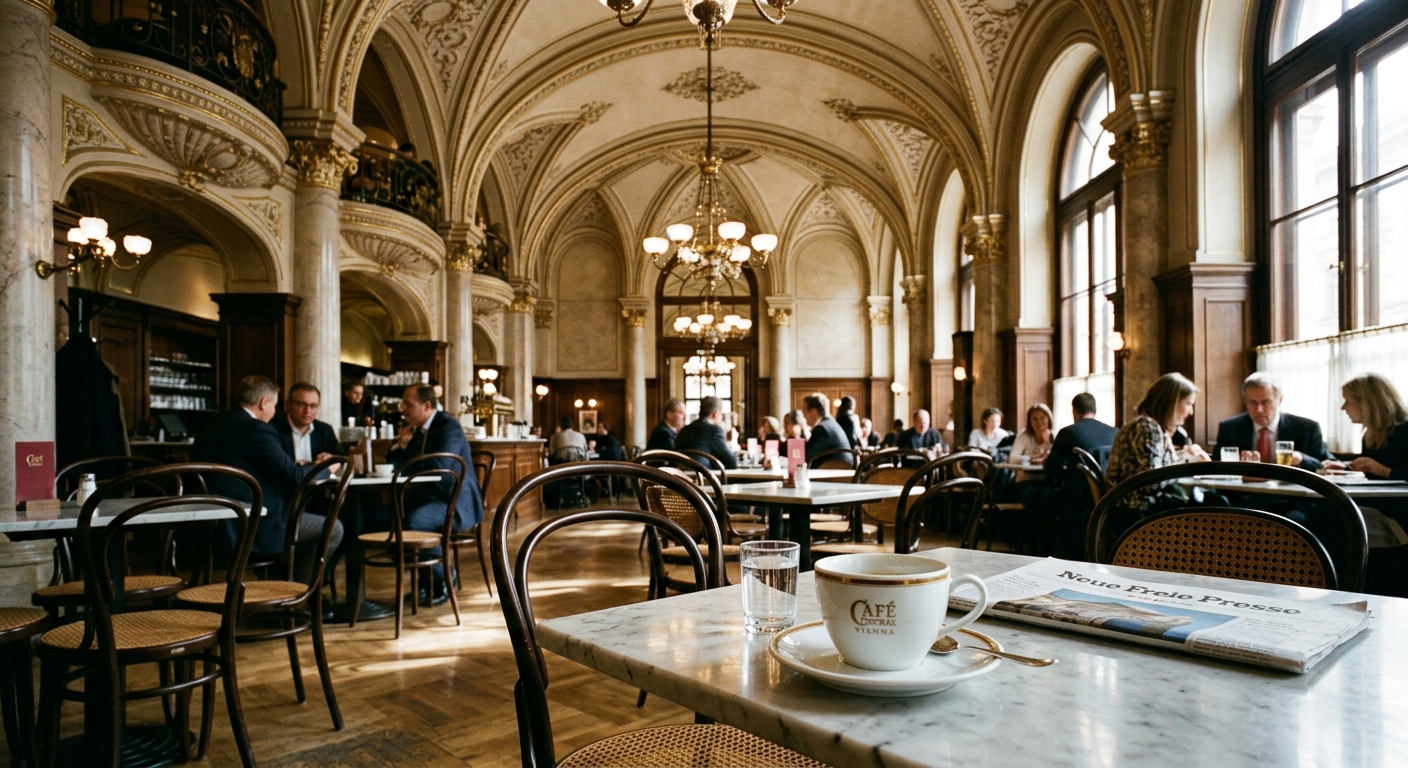
What makes Vienna historic coffeehouses so culturally significant
Vienna historic coffeehouses are not simply places to drink coffee. They are living monuments. For over three centuries, they have served as the city’s true public living rooms, where politics, philosophy, art and gossip have all swirled together over a single cup of Melange. No other café culture on earth comes close to matching their depth and continuity.
UNESCO-recognised heritage of Vienna historic coffeehouses
In 2011, UNESCO formally inscribed Viennese coffeehouse culture onto its list of Intangible Cultural Heritage. This recognition was a milestone. It confirmed what Viennese residents had long known: these spaces are irreplaceable.
The designation covers not just the buildings, but the rituals, the social codes and the very atmosphere of sitting undisturbed for hours. UNESCO described Vienna’s café culture as a place where time and space are consumed, but only coffee is billed. That phrase captures everything.
The intellectual and artistic soul of Vienna’s café culture
Vienna historic coffeehouses have always attracted thinkers, dreamers and rebels. Sigmund Freud developed psychoanalytic theories over marble tables. Gustav Klimt sketched between sips of Einspänner. Leon Trotsky reportedly played chess at Café Central before returning to revolutionary politics in Russia.
These were not coincidences. The coffeehouses offered warmth, light, newspapers and no pressure to leave. For writers without offices and artists without studios, they were the perfect sanctuary. That welcoming spirit still lingers in every corner today.
How historic coffeehouses shaped European thought and creativity
The influence of Vienna’s café culture radiated outward across Europe. Intellectuals from Paris, Berlin and Prague visited and returned home inspired. Literary movements, political philosophies and musical innovations all germinated here.
Additionally, the coffeehouse model of open, unhurried exchange encouraged debate in ways that universities and salons could not. Ideas moved freely across class lines. A merchant could argue with a poet. A student could challenge a professor. In short, these spaces were the original democratic forums of modern Europe.
The essential Vienna historic coffeehouses every visitor must experience
Not every café in Vienna carries equal weight. However, a handful of legendary establishments rise above the rest. These are the ones that every food-focused traveller and heritage enthusiast must visit at least once in their lifetime.
Café Central: where emperors and intellectuals converged
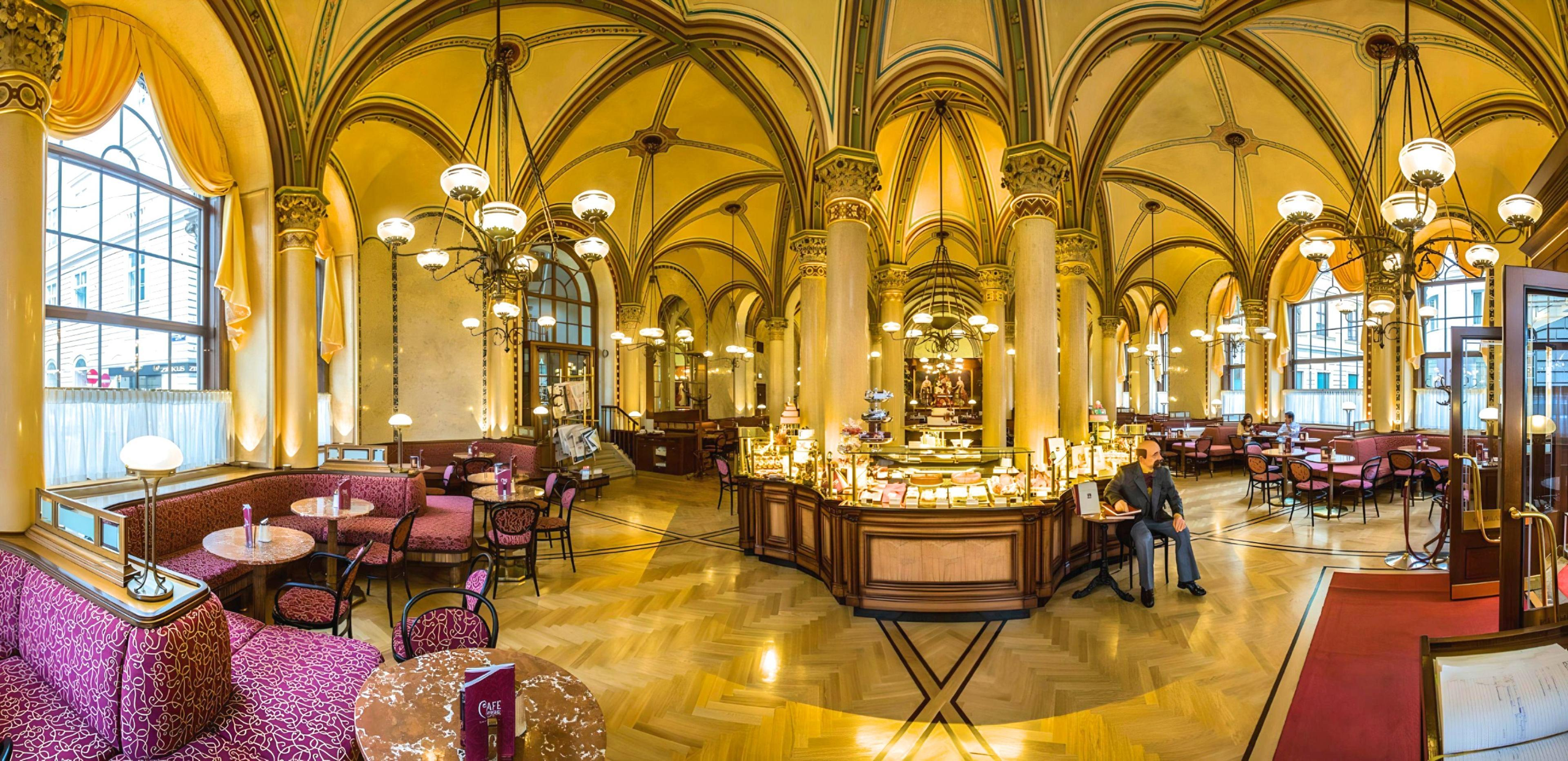
Café Central opened in 1876 inside the Palais Ferstel, a neo-Gothic masterpiece in Vienna’s First District. The soaring vaulted ceilings and elegant archways make it immediately breathtaking. It is arguably the most architecturally stunning of all Vienna’s historic coffeehouses.
The menu is extensive, covering everything from a classic Melange to elaborate pastry platters. Arrive early on weekdays to secure a window seat. The breakfast service here is particularly impressive, featuring freshly baked Kipferl and seasonal fruit preserves alongside your coffee.
Café Sacher: the birthplace of Austria’s most iconic dessert
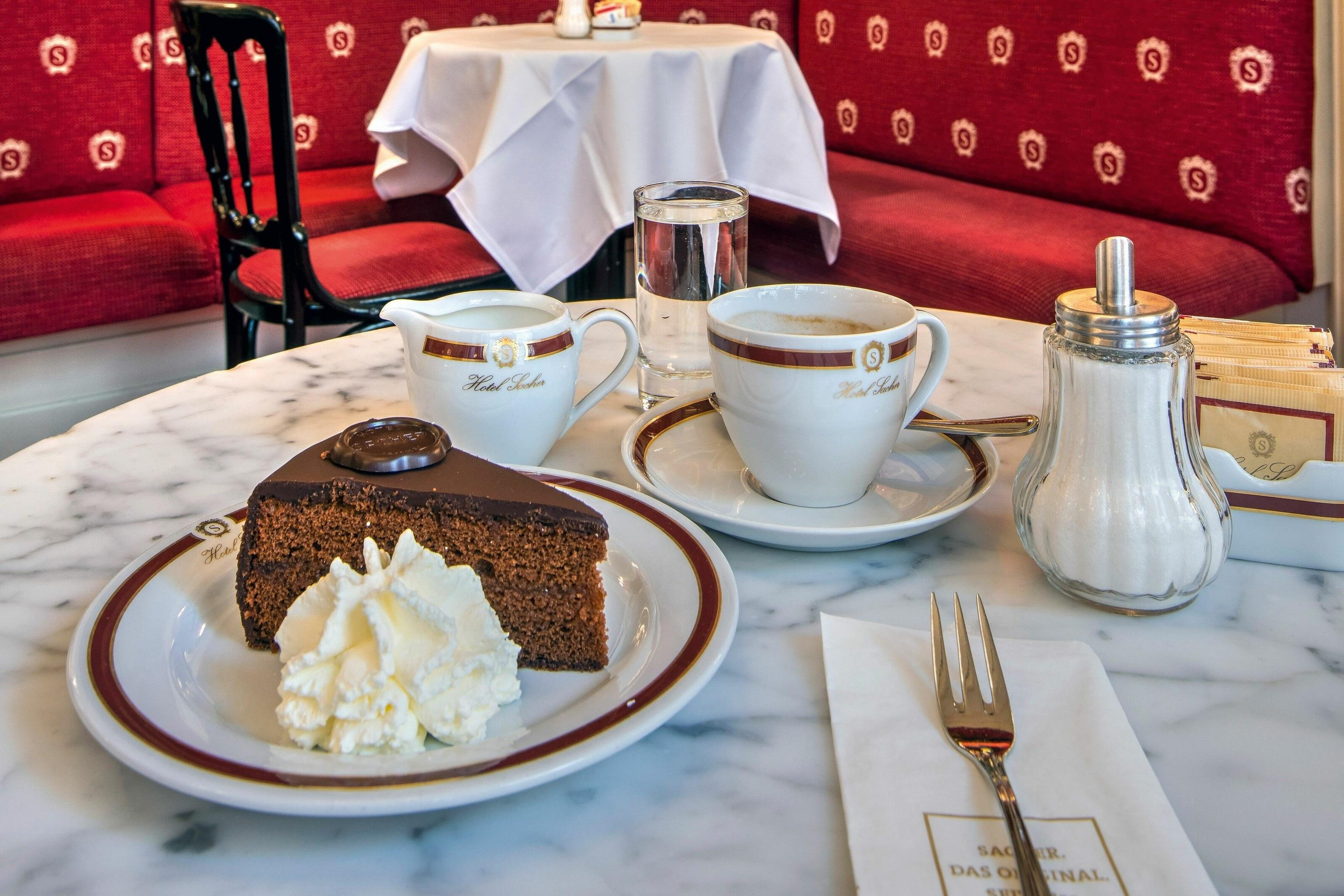
Café Sacher sits adjacent to the legendary Hotel Sacher, just steps from the Vienna State Opera. It is the only place in the world where you can eat the original Sachertorte in its proper setting. That fact alone justifies any queue.
The atmosphere is plush and slightly formal, with deep red banquettes and white-gloved service. However, do not let that intimidate you. The staff are warm and professional. The Sachertorte itself is dense, chocolatey and intensely satisfying. Pair it with an Einspänner for the full experience.
Demel: imperial confectionery meets historic coffeehouse
Demel occupies a rarefied position in Vienna’s culinary landscape. Founded in 1786, it held the title of Imperial and Royal Court Confectioner for decades. Today, it remains one of the finest pastry establishments in the world.
The window displays alone are worth a visit. Elaborate sugar sculptures and marzipan creations change with the seasons. Inside, the gilded interior and marble countertops feel genuinely imperial. Demel’s version of the Sachertorte is famously different from Café Sacher’s, and the debate between devotees of each version remains delightfully unresolved.
Café Landtmann: where Viennese tradition meets timeless elegance
Café Landtmann opened in 1873 and has since become the preferred gathering spot for Austria’s political class. It sits directly opposite the Burgtheater, one of Europe’s great theatres. Sigmund Freud was a regular guest.
The atmosphere here balances grandeur with comfort. The dark wood panelling and generous booth seating make it easy to settle in for hours. Of all Vienna’s historic coffeehouses, Landtmann perhaps best embodies the idea of the café as a true second home for its guests.
Understanding the customs and rituals of Vienna’s historic coffeehouses
Walking into a Vienna historic coffeehouse without knowing the customs can feel slightly daunting. However, once you understand the rhythms and the unwritten rules, you will feel immediately at ease. The culture rewards patience and observation.
The Melange: Vienna historic coffeehouses’ most beloved beverage
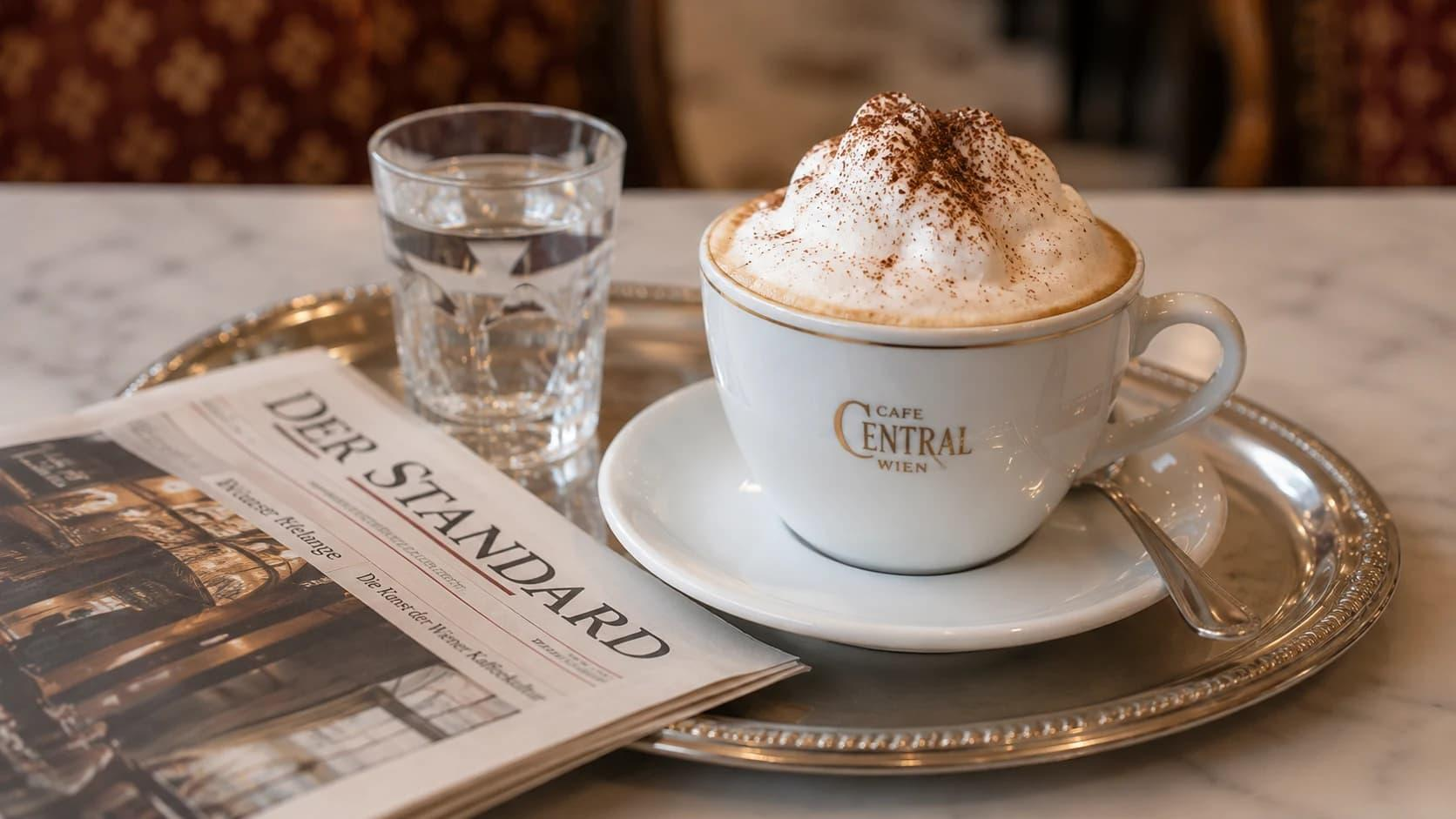
The Melange is Vienna’s signature coffee drink. It consists of espresso topped with steamed milk and a little milk foam, similar in spirit to a cappuccino but distinctly Viennese in character. It arrives alongside a small glass of still water, always.
In Vienna historic coffeehouses, the water glass is quietly refilled by your waiter without you needing to ask. This small gesture embodies the philosophy of the entire institution. You are a guest, not a transaction. The Melange is best enjoyed slowly, without rush.
Coffee terminology and ordering etiquette in Vienna cafés
The Viennese coffee menu can surprise first-time visitors. Beyond the Melange, you will encounter the Einspänner (black coffee topped with whipped cream in a glass), the Verlängerter (a weaker, longer espresso), and the Schwarzer (a simple, strong black coffee). Each has its own devoted following.
When ordering, catching a waiter’s eye is the accepted method. Do not wave or call out. The staff in these historic establishments are professionals. They will come to you. Address them politely and they will guide you through the menu with genuine expertise and quiet pride.
The unwritten social codes of spending time in historic coffeehouses
One of the defining features of Vienna’s café culture is that you are never rushed. A table is yours for as long as you wish. You may sit for three hours over a single coffee without any expectation of spending more. This is not just tolerance. It is the house philosophy.
Similarly, the newspapers provided on wooden holders are for communal use. Pick one up, read it, return it. Conversations are generally kept to a respectful volume. There is a particular kind of contemplative quiet in these spaces. Embrace it rather than fighting it.
Pastries, newspapers and the art of unhurried conversation
The coffeehouse experience is inseparable from its accompaniments. A fresh Apfelstrudel, a folded newspaper and a conversation with a companion are the holy trinity of the Viennese café afternoon. Each element supports the others.
For example, the pastry gives you something to do with your hands while you think. The newspaper offers a bridge between solitary reflection and social engagement. The conversation deepens when there is no sense of urgency. Taken together, these rituals create one of the most genuinely civilised leisure experiences available anywhere on earth.
How to plan your visit to Vienna historic coffeehouses
Planning your coffeehouse visits carefully will transform a pleasant afternoon into an unforgettable cultural experience. There are several practical considerations worth addressing before you arrive.
Best times to visit Vienna’s coffeehouses for an authentic experience
Weekday mornings between 9am and 11am are the sweet spot. The tourist crowds have not yet gathered, and you will see Viennese locals reading their papers and conducting quiet business meetings. That is the authentic coffeehouse atmosphere at its most genuine.
Spring (April and May) and autumn (September and October) are the best seasons overall. The weather is mild and the city is not overwhelmed with visitors. That said, visiting in winter has its own appeal. A cup of hot Melange during a Viennese snowfall is genuinely magical.
What to expect: atmosphere, pricing and dress codes
There is no formal dress code at most Vienna historic coffeehouses. However, smart casual clothing shows appropriate respect for these storied spaces. Avoid beachwear or overly casual athletic clothes. The atmosphere calls for a little effort.
Pricing is reasonable for the quality and setting. A Melange typically costs between 3 and 5 euros. A slice of Sachertorte or Apfelstrudel runs between 6 and 10 euros. Premium establishments like Café Sacher charge slightly more. However, considering the hours of unrushed comfort on offer, the value is exceptional.
Booking and accessibility information for Vienna’s historic cafés
Most Vienna historic coffeehouses operate on a walk-in basis. Reservations are generally not required, though booking ahead is wise if you plan to visit for a full lunch or dinner service. Café Landtmann and Café Central both accept reservations online.
Accessibility varies by venue. Café Central has steps at its main entrance. Café Landtmann is largely accessible at ground level. If accessibility is a concern, contact the specific café directly before visiting. The staff are generally very helpful and accommodating.
Creating your personalized Vienna coffeehouse itinerary
A well-planned itinerary might include breakfast at Demel, a mid-morning coffee at Café Central, and an afternoon treat at Café Sacher. That covers three distinct architectural styles and three very different atmospheres in a single day.
On a second day, add Café Landtmann for lunch and end with an evening visit to one of the smaller, lesser-known historic cafés in the Seventh or Eighth Districts. These neighbourhood establishments offer a quieter, more residential version of the same extraordinary culture.
The history behind Vienna historic coffeehouses and their legacy
To truly appreciate Vienna historic coffeehouses, you need to understand how they came to exist and why they became so culturally foundational. The story spans more than three hundred years.
How coffeehouses arrived in Vienna and transformed the city
Coffee arrived in Vienna in the late 17th century, most likely following the Ottoman siege of 1683. According to popular legend, the Polish-born merchant Georg Franz Kolschitzky obtained sacks of coffee beans left behind by retreating Ottoman forces. He opened one of the city’s first coffeehouses shortly after.
Within decades, coffeehouses had spread across the city. They quickly outgrew their role as mere refreshment stops. By the 18th century, they functioned as post offices, business exchanges, reading rooms and social hubs all rolled into one. The transformation of Vienna’s civic life was rapid and lasting.
Literary giants, musicians and philosophers who shaped Vienna’s café culture
The list of famous regulars at Vienna’s historic coffeehouses reads like a cultural hall of fame. Stefan Zweig wrote about coffeehouse culture with deep affection. Johannes Brahms composed between visits to Café Frauenhuber. Arthur Schnitzler developed his literary ideas over long afternoons at his favourite table.
These were not passive consumers of atmosphere. They were active participants who shaped the intellectual character of each establishment. In turn, the coffeehouses shaped them. The relationship was genuinely symbiotic and explains why Vienna’s café culture produced such extraordinary creative output over such a sustained period.
Preserving Vienna’s historic coffeehouses for future generations
Preservation is an ongoing challenge. Several historic coffeehouses have closed in recent decades due to rising rents and changing consumer habits. Each closure represents a genuine cultural loss. However, the UNESCO designation has brought renewed attention and some financial support for preservation efforts.
Furthermore, a growing movement of young Viennese entrepreneurs is choosing to restore rather than replace. Several formerly closed historic cafés have reopened with careful attention to their original interiors and traditions. That gives reason for genuine optimism about the future of Vienna’s café heritage.
Modern challenges facing traditional Vienna coffeehouses
The rise of global coffee chains poses a real threat. International brands offering fast service and take-away cups operate on a fundamentally different philosophy. They compete for the same urban foot traffic and often win on convenience and price.
Additionally, the demand for fast WiFi, laptop-friendly seating and mobile ordering sits uneasily with the unhurried, conversation-centred culture of the traditional coffeehouse. Some historic establishments have adapted cautiously. Others have held firm to their traditions. The tension between heritage and modernity remains unresolved and worth watching closely.
Complementary food and beverage experiences at Vienna historic coffeehouses
The food and drink menus at Vienna historic coffeehouses deserve as much attention as the coffee itself. In fact, for many visitors, the pastry selection is the highlight of the entire visit.
Sachertorte and signature cakes unique to each historic coffeehouse
The Sachertorte is Vienna’s most famous cake. A dense chocolate sponge layered with apricot jam and coated in smooth dark chocolate glaze, it is a masterpiece of restrained sweetness. Café Sacher and Demel both claim the authentic recipe, a dispute that has never been fully settled.
Beyond the Sachertorte, each historic coffeehouse tends to have its own signature cake. Café Central is known for its Esterhazytorte, a delicate layered almond meringue cake. Café Landtmann offers a superb Gugelhupf. Exploring these unique offerings is a delicious reason to visit multiple establishments rather than just one.
Viennese pastries and their perfect coffee pairings
Apfelstrudel pairs beautifully with a Melange. The warmth of the flaky pastry and the cinnamon-spiced apple filling complement the creamy, milky coffee perfectly. This is probably the most classic combination in the entire Viennese coffeehouse repertoire.
For something richer, try a Topfenstrudel (cream cheese strudel) alongside an Einspänner. The thick whipped cream on the coffee mirrors the lightness of the strudel filling. Meanwhile, a Kipferl, the crescent-shaped pastry that inspired the French croissant, is best enjoyed in the morning with a simple Verlängerter.
Beyond coffee: specialty teas and hot chocolate traditions
Not every visitor drinks coffee. Fortunately, Vienna’s historic coffeehouses have always catered to tea drinkers as well. Establishment like Demel offer an extensive loose-leaf tea menu featuring blends sourced from across Europe and Asia.
Hot chocolate at Demel and Café Central is particularly exceptional. It is typically thick, dark and intensely flavoured, closer to drinking melted chocolate than anything you might find in a chain café. In autumn and winter, it is the single most comforting thing you can order in the entire city.
Lunch and dinner menus at Vienna’s distinguished historic cafés
Many visitors overlook the fact that Vienna historic coffeehouses serve full meals. The lunch menus at Café Central and Café Landtmann are genuinely impressive. Expect classic Austrian dishes such as Tafelspitz (boiled beef with horseradish), Wiener Schnitzel and seasonal soups.
Dinner at a Vienna historic coffeehouse is a different and special experience. The pace slows, the lighting softens and the evening crowd tends to be more local and less tourist-heavy. Booking a dinner table at Café Landtmann, in particular, offers a window into how Viennese society actually lives and entertains.
Conclusion: why Vienna historic coffeehouses belong on every traveller’s list
Vienna historic coffeehouses are far more than beautiful old buildings serving good coffee. They are active, living expressions of a cultural philosophy that places human connection, intellectual exchange and unhurried pleasure at the centre of daily life.
Whether you are a first-time visitor or a returning admirer, these legendary establishments offer something genuinely rare. That is, a direct and unbroken connection to centuries of European cultural history. No museum exhibit can replicate the experience of sitting where Freud once sat, drinking the same Melange, watching the city move past the window.
Plan your visit thoughtfully. Go on a quiet weekday morning. Order slowly. Stay as long as you wish. Vienna historic coffeehouses will reward every moment you give them with an atmosphere that is simply impossible to find anywhere else on earth.
Frequently Asked Questions
What are the most famous Vienna historic coffeehouses for tourists?
The top destinations are Café Central, Café Sacher, Demel and Café Landtmann. Each offers unique historical significance, stunning architecture and exceptional food. Café Central impresses with its vaulted ceilings, while Café Sacher is the only place to enjoy the original Sachertorte in its authentic setting.
Why are Vienna historic coffeehouses considered UNESCO cultural heritage?
UNESCO recognised Viennese coffeehouse culture in 2011 as Intangible Cultural Heritage. These establishments have shaped European intellectual, artistic and social life for over 300 years. Their unique philosophy of unhurried, open exchange makes them irreplaceable cultural institutions rather than ordinary commercial cafés.
How much does it cost to visit Vienna coffeehouses?
A Melange typically costs between 3 and 5 euros. Pastries range from 6 to 10 euros per slice. Premium venues like Café Sacher charge slightly higher prices. Overall, considering the extraordinary atmosphere and the unlimited time at your table, the value is genuinely exceptional for any visitor.
What is the best time of year to visit Vienna historic coffeehouses?
Spring (April and May) and autumn (September and October) offer the best combination of pleasant weather and manageable crowds. However, Vienna’s historic coffeehouses are charming year-round. A winter visit during snowfall, warming your hands around a hot Melange, is a truly unforgettable experience.
What should I order when visiting a Vienna coffeehouse for the first time?
Start with a traditional Melange, Vienna’s signature espresso-based coffee with steamed milk. Pair it with a slice of Sachertorte or a warm Apfelstrudel. This combination represents the very heart of authentic Viennese café culture and gives first-time visitors the most complete and satisfying introduction possible.