Singapore’s luxury hotel scene is closely connected to the city’s architectural history. While the skyline is increasingly defined by contemporary towers and ambitious new developments, some of the country’s most distinctive places to stay occupy buildings that were constructed decades, and in some cases more than a century, ago.
These properties offer a different interpretation of luxury. Their appeal is not based solely on contemporary interiors, expansive facilities or technology, but on the opportunity to stay within buildings that have played a role in Singapore’s social, commercial or architectural development. Former government buildings, colonial clubs, military residences and waterfront landmarks have been carefully restored and adapted into hotels while retaining important elements of their original identity.
Among them, Raffles Singapore remains one of the country’s most recognisable historic hotels, while The Fullerton Hotel occupies a former General Post Office and government building overlooking the Singapore River. Goodwood Park Hotel brings the atmosphere of a grand early-20th-century club to Orchard Road, while The Capitol Kempinski combines two conserved buildings in the Civic and Cultural District. On Sentosa, Capella Singapore and The Barracks Hotel offer different interpretations of island heritage, incorporating restored historic structures into contemporary resort environments.
For travellers interested in architecture and history as part of the hotel experience, these properties offer a way to understand Singapore through its places to stay.
Raffles Singapore: The Grande Dame of Singapore Hospitality
Few hotels are as closely associated with Singapore’s history as Raffles Singapore. The hotel opened in 1887 and became an important landmark during the city’s transformation into a major international trading centre. Today, it remains one of the world’s best-known surviving grand hotels from the colonial era. (Raffles Hotels & Resorts)
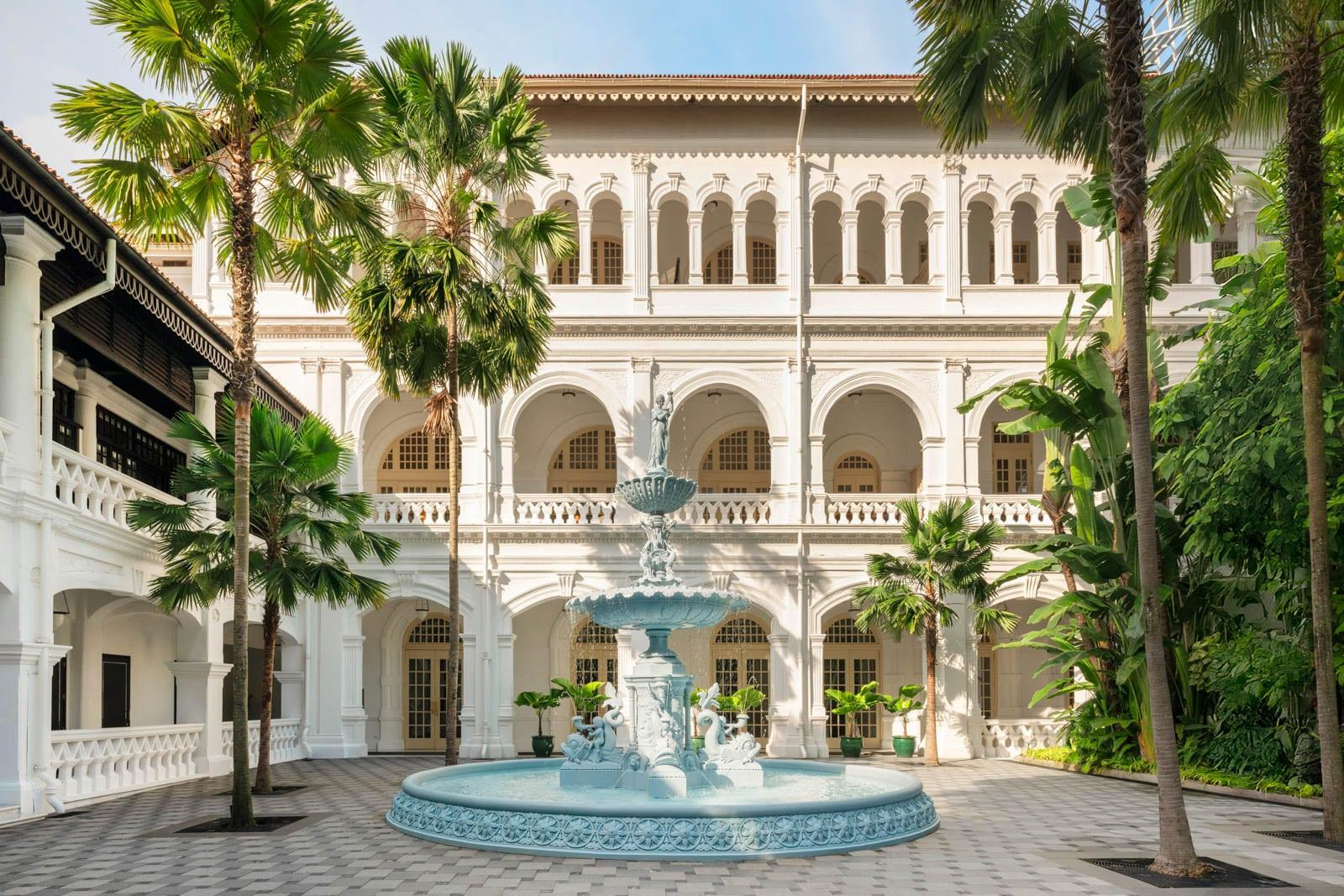
Its architecture is immediately recognisable: a white Neo-Renaissance-inspired façade, deep verandahs, high ceilings and extensive gardens create a visual contrast with the surrounding city. The property has retained the atmosphere of a traditional grand hotel while undergoing major restoration and modernisation.
Accommodation is now entirely composed of suites, with 115 suites arranged around courtyards and gardens. The interiors combine historic architectural details with contemporary technology and furnishings, maintaining the sense of staying within an important heritage property rather than converting it into a generic modern hotel. (Raffles Hotels & Resorts)
The hotel’s historical identity also extends into its restaurants and bars. Tiffin Room occupies a historic setting dating to 1892, while the Long Bar remains associated with the Singapore Sling. More recent additions, including 1887 by André and yì by Jereme Leung, introduce contemporary culinary interpretations without abandoning the property’s broader sense of history. (Raffles Hotels & Resorts)
Raffles has also developed heritage experiences that allow guests and visitors to explore the property’s history. Its current Heritage Tour is led by resident historians and focuses on the people, stories and defining moments associated with the hotel. (Raffles Hotels & Resorts)
This makes Raffles more than a historic façade preserved around a modern hotel. Its heritage remains part of the guest experience itself.
For readers interested in exploring the property in greater depth, our dedicated feature on Raffles Singapore can sit naturally within this wider guide to the city’s historic luxury hotels.
The Fullerton Hotel Singapore: From General Post Office to Heritage Hotel
Singapore’s relationship with its waterfront is particularly visible at The Fullerton Hotel Singapore. The hotel occupies the former Fullerton Building, a monumental neoclassical structure completed in 1928.
The building originally housed the General Post Office, the Exchange, the Chamber of Commerce and the Singapore Club. It therefore occupied a central position in the commercial and civic life of Singapore during the first half of the 20th century. The building was later gazetted as a National Monument in December 2015. (Fullerton Hotels)
The transformation into a hotel began a new chapter without erasing the building’s previous functions. Today, the 400-room property retains its monumental columns, grand central spaces and historic architectural proportions, while its rooms, restaurants and spa introduce the amenities expected of a contemporary luxury hotel. (Fullerton Hotels)
Its location is equally important. The hotel forms part of the wider Fullerton Heritage precinct, which brings together historic and contemporary waterfront buildings including The Fullerton Bay Hotel, Clifford Pier, Customs House, One Fullerton and The Fullerton Waterboat House. (Fullerton Hotels)
This means guests can experience heritage not simply within the hotel but throughout the surrounding district. The Singapore River, Marina Bay and the Civic District are all closely connected to the property’s history and current identity.
The Fullerton’s transformation demonstrates one of the most successful models of heritage hospitality in Singapore: rather than isolating a historic building from the city around it, the hotel places that history at the centre of a continually evolving waterfront district.

Goodwood Park Hotel: A Colonial-Era Landmark on Orchard Road
Goodwood Park Hotel offers a different perspective on Singapore’s heritage. Located on Scotts Road just off Orchard Road, the property occupies a building originally constructed in 1900 as the Teutonia Club, an exclusive social club for Singapore’s German expatriate community. (goodwoodparkhotel.com)
The architecture was designed by R. A. J. Bidwell of Swan and Maclaren and incorporates elements of Queen Anne Revival architecture. Its distinctive tower, verandahs, decorative pediments and ornamental details give the building a castle-like appearance that remains unusual within contemporary Singapore. The historic Tower Block was gazetted as a National Monument in 1989. (Roots)
The property became Goodwood Park Hotel in 1929 after the building had passed through several different uses. Its history also encompasses the difficult years of the Second World War, when the hotel became a residence for senior Japanese officers, followed by its use as a British War Crimes Court after the war. (goodwoodparkhotel.com)
Today, the hotel retains its distinctive architectural character while operating as a full-service luxury property with 233 rooms and suites, two outdoor swimming pools, restaurants, a fitness centre and spa facilities. (goodwoodparkhotel.com)
Its accommodation includes Heritage Rooms located alongside the historic Grand Tower. These rooms combine contemporary amenities with furnishings and colours intended to complement the building’s historic character. (goodwoodparkhotel.com)
The hotel’s position also creates an interesting contrast. Orchard Road is one of Singapore’s most intensely developed shopping and lifestyle districts, yet Goodwood Park is surrounded by landscaped grounds that give it a more secluded atmosphere.
That combination of urban convenience, gardens and architectural history makes the property a particularly distinctive example of how Singapore’s historic hotels continue to function within a rapidly changing city.
The Capitol Kempinski Hotel Singapore: Two Historic Buildings, One Luxury Address
In Singapore’s Civic and Cultural District, The Capitol Kempinski Hotel offers perhaps the clearest example of heritage architecture being integrated into a contemporary luxury development.
The hotel occupies two conserved buildings: the neoclassical Capitol Building, dating from 1933, and Stamford House, constructed in 1904 in a Venetian Renaissance style. The two structures were carefully restored and connected to create a 155-room hotel, which opened in 2018. (Kempinski Hotels)
The restoration was led by architect Richard Meier, while the interiors were designed by Jaya Ibrahim. Historic architectural details were retained alongside contemporary hotel facilities, with elements such as travertine, Italian marble, original Chengal wood and high ceilings helping preserve the character of the buildings. (Kempinski Hotels)
The hotel’s rooms and suites are particularly shaped by the unusual geometry of the conserved structures. There are almost 50 different room configurations, reflecting the fact that the hotel has been fitted into existing historic architecture rather than built according to a standard modern hotel plan. (Kempinski Hotels)
The Heritage Suite takes this idea further. Measuring 137 square metres, it incorporates artworks and design references that tell the story of Stamford House, while providing contemporary facilities including a deep-soaking bathtub, steam facilities and a separate dining area. (Kempinski Hotels)
Heritage also remains an active part of the hotel experience. The Capitol Kempinski currently offers a dedicated Heritage & Art Immersion led by a local Heritage Curator, taking guests through the history of Stamford House and Capitol Building and connecting the hotel with the surrounding Civic and Cultural District. (Kempinski Hotels)
The relationship with Capitol Theatre adds another layer. The restored theatre, originally opened in 1930, remains part of the wider Capitol Singapore development, and its current programme includes restored classic films and cultural events. (Kempinski Hotels)
For travellers who want to combine architecture, art, history and contemporary hospitality, this is one of the city’s clearest examples of a historic stay designed around the past without becoming museum-like.

Capella Singapore: Colonial Heritage in a Tropical Resort
Singapore’s heritage hotels are not limited to the city centre. On Sentosa Island, Capella Singapore offers a completely different interpretation of historic accommodation.
The resort is built around two restored Tanah Merah colonial bungalows dating from the 1880s. Foster + Partners designed the wider resort to sit in harmony with these historic structures and the surrounding landscape, creating a relationship between colonial architecture, tropical gardens and contemporary hospitality. (Capella Hotels)
The property now extends across approximately 30 acres and contains 113 rooms, suites, villas and manors. The two Colonial Manors occupy restored historical buildings and provide a particularly direct connection with the resort’s architectural past. (Capella Hotels)
Unlike the grand urban hotels of the Civic District, Capella’s heritage is experienced through landscape. The original bungalows are surrounded by greenery, while contemporary buildings and villas are positioned throughout the estate.
This gives the historical architecture a different role. It is not simply the façade of a city hotel; it becomes part of a broader tropical environment where architecture, gardens, wellness and accommodation interact.
The resort’s current programme also continues to incorporate local heritage and culture. In 2026, Capella introduced a series of cultural experiences through its Capella Culturists, alongside programmes exploring Singapore’s traditions and Sentosa’s island heritage. (Capella Hotels)
For travellers interested in the connection between historic architecture and resort hospitality, Capella demonstrates how a colonial structure can become the foundation of a distinctly contemporary island retreat.

The Barracks Hotel Sentosa: Military History Reimagined
Another Sentosa property takes its heritage directly from the island’s military history.
The Barracks Hotel occupies restored former military buildings dating from the early 20th century. The property forms part of a larger heritage area on Sentosa and has been adapted into an intimate hotel with just 40 rooms.
Its scale is central to the experience. Unlike the large resort properties elsewhere on the island, The Barracks Hotel maintains a more residential and secluded atmosphere, with landscaped grounds and restored low-rise buildings surrounding the accommodation.
The hotel’s history can also be explored through dedicated heritage experiences. The Barracks Heritage Tour provides insight into the site’s military past, while wider heritage itineraries can connect the property with Fort Siloso, Mount Imbiah and other historic locations on Sentosa.
The architecture remains relatively restrained, allowing the original proportions and tropical setting to define much of the atmosphere. Modern guestrooms and hospitality facilities are integrated without overwhelming the historic character.
This creates an interesting contrast with contemporary Sentosa resorts. Where properties such as W Singapore emphasise design, nightlife and the marina, The Barracks offers a quieter experience shaped by history and a much smaller scale.
For travellers looking for an island stay with a stronger connection to Singapore’s military and colonial past, it provides an alternative interpretation of Sentosa’s luxury hospitality.

When Heritage Becomes Part of the Luxury Experience
The appeal of Singapore’s historic hotels lies partly in what they preserve, but equally in what they make possible today.
At Raffles, the history is expressed through grand architecture, suites, dining rooms and resident historians. At The Fullerton, the former centre of Singapore’s commercial life has become a hotel overlooking a transformed waterfront. Goodwood Park retains the character of an early-20th-century club while operating beside one of Asia’s major shopping districts.
The Capitol Kempinski demonstrates the possibilities of adaptive reuse at a larger architectural scale, while Capella and The Barracks show how heritage can be incorporated into resort environments rather than remaining confined to the city centre.
This approach also explains why heritage hotels remain relevant to contemporary luxury travellers. Their appeal is not simply nostalgia. A well-restored historic hotel provides something that a newly constructed property cannot reproduce: a sense of continuity.
The architecture has already accumulated stories before the guest arrives. Corridors, staircases, courtyards and façades can form part of an experience that connects accommodation with the wider history of the destination.
For a city such as Singapore, where rapid development has transformed the skyline within a few generations, these buildings provide an important counterpoint. They demonstrate that luxury and modernity do not necessarily require the disappearance of architectural memory.
Exploring Singapore Through Its Historic Hotels
A heritage-focused hotel itinerary can also provide an alternative way to explore Singapore itself.
Raffles places guests close to the Civic District and Bras Basah, while The Fullerton connects directly with the Singapore River and Marina Bay. Goodwood Park offers access to Orchard Road and the Botanic Gardens, while The Capitol Kempinski places guests within walking distance of National Gallery Singapore, the National Museum and St Andrew’s Cathedral. (Kempinski Hotels)
Sentosa provides another perspective. Capella and The Barracks connect historic architecture with the island’s tropical landscape and military history, offering a slower alternative to the dense urban environment.
The most interesting approach is therefore not simply to choose a historic hotel because of its age. Each property tells a different story about Singapore: commercial development, colonial society, military history, architecture, the transformation of the waterfront and the evolution of luxury hospitality.
Together, they form an architectural thread through the city.
For travellers who value a strong sense of place, these historic stays provide an opportunity to experience Singapore not only through its restaurants, museums and landmarks, but through buildings in which the city’s own history remains part of everyday life.
Frequently Asked Questions
What are some of Singapore’s historic luxury hotels?
Notable historic luxury stays include Raffles Singapore, The Fullerton Hotel Singapore, Goodwood Park Hotel, The Capitol Kempinski Hotel Singapore, Capella Singapore and The Barracks Hotel Sentosa. Each has a different architectural and historical background.
Which Singapore hotels are housed in National Monuments?
Raffles Singapore is a National Monument, as is the historic Tower Block of Goodwood Park Hotel. The Fullerton Building, which houses The Fullerton Hotel Singapore, was gazetted as a National Monument in 2015. (Roots)
Can travellers stay in historic buildings in Singapore?
Yes. Several historic buildings have been carefully adapted into functioning luxury hotels. The Fullerton Hotel, The Capitol Kempinski and Goodwood Park Hotel are particularly notable examples, while Capella Singapore and The Barracks Hotel incorporate restored historic buildings into resort environments.
Which heritage hotel is near Orchard Road?
Goodwood Park Hotel is located at 22 Scotts Road, just off Orchard Road. Its historic Tower Block forms a distinctive landmark within the Orchard area. (goodwoodparkhotel.com)
Are there heritage hotels on Sentosa Island?
Yes. Capella Singapore incorporates two restored colonial bungalows dating from the 1880s, while The Barracks Hotel occupies restored former military buildings associated with Sentosa’s historic military presence. (Capella Hotels)
Do Singapore heritage hotels offer modern luxury facilities?
Yes. Historic properties have been adapted to contemporary hotel standards while retaining important architectural elements. Depending on the property, facilities can include restaurants and bars, spas, swimming pools, fitness centres, private suites and dedicated heritage experiences.
By Luxury Magazine Editorial Team