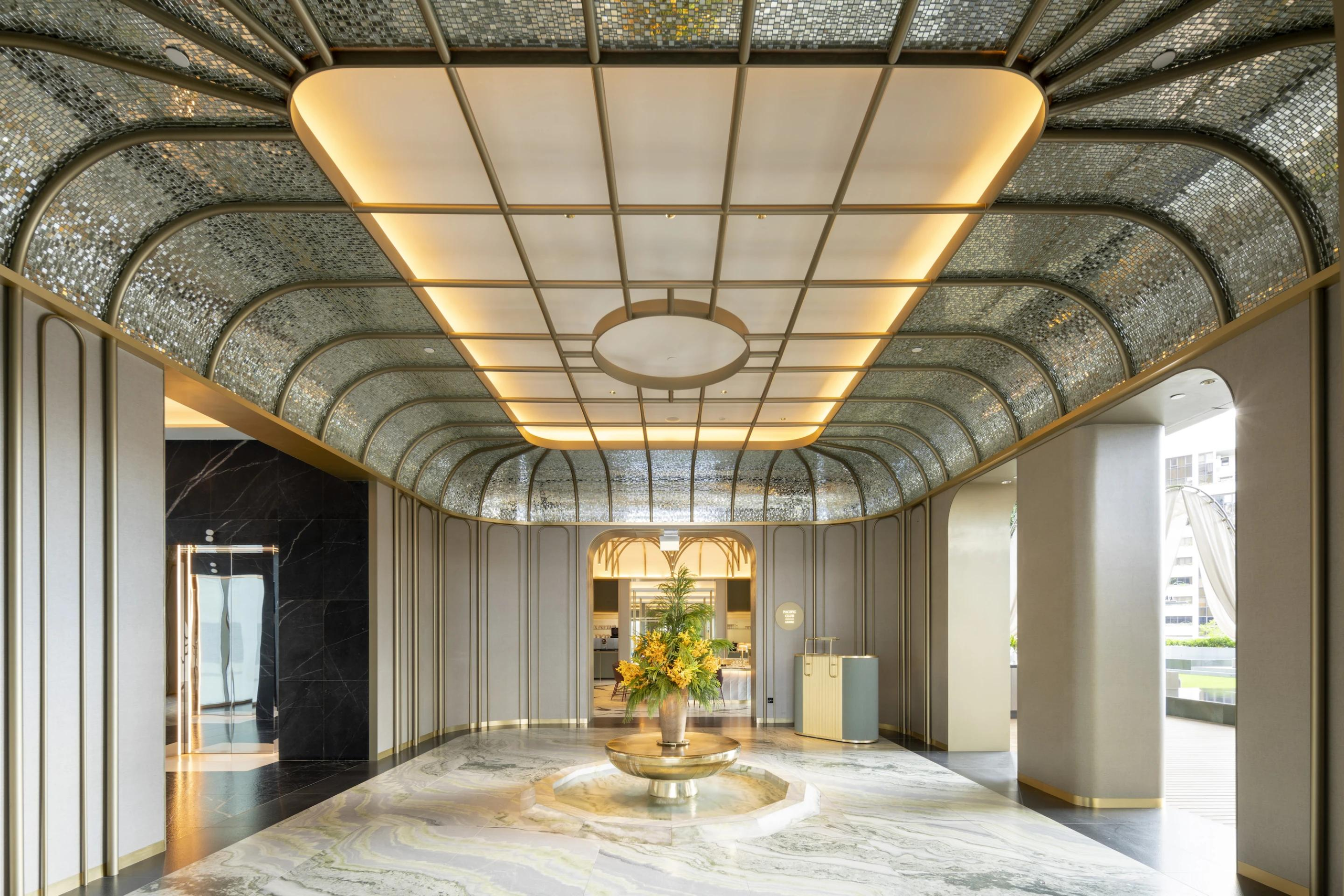
Singapore has long treated architecture as an essential part of its identity. The city’s skyline brings together preserved colonial buildings, ambitious contemporary structures, tropical landscaping and carefully considered interiors, creating an urban environment where heritage and modernity exist within remarkably close proximity. Its luxury hotels reflect this same character. Some occupy historic landmarks, others were conceived as architectural statements, while a newer generation places greenery, sustainability and local culture at the centre of the guest experience.
For luxury travellers, this makes Singapore particularly interesting. The design of a hotel is not simply a decorative layer added to the accommodation; in the city’s most distinctive properties, architecture determines how guests move through the building, experience the skyline and connect with the destination. From the preserved elegance of Raffles Singapore to the tropical modernism of Capella Singapore and the vertical gardens of Pan Pacific Orchard, each property offers a different interpretation of contemporary luxury.
Raffles Singapore: A Colonial Icon Reimagined
Few hotels demonstrate Singapore’s architectural evolution as clearly as Raffles Singapore. Opened in 1887, the hotel remains one of the city’s defining heritage landmarks, standing in striking contrast to the contemporary towers surrounding it. Its colonial-style architecture, courtyards, verandahs and generous proportions create a sense of place that could not easily be reproduced elsewhere.
Raffles was declared a National Monument in 1987, reinforcing its importance within Singapore’s architectural heritage. A major restoration completed in 2019 preserved the character of the historic property while introducing new restaurants, bars, courtyards and social spaces. The result is not a museum-like interpretation of the past, but a functioning luxury hotel that continues to evolve while maintaining its architectural identity.
The appeal of Raffles lies partly in this balance. Its design is rooted in an earlier Singapore, yet the property remains relevant to contemporary travellers because its spaces encourage a slower form of hospitality. Open-air courtyards, shaded walkways and verandahs provide an experience very different from the glass-and-steel towers of Marina Bay.
For travellers interested in Singapore’s heritage, Raffles is therefore more than a hotel. It is an architectural introduction to an earlier chapter of the city and an important reference point for understanding how Singapore has developed around its historic core.
It also provides a natural complement to our broader guide to the best luxury hotels in Singapore, where heritage properties sit alongside contemporary resorts and modern city landmarks.
Capella Singapore: Tropical Modernism on Sentosa
On Sentosa Island, the design language changes completely. Capella Singapore combines restored 1880s colonial buildings with a contemporary resort designed by Foster + Partners, creating an architectural composition that moves between heritage, tropical landscape and modern forms.
The property occupies approximately 30 acres of landscaped grounds. At its historic centre are two restored Tanah Merah colonial bungalows dating from the 1880s, while the newer structures extend into the surrounding landscape. Foster + Partners designed the contemporary elements to work in harmony with the existing architecture and natural setting. The hotel currently comprises 113 rooms, suites, villas and manors.
This combination gives Capella a distinctive sense of rhythm. Rather than presenting one monumental building, the resort unfolds through gardens, pathways, terraces and separate architectural volumes. The result feels closer to a private tropical estate than a conventional urban hotel.
Interior design also plays an important role. Jaya Ibrahim created the interiors of the accommodation, using natural materials and Asian references, while André Fu has contributed to the property’s more contemporary design evolution. Fu has described the architectural challenge as integrating the resort with Sentosa’s natural topography through textures, colours and materials inspired by the surroundings.
For travellers interested in design, Capella demonstrates how luxury hospitality can preserve historic architecture without becoming nostalgic. The colonial structures provide a sense of history, while the modern buildings and landscaping establish a distinctly contemporary interpretation of a tropical retreat.
The Ritz-Carlton, Millenia Singapore: Architecture as an Art Experience
At Marina Bay, The Ritz-Carlton, Millenia Singapore represents another interpretation of design-led luxury. Designed by Pritzker Prize-winning architect Kevin Roche, the 32-storey hotel opened in 1996 and became one of the architectural landmarks of the Millenia Singapore development.
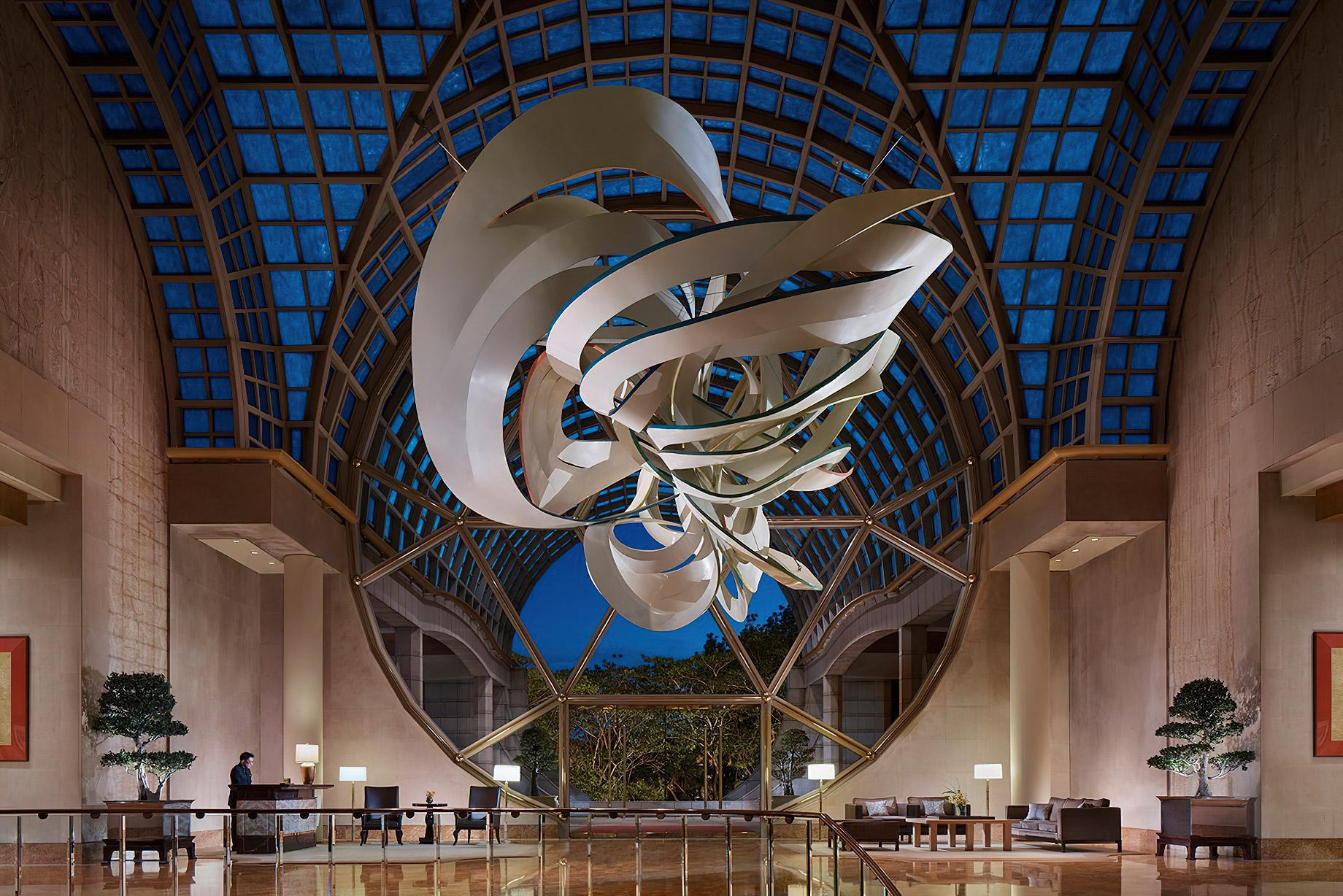
Its design is particularly distinctive because architecture and art were conceived as complementary elements. The hotel houses approximately 4,200 artworks, including works by David Hockney, Andy Warhol, Dale Chihuly, Frank Stella and Zhu Wei. According to the hotel, around 90 per cent of the collection was specially commissioned, with approximately 350 pieces considered museum-quality.
The interior is equally deliberate. More than 10,000 square metres of chromafusion glass with a mother-of-pearl filter are incorporated into the design, while light wood and other materials contribute to the spacious atmosphere. Feng Shui principles were also incorporated into the architecture and interiors, including the distinctive octagonal windows found in guest bathrooms.
The result is a hotel where the art collection is not simply decoration placed around the property. It forms part of the architectural experience, encouraging guests to encounter the building almost as they would a private contemporary art collection.
The Ritz-Carlton, Millenia Singapore therefore occupies an interesting position within Singapore’s luxury landscape. Its architecture belongs firmly to the modern era, but its design philosophy is broader than visual minimalism. It brings together architecture, art, cultural symbolism and panoramic views of Marina Bay.
For readers interested in this approach to hospitality, our dedicated feature on The Ritz-Carlton, Millenia Singapore: Art, Architecture and Modern Luxury explores the property in greater depth.
Mandarin Oriental, Singapore: Singaporean Identity Through Design
Mandarin Oriental, Singapore offers a more recent interpretation of design-led hospitality. Originally opened in 1987, the hotel underwent an extensive transformation before reopening in September 2023. The redesign was led by Jeffrey Wilkes of DESIGNWILKES, who used elements of Singaporean architecture and landscape as key sources of inspiration.
The hotel’s original fan-shaped atrium was designed by American architect John Portman, whose neo-futuristic approach became an important feature of the building’s identity. Following the transformation, the atrium was reinterpreted through a palette of clay-inspired pink and terracotta tones, drawing references from the traditional roofs of Singapore’s shophouses.
Local influences continue throughout the property. Peranakan architecture, Singapore’s black-and-white houses and Angsana trees informed elements of the interiors, while guestrooms were designed to respond to their surroundings. Marina Bay-facing rooms incorporate patterns and colours inspired by the water, while other rooms use botanical references to connect the interiors with Singapore’s greenery.
This relationship between architecture, interiors and destination is increasingly central to contemporary luxury hospitality. In Singapore, it creates an especially compelling design vocabulary because the city itself is defined by the meeting of tropical nature, historic neighbourhoods and ambitious modern architecture.
Mandarin Oriental, Singapore is consequently less about reproducing a traditional idea of Asian luxury and more about interpreting the city through contemporary interiors. Its design provides another perspective on Singapore’s most distinctive design hotels, where local references are translated into modern hospitality rather than simply reproduced as decoration.
PARKROYAL COLLECTION Pickering: The Hotel as a Vertical Garden
Singapore’s reputation as a Garden City has influenced some of its most ambitious contemporary architecture, and PARKROYAL COLLECTION Pickering is one of the clearest examples.
The hotel pioneered the idea of the “hotel-in-a-garden”, using extensive landscaping, cascading greenery, sky gardens and reflective pools to bring nature into a dense urban environment. The property incorporates approximately 15,000 square metres of gardens and planted areas, creating a strong visual relationship between the architecture and the surrounding city.
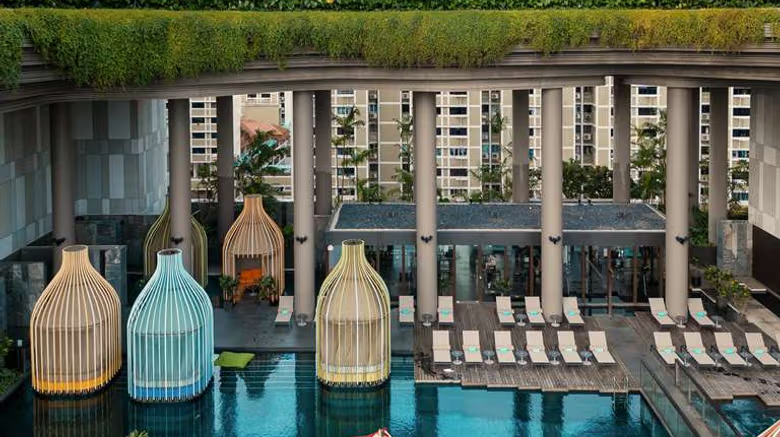
Instead of treating greenery as something confined to a ground-level courtyard, the design distributes it vertically throughout the building. Terraced forms allow landscaped areas to become part of the architecture itself, changing the relationship between guestrooms, public spaces and the city beyond.
This is particularly significant in Singapore, where limited land and high-density development have encouraged architects to reconsider how nature can be incorporated into urban buildings. At PARKROYAL COLLECTION Pickering, greenery becomes an architectural element rather than an accessory.
The design also reflects a broader change in luxury hospitality. Today’s luxury traveller increasingly notices not only materials and visual aesthetics but also how a building interacts with its environment. Architecture that creates shade, natural light, planted spaces and connections to the outdoors can influence the experience of a hotel as strongly as its interiors.
PARKROYAL COLLECTION Pickering consequently represents one of Singapore’s most influential approaches to contemporary hotel design: architecture that attempts to make the city greener rather than simply more spectacular.
Pan Pacific Orchard: A New Generation of Biophilic Luxury
If PARKROYAL COLLECTION Pickering demonstrated the potential of the hotel-in-a-garden concept, Pan Pacific Orchard takes the idea into a more contemporary architectural language.
Located on Orchard Road, the hotel was designed around four distinct environments: Forest, Beach, Garden and Cloud. These open-air terraces create a sequence of landscaped spaces rising through the building, while the architecture remains closely connected to the surrounding shopping and commercial district.
The property contains more than 12,000 square metres of foliage. The Forest Terrace introduces tropical planting and water features, the Beach Terrace evokes a coastal landscape with an organically shaped lagoon and sandy areas, the Garden Terrace creates a more formal landscaped setting, and the Cloud Terrace places gardens and reflective pools high above the city.
The architectural concept was developed by WOHA, a Singapore-based practice known for integrating greenery and environmental strategies into high-density urban architecture. The building effectively turns the conventional tower upside down: instead of concentrating public greenery at street level, it distributes landscape vertically through the structure.
For a luxury hotel, this changes the experience considerably. Guests do not have to leave the building to encounter different landscapes. Forest, water, gardens and skyline views become part of the architecture itself.
Pan Pacific Orchard also demonstrates how Singapore’s architectural identity continues to evolve. The traditional image of the city as a futuristic financial centre is increasingly being complemented by buildings that blur the boundary between urban development and tropical landscape.
The Fullerton Hotels: Heritage Architecture Along the Waterfront
Singapore’s design story cannot be understood entirely through new architecture. The Fullerton heritage precinct demonstrates how historic structures can be transformed into contemporary luxury destinations without losing their architectural significance.
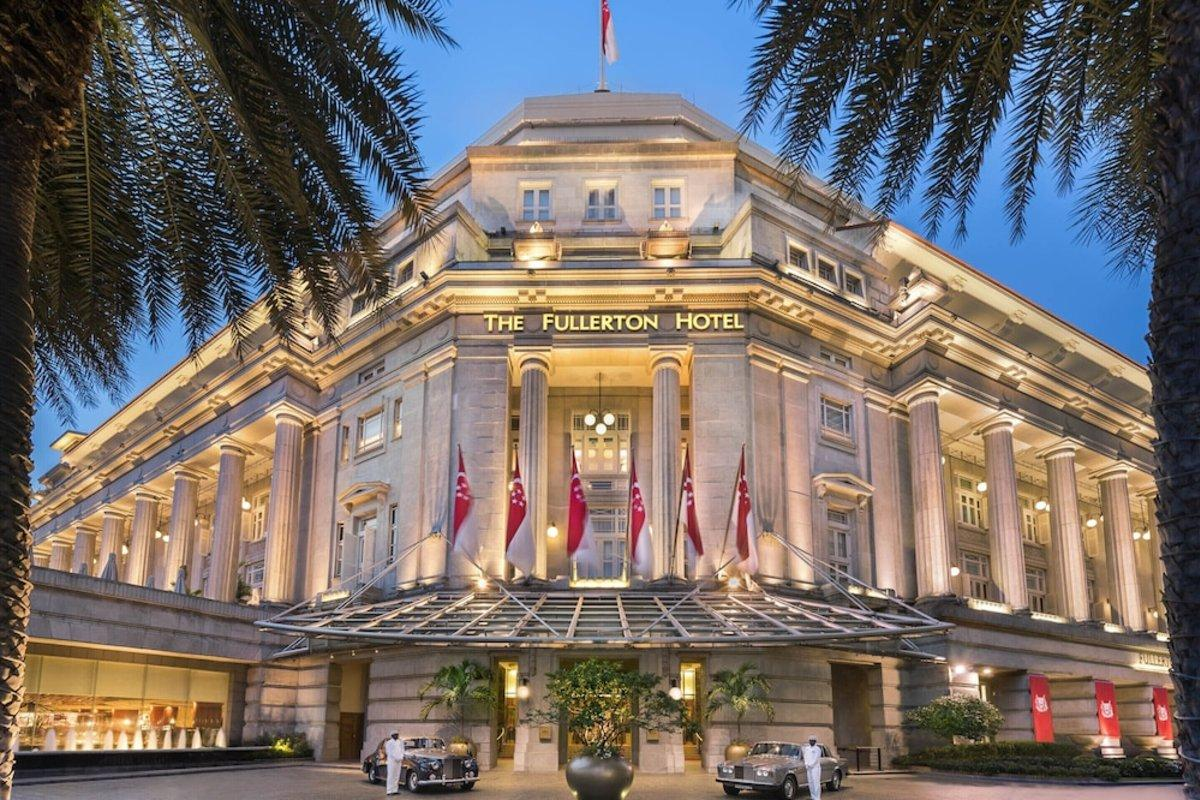
The Fullerton Hotel Singapore occupies the former Fullerton Building, a grand neoclassical structure completed in 1928. Designed with classical architectural influences and monumental Doric colonnades, the building once housed Singapore’s General Post Office and other important civic institutions. It was gazetted as a National Monument in 2015 before being transformed into a luxury hotel.
Nearby, The Fullerton Bay Hotel Singapore offers a contrasting interpretation. Opened in 2010, the 100-room waterfront hotel was conceived as a sleek contemporary addition to the heritage precinct. Its architecture and interiors combine modern international design with references to Singapore’s waterfront history.
The two properties demonstrate why Singapore’s most interesting hotels are not necessarily defined by a single architectural style. One is monumental and neoclassical; the other is contemporary and waterfront-oriented. Together, they form part of a larger district in which historic buildings and new structures coexist.
For luxury travellers, this creates a particularly attractive setting. A stay in the Fullerton precinct offers access not only to a hotel but to an architectural landscape where Singapore’s maritime, commercial and civic history intersects with the modern Marina Bay skyline.
Why Design Has Become Central to Singapore’s Luxury Hotels
The most distinctive design hotels in Singapore reveal several different approaches to luxury. Raffles preserves a historic architectural language. Capella integrates colonial heritage with tropical modernism. The Ritz-Carlton, Millenia treats art as part of the architectural experience. Mandarin Oriental interprets local culture through contemporary interiors. PARKROYAL COLLECTION Pickering and Pan Pacific Orchard place greenery at the centre of the building itself, while the Fullerton properties demonstrate how heritage architecture can be adapted for modern hospitality.
What connects these hotels is not a single aesthetic. It is the idea that design should contribute to the identity of the destination.
This is particularly important in Singapore because the city is itself a carefully constructed visual environment. Historic shophouses, colonial monuments, tropical gardens, waterfront developments and contemporary skyscrapers occupy a relatively compact geographical area. The best hotels respond to this context rather than existing independently from it.
For travellers choosing a luxury hotel based on design, the distinction is therefore less about whether a property is modern or traditional and more about whether its architecture tells a convincing story. In Singapore, that story may be about heritage, art, nature, local culture or the future of the city.
The result is an unusually diverse hotel landscape in which architecture becomes part of the destination experience itself.
Frequently Asked Questions
Which Singapore hotels are known for distinctive architecture?
Raffles Singapore, Capella Singapore, The Ritz-Carlton, Millenia Singapore, Mandarin Oriental, Singapore, PARKROYAL COLLECTION Pickering, Pan Pacific Orchard and the Fullerton properties all offer notably different architectural approaches, ranging from heritage conservation to contemporary biophilic design.
Which Singapore hotel is best known for its art collection?
The Ritz-Carlton, Millenia Singapore is particularly notable for its contemporary art collection. The hotel states that it houses approximately 4,200 artworks, including works by internationally recognised artists such as David Hockney, Andy Warhol, Dale Chihuly and Frank Stella.
Which Singapore hotel combines historic architecture with contemporary design?
Capella Singapore is one of the clearest examples. The property combines restored 1880s Tanah Merah colonial bungalows with contemporary architecture by Foster + Partners and landscaped tropical grounds.
Which Singapore hotels are known for biophilic design?
PARKROYAL COLLECTION Pickering and Pan Pacific Orchard are particularly associated with integrating extensive greenery into their architecture. PARKROYAL COLLECTION Pickering uses more than 15,000 square metres of landscaped areas, while Pan Pacific Orchard incorporates more than 12,000 square metres of foliage across its four themed terraces.
Which hotel is best suited to travellers interested in Singaporean design?
Mandarin Oriental, Singapore offers a particularly direct interpretation of local design references. Its transformation incorporated influences from Peranakan architecture, Singapore’s black-and-white houses, Angsana trees and traditional shophouses.
Is Raffles Singapore a heritage hotel?
Yes. Raffles Singapore is a preserved colonial-style landmark and was declared a National Monument in 1987. Its 2019 restoration retained the character of the historic property while introducing new hospitality, dining and social spaces.
Which design hotels are near Marina Bay?
Several distinctive design-led hotels are located in or around Marina Bay, including The Ritz-Carlton, Millenia Singapore, Mandarin Oriental, Singapore and The Fullerton Bay Hotel Singapore. Their architectural approaches range from modernist and art-focused to contemporary waterfront and locally inspired design.
By Luxury Magazine Editorial Team