Languedoc offers a version of southern France that can feel remarkably different from the polished glamour of Saint-Tropez, Cannes or Monaco. Luxury here is less dependent on being seen and more closely connected to access: entering a wine estate with time to meet the people behind the bottles, staying among vineyards, cruising slowly beneath plane trees on the Canal du Midi or eating oysters overlooking the lagoon where they were cultivated.
That difference makes the region particularly compelling for experienced travellers.
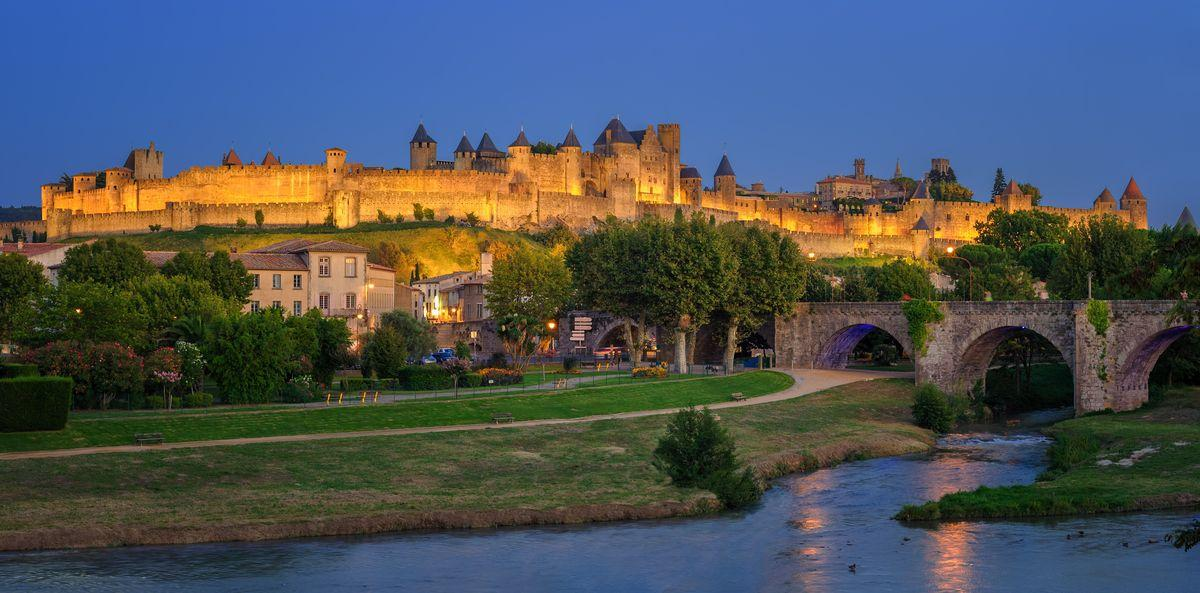
Stretching across part of today’s Occitanie, historic Languedoc contains some of southern France’s most important cultural and gastronomic landscapes. Carcassonne provides one of Europe’s great fortified settings. The Canal du Midi crosses the countryside through an extraordinary system of waterways and engineering. Around Montpellier, Pic Saint-Loup has developed a distinctive wine identity, while farther south and west, vineyards stretch towards Béziers, Narbonne and the Corbières.
On the Mediterranean side, Étang de Thau adds another dimension through oyster and mussel farming and the maritime culture surrounding Sète, Bouzigues and Mèze.
Luxury travel in Languedoc therefore works best as a journey rather than a single-resort holiday. The experience comes from combining wine, history, landscape, gastronomy and slow travel—and allowing enough time for each.
Private Wine Experiences in Pic Saint-Loup
Wine provides one of the most convincing introductions to Languedoc, particularly in the dramatic landscape around Pic Saint-Loup north of Montpellier.
The appellation is particularly associated with red wines and rosé. The local tourism authority describes the wines as strongly expressive of their Mediterranean environment and notes the ageing potential of its more serious reds. (grandpicsaintloup-tourisme.fr)
For the luxury traveller, however, the real attraction is not simply tasting the wines. It is the intimacy with which the region can still be explored.
The Grand Pic Saint-Loup tourism authority currently lists more than 90 wine-tourism visits and tasting experiences across the area, including guided estate visits, introductions to tasting, vineyard walks and food-and-wine activities. Participating producers include Château La Roque and Château de Lascaux, among many others. (grandpicsaintloup-tourisme.fr)
Rather than attempting to visit several wineries in one afternoon, a more sophisticated itinerary would concentrate on one or two estates.
A private driver removes the practical restrictions associated with tasting, while advance arrangements can create time for a detailed cellar visit, vineyard walk and conversation about the appellation’s soils and grape varieties.
This slower approach is especially appropriate in Languedoc. Unlike more formal wine destinations where prestige can dominate the experience, some of the most rewarding encounters here retain a direct connection between visitor and producer.
The landscape itself also deserves time. Limestone relief, vineyards and Mediterranean vegetation give Pic Saint-Loup an identity strong enough to justify an entire day rather than a quick tasting excursion from Montpellier.
A Vineyard Estate Stay at Château St Pierre de Serjac
Some places are best experienced by remaining after the tasting room closes.
Château St Pierre de Serjac is a particularly good example. Set near Béziers in approximately 200 acres of Mediterranean countryside, the working wine estate combines eight hotel rooms with 36 self-catering properties, a restaurant, spa, wine tourism, heated main pool, tennis and concierge service. (serjac.com)

The château’s history adds substance to the experience.
In 1896, Baron Cyprian de Crozals commissioned Bordeaux architect Louis-Michel Garros to transform the estate during the great regional wine boom. At its height, St Pierre de Serjac produced almost one million litres of wine annually. The current hospitality project opened to guests in 2016 following a five-year transformation. (serjac.com)
This combination of working vineyard and contemporary hospitality represents Languedoc particularly well.
Guests do not have to choose between a private villa and hotel infrastructure. The estate combines both, making it suitable for couples as well as families or groups who want greater independence.
More importantly, staying on a vineyard changes the rhythm of a wine trip. There is no pressure to move continuously between estates. Wine becomes part of the landscape in which the guest wakes, walks, eats and relaxes.
That is arguably a more luxurious interpretation of wine tourism than attempting to collect as many tastings as possible.
Carcassonne After the Day Visitors Leave
Carcassonne is one of the places where staying overnight changes the experience substantially.

The Historic Fortified City of Carcassonne was inscribed on UNESCO’s World Heritage List in 1997. UNESCO describes it as an outstanding medieval fortified town, with massive defensive walls built upon fortifications dating to Late Antiquity. The nineteenth-century restoration led by Eugène Viollet-le-Duc also became highly influential in the development of architectural conservation. (UNESCO World Heritage Centre)
Its importance is therefore greater than its visual drama alone.
For luxury travellers, the better strategy is to avoid treating Carcassonne as a hurried sightseeing stop. Staying within or immediately beside the historic city creates opportunities to experience the setting early and late in the day, when its atmosphere changes.
Hôtel de la Cité Carcassonne – MGallery Collection occupies an exceptional position within the medieval environment and is one of the natural choices for travellers who want to make the citadel itself part of their stay.
The ideal experience combines accommodation with private historical interpretation.
A knowledgeable guide can explain not only the medieval architecture but also the complicated restoration history that produced much of what visitors encounter today. That context makes Carcassonne considerably more interesting than simply photographing its towers.
Dinner and an evening walk can then replace the conventional pattern of visiting for several hours before driving elsewhere.
In a region where distances encourage road travel, choosing several strategic overnight bases rather than one hotel for the entire trip can greatly improve the experience.
A Private Journey Along the Canal du Midi
The Canal du Midi is one of Languedoc’s strongest luxury-travel experiences precisely because it is slow.

UNESCO describes the Canal du Midi as a 360-kilometre network of navigable waterways with 328 structures including locks, aqueducts, bridges and tunnels. Built between 1667 and 1694 under Pierre-Paul Riquet, it was inscribed on the World Heritage List in 1996. (UNESCO World Heritage Centre)
The principal canal runs for approximately 240 kilometres from Toulouse to Étang de Thau at Marseillan, connecting the interior landscape with the Mediterranean. (UNESCO World Heritage Centre)
The luxury approach is not to see the canal from the road but to live on it.
Hotel barges operate as small floating hotels, combining private cabins with dining and outdoor deck space. The Canal du Midi–Saint-Chinian tourism authority currently lists several hotel barges around Capestang and notes that some offer private cruising, sunset dining and facilities such as Jacuzzis and deck lounges. (Canal du Midi au Saint-Chinian)
A multi-day private or small-capacity barge journey can include village visits, vineyards and cultural excursions while eliminating much of the constant packing and driving associated with a conventional road trip.
The pace is deliberately restrained.
Locks become part of the experience rather than an inconvenience. Breakfast can be taken beside the water. Bicycles can allow guests to follow sections of the towpath before rejoining the vessel farther along.
For travellers accustomed to yachts, the attraction is quite different. The canal is not about speed, open water or glamorous ports. Its luxury lies in privacy, landscape and the ability to move through rural France at an unusually gentle pace.
Oysters and Seafood Around Étang de Thau

Languedoc’s gastronomic identity changes when the journey reaches Étang de Thau.
The lagoon lies beside the Mediterranean and forms the eastern end of the principal Canal du Midi route. (UNESCO World Heritage Centre) Its waters are immediately recognisable from the geometric shellfish structures extending across the lagoon.
This is one of the places where luxury travellers should resist searching only for formal fine dining.
The more memorable experience can be proximity to production.
Around Bouzigues, Mèze and the wider lagoon, oysters and mussels are part of a living aquaculture economy. A thoughtfully planned day might combine time on or beside the water with a tasting of oysters close to where they were raised, followed by a more elaborate dinner in Sète.
The contrast is precisely what makes the experience sophisticated.
Luxury gastronomy does not always require white tablecloths. In a producing region, access to exceptional ingredients and the people who understand them can be more valuable than ceremony.
The wines of Languedoc also make the lagoon an obvious place to explore regional pairings, particularly fresh whites and other styles suited to shellfish and Mediterranean seafood.
A private driver is useful if the day combines producers, villages and wine. For travellers staying around Montpellier or farther west in the vineyards, the lagoon can also become a natural transition between inland Languedoc and the Mediterranean coast.
Montpellier as a Cultural and Gastronomic Base
Languedoc should not be interpreted exclusively through rural estates.
Montpellier provides a more urban expression of the region and works particularly well as either the beginning or end of a wider journey.

The city combines a historic centre with contemporary architecture, museums, restaurants and easy access to both vineyards and the Mediterranean. Pic Saint-Loup lies to the north, while the coastal and lagoon landscapes are accessible to the south.
For luxury travellers, this geography makes Montpellier particularly useful.
A stay here can support a private architecture or cultural tour one day and a chauffeur-driven wine itinerary the next. It also allows the traveller to experience Languedoc gastronomy in a more contemporary urban context after several days in vineyards or historic villages.
The city’s role should therefore be understood strategically.
Rather than simply adding Montpellier to a list of places to see, use it as a base from which several different versions of Languedoc become accessible.
It can also provide a useful contrast to Carcassonne. One is defined by an extraordinary medieval fortified environment; the other feels youthful, lived-in and connected to contemporary southern French culture.
Including both prevents a Languedoc itinerary from becoming excessively nostalgic.
The Villages and Landscapes Beyond the Famous Names
One of the pleasures of luxury travel in Languedoc is that some of the strongest experiences occur between headline destinations.
Villages, vineyards, garrigue and limestone landscapes reward travellers willing to move slowly and use a private guide or driver selectively.
This is where a bespoke road itinerary becomes particularly effective.
Rather than travelling directly from Montpellier to Carcassonne, the journey can be broken around wine estates, markets, abbeys and small villages. The precise route should depend on the interests of the traveller rather than an attempt to reproduce a standard circuit.
The advantage of private touring is not simply a more comfortable vehicle.
It is flexibility.
A tasting that becomes interesting can continue longer. Lunch does not need to finish because a coach is waiting. A village can be explored because it happens to look appealing rather than because it appears on a fixed schedule.
Languedoc’s relatively dispersed attractions make this form of travel particularly valuable.
It is also an area where knowledgeable local guides can make an enormous difference. The region’s history encompasses Roman heritage, medieval religious conflict, viticulture, maritime trade and major engineering projects. Without context, a journey can become a sequence of attractive landscapes. With it, those landscapes begin to connect.
A More Private Alternative to the Riviera
Languedoc should not be sold as a cheaper Côte d’Azur.
That comparison misses what makes the region interesting.
The Riviera’s luxury culture revolves substantially around celebrated hotels, beaches, yachts, restaurants and highly visible social destinations. Languedoc’s strongest luxury experiences are generally more private and dispersed.
A vineyard estate can become the destination. A private barge can replace a superyacht. An oyster tasting beside a lagoon can become more memorable than an elaborate beach-club lunch. A medieval city can provide the evening entertainment.
The region therefore suits travellers who no longer measure luxury purely through brand recognition.
It can also work particularly well for repeat visitors to France who already know Paris, Provence and the Riviera and want something less predictable without sacrificing comfort.
This does not mean Languedoc lacks sophisticated hospitality. Properties such as Château St Pierre de Serjac demonstrate otherwise, while luxury residences around the Canal du Midi and Saint-Chinian can offer private pools, concierge services, chefs and private tastings. (Canal du Midi au Saint-Chinian)
The difference is that hospitality tends to sit inside the destination rather than overwhelm it.
Building a Luxury Languedoc Itinerary
A successful Languedoc trip should be organised geographically rather than as a collection of disconnected experiences.
For a shorter trip, Montpellier can provide the first base, allowing time for the city and Pic Saint-Loup. The journey can then move west through the vineyards towards Béziers and a wine-estate stay.
From there, the Canal du Midi becomes a natural theme rather than a separate excursion. Travellers with more time can dedicate several nights to a barge journey before continuing towards Carcassonne.
The Mediterranean dimension can be added through Étang de Thau either near the beginning or end of the trip.
The key is not trying to include everything.
Five nights may be sufficient for Montpellier, wine country and one major cultural destination. Seven to ten nights allows a much more satisfying combination of vineyards, Carcassonne, the canal and the coast.
Private transport is particularly valuable between rural properties, but a chauffeur does not necessarily need to remain with the traveller throughout the entire holiday. Transfers can be combined with occasional guided touring, creating independence without excessive logistical planning.
Spring and early autumn are especially attractive for itineraries focused on wine, walking, cultural exploration and outdoor dining, although individual hotels, barges, estates and restaurants should always be checked for seasonal opening periods.
Frequently Asked Questions
What are the best luxury experiences in Languedoc?
Wine tourism around Pic Saint-Loup, staying on a vineyard estate, exploring Carcassonne privately, cruising the Canal du Midi and discovering the oyster culture of Étang de Thau are among the most distinctive experiences. The region is strongest when these are combined rather than experienced independently.
Is Languedoc a luxury destination?
Yes, although its luxury identity is generally more understated than that of the French Riviera. Vineyard estates, private residences, hotel barges, wine experiences, private guides and gastronomy allow sophisticated trips to be built around privacy and access rather than conspicuous glamour.
Is Carcassonne worth staying overnight?
Yes. The Historic Fortified City is a UNESCO World Heritage Site, and an overnight stay provides opportunities to experience its architecture beyond a simple daytime visit. (UNESCO World Heritage Centre) Staying within the medieval environment can make Carcassonne a central part of the trip rather than a sightseeing stop.
Can you take a luxury cruise on the Canal du Midi?
Yes. Hotel barges operate along the canal, with some offering private cruises and amenities such as dining, outdoor lounges and Jacuzzis. (Canal du Midi au Saint-Chinian) Because capacity can be very limited, a private barge can provide a particularly intimate way of experiencing Languedoc.
Where should wine lovers go in Languedoc?
Pic Saint-Loup is an excellent starting point, particularly for travellers based around Montpellier. The local tourism authority lists a substantial range of estate visits, guided tastings and vineyard experiences. (grandpicsaintloup-tourisme.fr) Longer itineraries can continue through other Languedoc wine areas towards Béziers, Saint-Chinian, Corbières and beyond.
Is Château St Pierre de Serjac a working wine estate?
Yes. The property describes itself as a working wine estate combining hotel rooms, luxury self-catering accommodation, restaurant, spa and wine tourism within approximately 200 acres of Mediterranean countryside. (serjac.com)
How many days are needed for a luxury Languedoc trip?
Five days can provide an introduction, but seven to ten nights is considerably better for travellers wanting to combine wine country, the Canal du Midi, Carcassonne, Montpellier and the Mediterranean coast without rushing.
Is Languedoc good for food-focused travel?
Yes. The combination of vineyards, Mediterranean seafood, shellfish from Étang de Thau, markets and regional cooking makes gastronomy one of the natural foundations of a Languedoc itinerary. Food experiences work particularly well when paired geographically with wine and cultural visits.
Is a private driver useful in Languedoc?
A private driver is especially useful for wine-tasting days and itineraries involving rural estates. The region is geographically dispersed, so chauffeur-driven touring can also allow travellers to combine several smaller destinations without worrying about navigation or alcohol consumption.
By Luxury Magazine Editorial Team