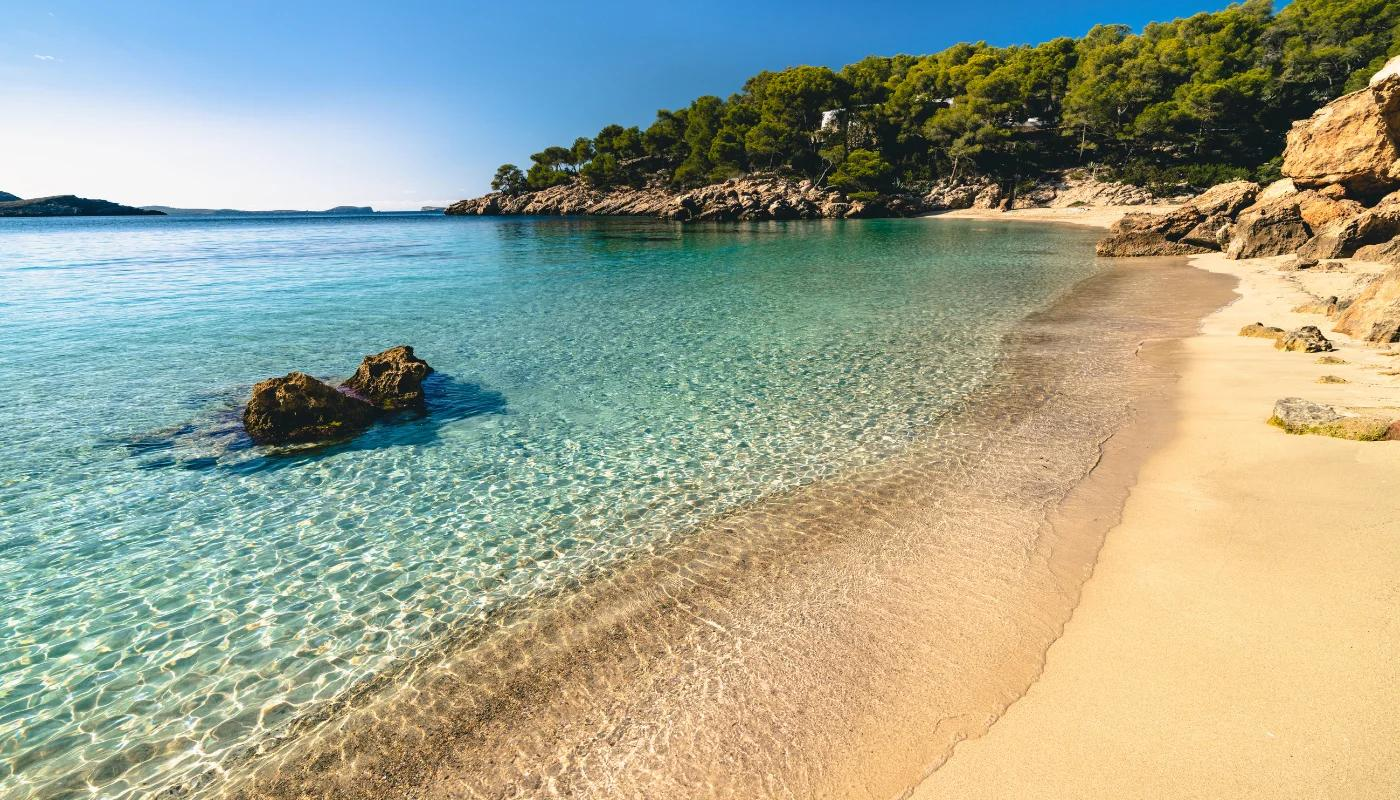
Ibiza’s coastline reveals a side of the island that is considerably more diverse than its international reputation might suggest. Beyond the famous beach clubs and yacht-filled bays are protected dunes, pine-framed coves, dramatic cliffs, transparent northern waters and western beaches where sunset becomes the defining event of the day.
Choosing the best beaches in Ibiza therefore depends on what kind of Mediterranean experience you want. Some travellers are looking for polished service and a long lunch close to the water, while others would exchange every luxury amenity for a small cove and an afternoon of uninterrupted swimming. Families need easier access and gentler conditions, whereas couples may prefer a secluded setting or a beach that becomes particularly beautiful towards sunset.
The island’s official tourism authority identifies Ses Salines, Es Cavallet, Platges de Comte, Cala d’Hort and Cala Bassa among Ibiza’s best-known beaches, while pointing towards Cala Xarraca, Benirràs, Cala d’en Serra and other northern coves for a quieter and wilder experience. (en.ibiza.travel)
This guide approaches Ibiza from the perspective of the luxury traveller, but luxury here does not necessarily mean exclusivity or elaborate service. At Ibiza’s finest beaches, it can simply mean clear water, enough time to stay until sunset and knowing which part of the island is worth crossing for the experience.
Cala Comte: Ibiza’s Extraordinary Turquoise Water and Sunset Views
Cala Comte, also widely known as Platges de Comte, deserves its place among Ibiza’s essential beaches. Situated on the western side of the island, it combines exceptionally transparent water with views towards small offshore islands, creating one of the coastline’s most recognisable panoramas.

The appeal is immediately visual. Rather than one uninterrupted stretch of sand, the coastline is divided by rocky formations and smaller bathing areas, while the shallow water shifts through intense shades of turquoise and blue. Ibiza’s official tourism organisation also highlights Platges de Comte as one of the west coast’s particularly noteworthy sunset locations. (en.ibiza.travel)
That combination makes Cala Comte particularly versatile. Arrive earlier in the day if swimming and enjoying the clarity of the water are the priorities, or plan the visit around late afternoon if the sunset is the main event. During the busiest summer weeks, however, its fame means that tranquillity should not be expected at peak times.
For a luxury itinerary, Cala Comte works particularly well when the day has deliberately been kept simple. Rather than treating it as another attraction to photograph before moving elsewhere, allow several hours for swimming and remain as the light begins to soften. The transition towards sunset is part of what makes this coastline memorable.
Cala d’Hort: The Iconic View Towards Es Vedrà
Few beaches communicate a sense of place as immediately as Cala d’Hort. The relatively compact cove on Ibiza’s southwest coast looks directly towards Es Vedrà, the enormous limestone formation rising dramatically from the Mediterranean.
Ibiza’s tourism authority describes the view from Cala d’Hort towards Es Vedrà as one of the island’s most iconic, and it is difficult to disagree. (Ibiza Travel) The attraction is not simply the beach itself but the relationship between the water, cliffs and offshore landscape.
Cala d’Hort is consequently an excellent choice for travellers who value scenery as highly as sand. Swimming beneath the silhouette of Es Vedrà provides a very different experience from the long, open beaches elsewhere on Ibiza, while the changing light gives the cove an increasingly atmospheric quality later in the day.
Its fame also requires realistic expectations. This is not an undiscovered secret, particularly during high season. Travellers hoping for solitude should look north or investigate smaller coves instead. Cala d’Hort should be chosen because the landscape is exceptional, not because it promises isolation.
Ses Salines: Ibiza’s Classic Beach Day
If Cala d’Hort represents dramatic Ibiza, Platja de ses Salines captures another side of the island: long Mediterranean beach days combining natural beauty with a distinctly social atmosphere.
Ses Salines lies within the protected natural environment of the Ses Salines area, and the contrast between pale sand, clear sea and surrounding landscape helps explain its enduring popularity. Ibiza Travel specifically identifies both Ses Salines and neighbouring Es Cavallet for their protected natural setting. (en.ibiza.travel)
This is one of the beaches where nature and Ibiza’s cosmopolitan personality meet most clearly. Visitors can spend hours swimming and walking along the shoreline while still feeling connected to the more sociable side of the island.
For luxury travellers, Ses Salines works best when approached as an extended day rather than a quick beach stop. The experience is about allowing lunch, swimming and relaxation to merge rather than imposing a rigid itinerary.
The surrounding ecosystem deserves equal respect. Ibiza’s transparent coastal waters are closely associated with Posidonia oceanica seagrass meadows, an ecologically important part of the marine environment highlighted by the island’s tourism authority in connection with Ibiza’s clear waters. (en.ibiza.travel)
Es Cavallet: Natural Beauty and a More Open Coastal Landscape
Close to Ses Salines but possessing its own character, Platja des Cavallet offers a long stretch of coastline backed by protected natural surroundings.
The beach feels more open than many of Ibiza’s compact coves. Its scale gives visitors room to walk and find a preferred section of shoreline, while its position within the same protected landscape as Ses Salines reinforces the sense that the natural environment remains an important part of the experience. (en.ibiza.travel)
Es Cavallet is particularly suitable for travellers who find some of Ibiza’s smaller famous coves visually beautiful but slightly confined. Here, the horizon feels broader and the experience is more about the landscape as a whole.
It also provides an interesting counterpoint to Ibiza’s image as an entirely constructed luxury destination. Some of the island’s greatest pleasures remain extremely simple: walking beside the Mediterranean, swimming and spending several hours without a schedule.
Cala Saladeta: A Small Cove with a Big Reputation
Cala Saladeta has become one of Ibiza’s most recognisable smaller coves, largely because it compresses so many desirable Mediterranean elements into a relatively intimate setting: pale sand, rocky surroundings and extraordinarily inviting water.

Its west-coast location also places it among the island’s noteworthy sunset areas. Ibiza’s tourism authority specifically highlights Cala Saladeta alongside Platges de Comte, Punta Galera and Cap Negret when discussing some of the island’s best-known places for watching the sun go down. (en.ibiza.travel)
The important word here, however, is small. Cala Saladeta’s beauty has made it extremely popular, and its physical scale means visitor numbers are more noticeable than on a large beach. Those seeking a serene experience should therefore avoid assuming that an idyllic photograph reflects conditions at every hour of a busy August day.
Visiting earlier, travelling outside the absolute peak of summer or accepting a less conventional beach schedule can make the experience considerably more rewarding.
Cala Xarraca: Discovering Ibiza’s Wilder North
The northern coast provides one of the strongest arguments for exploring beyond Ibiza’s most famous southern and western beaches. Cala Xarraca is a particularly good example.
Surrounded by pine-covered landscape, rocky coastline and clear water, Cala Xarraca feels markedly different from the more social beaches of southern Ibiza. The island’s official tourism authority identifies it among the quieter and more natural northern beaches, alongside Cala d’en Serra, Pou des Lleó and Cala Boix. (Ibiza Travel)
The clear, rocky water also makes Cala Xarraca particularly attractive for snorkelling. Its relatively compact size and natural surroundings encourage visitors to spend more time in the sea rather than viewing the beach simply as somewhere to sunbathe.
This is the kind of place that changes the perception of Ibiza for first-time visitors. Drive north after several days around Ibiza Town, Playa d’en Bossa or the west coast and the island suddenly feels quieter, greener and more rugged.
For luxury travellers, that contrast is valuable. A sophisticated Ibiza holiday does not need to consist entirely of serviced beaches and reserved sunbeds; escaping those environments for a day can make the more glamorous experiences feel fresher when you return.
Benirràs: A Northern Cove with a Distinctive Character
Another northern option is Benirràs, a cove surrounded by wooded hills and long associated with a more alternative side of Ibiza.
The landscape rather than luxury infrastructure should be the primary reason for visiting. Ibiza Travel places Benirràs among the quieter, more natural beaches of the north, an area characterised by pine forests, cliffs and a noticeably wilder atmosphere than many of the island’s southern coastal destinations. (en.ibiza.travel)
Benirràs is particularly interesting for travellers trying to understand why Ibiza has attracted such different communities over the decades. The island’s identity is not exclusively about contemporary resorts and nightlife; its northern coves preserve a more bohemian and landscape-focused character.
For a luxury itinerary, consider combining the beach with exploration of northern Ibiza rather than crossing the island solely for a short swim. The journey becomes much more rewarding when the entire day is allowed to adopt the slower rhythm of this part of the island.
Cala Bassa: An Accessible All-Rounder
For travellers wanting beautiful water without sacrificing convenience, Cala Bassa Beach is one of Ibiza’s strongest all-round choices.
The beach is among those specifically identified by Ibiza’s official tourism authority as one of the island’s best-known coastal destinations. (en.ibiza.travel) Its appeal comes from combining an attractive natural setting and clear water with a more developed beach-day experience.
That makes Cala Bassa particularly useful for mixed groups. One person may want to spend most of the day swimming, another may prefer shade and a more comfortable base, while others simply want a beautiful Mediterranean setting without navigating a more difficult or remote cove.
The trade-off is predictable: accessibility attracts visitors. Travellers searching for the quietest possible Ibiza should choose differently, particularly during the busiest part of summer.
Aigües Blanques: A More Rugged Eastern Escape
On Ibiza’s eastern side, Aigües Blanques offers another alternative to the polished beaches associated with the island’s principal resorts.
The beach is included by Ibiza’s official tourism authority among the notable coastal destinations of the Santa Eulària area, together with Cala Mestella, Cala Nova and Cala Llonga. (Ibiza Travel) Its appeal lies in the meeting of sea and rugged coastal landscape rather than a heavily constructed luxury environment.
Aigües Blanques is particularly attractive for travellers who prefer beaches that still feel geographically distinctive. The surrounding cliffs give the coastline a stronger visual identity, while the eastern location provides a completely different orientation from Ibiza’s famous sunset beaches.
It is therefore better viewed as a morning or daytime destination than somewhere selected specifically for sunset.
Cala Tarida: A Beautiful Choice for a Relaxed Mediterranean Day
Cala Tarida provides another appealing option on Ibiza’s western coast, particularly for travellers who want clear water and a relatively straightforward beach day.

Its broader setting makes it feel different from tiny coves such as Cala Saladeta. There is more of a resort-beach character, which can be advantageous for families and groups who prioritise comfort and accessibility over discovering somewhere remote.
The western orientation also makes the surrounding coast particularly attractive later in the day. Rather than rushing elsewhere for sunset, travellers can allow an afternoon visit to continue naturally into the evening.
Cala Tarida will not provide the sense of discovery associated with Ibiza’s smallest northern coves, but not every beach day needs to. Sometimes luxury means convenience combined with beautiful water and enough time to enjoy it.
How to Choose the Best Ibiza Beach for Your Trip
The strongest Ibiza itinerary usually includes more than one type of beach.
For spectacular water and sunset, begin with Cala Comte or Cala Saladeta. Ibiza Travel specifically identifies both among notable west-coast sunset locations. (en.ibiza.travel)
For iconic scenery, Cala d’Hort is difficult to surpass because of the direct relationship between the beach and Es Vedrà.
For a stylish full beach day, Ses Salines remains one of Ibiza’s classics, while Cala Bassa offers an accessible alternative.
For quieter natural surroundings, travel north towards Cala Xarraca, Benirràs or Cala d’en Serra. The north is specifically highlighted by the island’s tourism authority for its more peaceful coves, pine forests and cliffs. (Ibiza Travel)
For snorkelling and exploring clear water, Cala Xarraca deserves particular consideration. Ibiza’s coastal waters more generally also support activities including snorkelling, paddleboarding, kayaking, sailing and diving. (en.ibiza.travel)
The broader lesson is not to spend an entire Ibiza holiday travelling between the island’s most famous beaches merely to say you have seen them. Select three or four that provide genuinely different experiences and allow enough time to appreciate each one.
The Best Time to Visit Ibiza’s Beaches
June and September provide an excellent balance for many luxury travellers. The weather supports a Mediterranean beach itinerary, while the experience can be more manageable than during the height of the July-August holiday period.
July and August remain the obvious choice for travellers who actively want Ibiza at full summer intensity. The island’s coastal lifestyle, boating scene and seasonal hospitality are at their most energetic, but famous beaches can become extremely busy.
Timing within the day matters as well. Small coves are generally more rewarding when visited outside their busiest hours, while west-facing beaches deserve consideration later in the afternoon if sunset is part of the plan.
Travellers should also remember that access and parking conditions can change according to season and local management measures. Current information should therefore be checked shortly before travelling rather than relying on an old beach guide for precise access arrangements.
Frequently Asked Questions
What is the most beautiful beach in Ibiza?
There is no objective winner, but Cala d’Hort is one of the strongest choices for scenery because of its view towards Es Vedrà, while Cala Comte and Cala Saladeta stand out for exceptionally attractive water and western coastal landscapes. Ibiza’s tourism authority identifies all three among the island’s notable beaches or sunset locations. (en.ibiza.travel)
Which Ibiza beach has the best sunset?
Platges de Comte is one of the classic choices. Cala Saladeta, Punta Galera and Cap Negret are also specifically highlighted by Ibiza Travel as notable sunset locations on the west coast. (Ibiza Travel)
What are the quietest beaches in Ibiza?
Ibiza Travel recommends looking towards beaches including Cala Xarraca, Pou des Lleó, Cala d’en Serra and Cala Llentrisca for generally quieter surroundings. Conditions naturally vary according to season and time of day. (en.ibiza.travel)
Which beaches are best for first-time visitors to Ibiza?
Cala Comte, Cala d’Hort and Ses Salines provide three very different introductions to the island. Together they offer turquoise water and sunset, the Es Vedrà landscape and the classic southern Ibiza beach atmosphere.
Which part of Ibiza has the most natural beaches?
Northern Ibiza is particularly rewarding for a wilder coastal experience. Benirràs, Cala Xarraca, Cala d’en Serra, Pou des Lleó and Cala Boix are among the northern beaches highlighted by Ibiza’s official tourism organisation. (Ibiza Travel)
Is Ibiza good for snorkelling?
Yes. The island’s clear coastal waters make snorkelling one of the most accessible activities, alongside kayaking, paddleboarding and diving. Cala Xarraca is particularly attractive because of its clear water and rocky seabed. (en.ibiza.travel)
Are Ibiza’s beaches only worth visiting in summer?
No. Summer provides the classic swimming-and-beach experience, but late spring and early autumn can be especially appealing for travellers who value scenery and a less intense atmosphere. Sea and weather conditions should always be considered when planning activities outside peak summer.
Ibiza Travel’s official beach guide provides an island-wide directory for checking individual beaches before travelling. (en.ibiza.travel)
By Luxury Magazine Editorial Team